
50 Cal Air Pistol For Self Defense 2026 Best Reality Check

A 50 cal air pistol for self defense can sound reassuring at first. The large caliber, handgun-like shape, and forceful marketing language make the idea feel straightforward, yet the real picture has more moving parts. A large-caliber air pistol relies on stored pressure, seals, ammunition condition, and mechanical consistency rather than the operating system found in conventional defensive equipment. That difference matters because personal safety leaves little room for equipment that behaves differently after months in a drawer, a cold night, or neglected maintenance.
Reliability deserves more attention than caliber alone. Gas-powered pistols can be affected by temperature, aging seals, cartridge condition, and how long the system has been stored, so a big projectile doesn't automatically translate into dependable emergency performance. That's the rub: impressive specifications may describe controlled shooting conditions rather than the messy circumstances surrounding an unexpected threat. Anyone relying heavily on a single device can end up overlooking simpler safeguards that reduce the chance of a confrontation in the first place.
Legal considerations add another wrinkle. Air pistols aren't treated identically everywhere, and local rules can affect possession, transportation, display, discharge, and defensive use. A realistic-looking model may also be mistaken for a firearm by neighbors, bystanders, or responding officers, which creates a serious escalation risk before anybody has time to identify what it actually is. That uncertainty belongs in the buying decision just as much as projectile size or advertised velocity.
Storage isn't as simple as tossing the pistol into a bedside drawer, either. Some air-powered systems have manufacturer-specific recommendations concerning cartridges, pressure, seals, lubrication, and long-term storage, and ignoring those details can shorten component life or leave the pistol in questionable condition. Keeping equipment inaccessible to children and unauthorized people adds another responsibility. So, the practical burden may be noticeably greater than the product photos suggest.
Home security layers can address several common worries without depending on a confrontation. Reinforced locks, exterior lighting, alarms, cameras, secure doors, reliable communication, and a planned safe area all create barriers between a problem outside and the people inside. None of those measures promises absolute security, but they don't depend on projectile placement, stored gas pressure, or split-second decisions under stress. Frankly, reducing exposure is often more useful than simply adding another object to a nightstand.
A 50 caliber air pistol still makes sense in lawful recreational settings where its characteristics can be appreciated without treating it as a guaranteed defensive answer. Target shooting lets accuracy, handling, ammunition cost, gas consumption, ergonomics, and maintenance requirements be judged calmly. Those factors are concrete and easy to compare. Defensive claims are harder because real encounters vary wildly and no responsible product description can promise a predictable outcome.
Realistic expectations separate useful research from caliber hype. Large-bore air pistols may look intimidating, but appearance itself introduces another problem because someone facing one may reasonably believe it's a conventional firearm. That misunderstanding could escalate an encounter instead of calming it. A purchase motivated by safety therefore deserves a broader look at reliability, legal exposure, secure storage, maintenance, and alternatives that don't require presenting a weapon-like object.
The smartest evaluation starts with the boring questions. Read the manufacturer's storage guidance, confirm current local laws, understand the pressure system, and consider what happens if the equipment has been untouched for a long period. Then weigh those realities against non-weapon security measures that can work around the clock without requiring direct confrontation. A large caliber may grab attention, but dependable safety planning is built from several practical layers rather than one dramatic specification.

- ARS Mark10.0
ARS Mark is a ranking system developed by bestairriflescopes.com. ARS Mark has no relationship or impact from any manufacturers or sales agent websites. Learn more
- BrandBeeman

- ARS Mark10.0
ARS Mark is a ranking system developed by bestairriflescopes.com. ARS Mark has no relationship or impact from any manufacturers or sales agent websites. Learn more
- BrandByrna

- ARS Mark8.4
ARS Mark is a ranking system developed by bestairriflescopes.com. ARS Mark has no relationship or impact from any manufacturers or sales agent websites. Learn more
- BrandSALT

- ARS Mark7.6
ARS Mark is a ranking system developed by bestairriflescopes.com. ARS Mark has no relationship or impact from any manufacturers or sales agent websites. Learn more
- BrandGamo
- ARS Mark7.2
ARS Mark is a ranking system developed by bestairriflescopes.com. ARS Mark has no relationship or impact from any manufacturers or sales agent websites. Learn more
- BrandLancer Tactical

- ARS Mark7.0
ARS Mark is a ranking system developed by bestairriflescopes.com. ARS Mark has no relationship or impact from any manufacturers or sales agent websites. Learn more
- BrandSTREET WISE SECURITY PRODUCTS
Last update on 2026-08-13 / Affiliate links / Images, Product Titles, and Product Highlights from Amazon Product Advertising API
Beeman Protect BP50 Review
A defensive tool that spends most of its life sitting unused has a different job than a recreational air pistol. It has to remain understandable, maintainable, and predictable without turning storage into a weekly chore. The 50 cal air pistol for self defense conversation gets especially tricky here because caliber size sounds reassuring, yet reliability, legal context, storage condition, and safe handling matter just as much. The Beeman Protect BP50 approaches that problem with a compact CO2-powered format, an installed magazine, and a tool-free activation concept rather than a complicated setup.
Beeman Protect BP50
The Beeman Protect BP50 is a semi-automatic .50 caliber projectile launcher measuring about 7.32 inches long. Its listed velocity reaches 385 fps, and the pistol runs from a standard 12-gram CO2 cylinder. Those numbers make it compact enough to store without taking up the footprint of a long gun, while the familiar pistol-sized layout keeps the controls relatively contained. Still, specifications alone don't turn an air-powered launcher into a guaranteed defensive answer.
The supplied package includes an 8-round magazine, eight pepper balls, and eight steel balls. Beeman also lists a capacity of 20-plus shots from its CO2 system, which can reduce the nuisance of replacing a cartridge after only a handful of practice shots. That said, ammunition type changes the character of the product dramatically, and local rules may treat projectiles, carry, transportation, or defensive use differently. Steel projectiles in particular deserve careful handling because they can cause serious injury and property damage.
The advertised effective range of up to 150 feet is better viewed as a product specification than a promise about real defensive situations. Distance, projectile type, environmental conditions, and CO2 performance can all affect what happens after the trigger is pressed. For controlled practice, having a stated range gives a useful sense of what the system was designed to accommodate. For personal protection, however, responsible planning shouldn't depend on maximum-range figures.
CO2 Pierce System Keeps Activation Simple
The most distinctive feature is Beeman's CO2 Pierce Technology. The design uses a tool-free quick activation system, which addresses a common headache with CO2 equipment: balancing long-term storage against readiness. Instead of making cartridge installation a fiddly job involving extra tools, the system is intended to keep activation straightforward. That's practical engineering, especially for a device that may spend far more time stored than fired.
CO2 power still brings a few tradeoffs that shouldn't be brushed aside. Gas systems depend on seals, cartridge condition, and temperature, so CO2 reliability deserves periodic attention rather than blind trust. A cartridge that has been sitting for months isn't the same thing as a mechanical spring waiting under tension. Manufacturer storage guidance should take priority over assumptions about how long the pistol can remain prepared.
The claimed 20-plus shot capacity gives the BP50 some breathing room for familiarization and lawful practice. It also means a single CO2 cylinder isn't necessarily exhausted after one magazine. Even so, shot count is normally influenced by temperature, firing pace, and the condition of the gas system, so the listed number shouldn't be treated like an exact guarantee. CO2 is convenient, but it isn't completely maintenance-free.
Eight-Round Magazine And Semi-Automatic Operation
An installed 8-round magazine keeps the BP50 from feeling like a single-shot novelty. Semi-automatic operation means the mechanism is designed to cycle through loaded projectiles without manually reloading after every shot. For controlled range use, that makes practice less fragmented and gives the pistol a more conventional rhythm. The arrangement also means magazine condition and correct loading remain important parts of ownership.
The package includes both pepper balls and steel balls, but those projectiles shouldn't be treated as interchangeable simply because they share the same caliber. Pepper-based projectiles are intended around irritant effects, while steel balls introduce considerably different impact and ricochet concerns. Indoor use around hard surfaces can create additional hazards with solid projectiles. That distinction matters far more than the convenience of having both types supplied in the box.
A magazine-fed format also introduces a little housekeeping. Projectiles need to remain clean, undamaged, and appropriate for the launcher, while the magazine itself should be inspected rather than forgotten in storage indefinitely. That's not unusual for mechanical equipment, but it does push back against the idea that a defensive air pistol can simply be purchased, tucked away, and ignored. Familiarity and safe storage remain part of the package.
Compact Size Helps Storage Without Solving Everything
At roughly 7.32 inches long, the BP50 occupies relatively little space. That can make secure storage easier in a lockbox or other controlled location compared with bulkier air-powered platforms. A shorter frame can also be less awkward during routine handling or transport where lawful. Compactness is useful, though it doesn't eliminate the need for secure access control around children, guests, or anyone unfamiliar with the device.
The pistol-like profile creates another tradeoff. A realistic-looking launcher may be mistaken for a conventional firearm by bystanders or responding authorities, and that misunderstanding can escalate a situation very quickly. The fact that a product is marketed as non-lethal doesn't mean everyone seeing it will recognize that distinction. Appearance therefore belongs in the risk discussion, not just the aesthetics discussion.
Storage planning should also account for the CO2 system and ammunition separately. Heat, cold, humidity, and prolonged neglect can affect air-powered equipment, while pepper-based projectiles may have manufacturer-specific shelf-life or storage guidance. A compact footprint certainly makes organization easier. It doesn't remove the responsibility of checking condition periodically.
Automatic Trigger Safety Adds A Basic Safeguard
The listed automatic trigger safety is one of the BP50's more practical features. A safety system can help reduce unintended trigger movement during handling, particularly while loading, checking, or storing the pistol. Still, mechanical safeties are backup devices rather than substitutes for safe handling. Keeping fingers away from the trigger and controlling muzzle direction remain fundamental regardless of what safety mechanism is installed.
This distinction matters because defensive marketing can create a false sense that a product is somehow safer simply because it isn't categorized like a firearm. A .50 caliber launcher firing solid projectiles can still cause severe injury. Pepper projectiles can also create respiratory and environmental complications, particularly indoors. The safety mechanism is useful, but the product still deserves serious handling.
One practical benefit is that the safety feature doesn't seem to add another separate accessory or external locking component to the pistol itself. That keeps routine operation cleaner. Yet secure storage should still be independent of the pistol's onboard safety. A lockbox, restricted access, and adherence to local storage requirements remain the more dependable foundation.
Pros That Stand Out In Everyday Ownership
Compact dimensions make the BP50 easier to secure than many larger air-powered platforms. The 7.32-inch length keeps storage requirements modest, while the installed magazine reduces loose-piece clutter. For someone already comfortable maintaining CO2 equipment, that combination can feel refreshingly straightforward. The pistol doesn't demand a tank, pump, or bulky charging station.
The tool-free CO2 activation is another genuine convenience. CO2 equipment can become annoying when cartridge changes require extra tools or awkward cap systems, so simplifying that step removes a small but persistent hassle. The listed 20-plus-shot capacity also gives enough room for routine familiarization without immediately exhausting a cartridge. Those are practical ownership benefits rather than flashy claims.
The supplied 8-round magazine and included projectiles make the package relatively self-contained out of the box. Buyers aren't left guessing which caliber is required or whether a magazine is included separately. That reduces setup confusion, especially around a .50 caliber format that isn't as commonplace as smaller airgun ammunition. The combination of semi-automatic operation and magazine feeding also makes range practice less stop-and-start.
Cons And Tradeoffs Worth Taking Seriously
The biggest limitation is the CO2 power source itself. Temperature sensitivity, seal condition, and cartridge storage introduce variables that simpler mechanical systems don't share. Anyone considering the BP50 around emergency preparedness has to accept that those variables won't disappear just because the pistol sits unused. Periodic inspection becomes part of ownership rather than an optional chore.
The non-lethal label can also be misleading if interpreted too casually. Solid .50 caliber projectiles can cause serious injury, and pepper projectiles bring their own exposure concerns. Local laws may restrict possession, carry, discharge, or use differently depending on the jurisdiction. Treating the BP50 like a harmless recreational toy would be a serious mistake.
The advertised 150-foot effective range shouldn't overshadow the limitations of air-powered defensive equipment. Range figures are useful for understanding manufacturer intent, yet they don't account for every variable encountered outside controlled conditions. Real emergencies are unpredictable, and no projectile launcher can promise a specific outcome. That's why barriers, locks, alarms, lighting, and communication planning still matter alongside any defensive device.
Another limitation is the potential for weapon misidentification. The BP50 has the general visual language of a handgun, and someone seeing it from across a room or in poor light isn't likely to stop and identify its power source. That can change how other people respond to the situation. It's a drawback rooted in appearance rather than mechanical performance, but it's still an important part of real-world ownership.
How It Fits The 50 Cal Air Pistol Category
The 50 cal air pistol for self defense category tends to attract attention because projectile diameter is easy to understand. The BP50 adds useful features around that basic format, including semi-automatic operation, an 8-round magazine, CO2 activation, and a manageable 7.32-inch frame. Those attributes make it more practical than a bare-bones single-shot launcher for lawful practice and preparedness-oriented storage. They don't erase the inherent limitations of compressed-gas equipment.
From a product-design standpoint, the BP50's strongest difference is its emphasis on quick CO2 preparation rather than complicated charging equipment. PCP systems can require pumps, tanks, or compressors, while a 12-gram cartridge is compact and widely familiar within the airgun world. A relevant reference is compact PCP air rifle designs, which use a different compressed-air approach and carry their own size, charging, and maintenance tradeoffs. The two formats solve different practical problems rather than serving as direct substitutes.
That distinction also explains why the BP50 stays relatively compact. A small CO2 cartridge avoids the larger onboard reservoirs commonly associated with PCP platforms. The tradeoff is lower stored gas volume and greater dependence on disposable cartridges. For someone evaluating storage footprint, maintenance effort, and readiness, those differences matter more than simply asking which power system sounds stronger.
Realistic Expectations Around Defensive Use
Marketing language can make a personal defense air pistol seem like a simple middle ground between an alarm and a conventional firearm. Reality is messier. Effectiveness depends on circumstances, projectile type, launcher condition, distance, and legal context, while human behavior under stress adds another layer of uncertainty. No responsible review can turn those variables into a guaranteed outcome.
The BP50 makes more sense when judged by things that can actually be verified from the supplied specifications. It is .50 caliber, semi-automatic, CO2 powered, approximately 7.32 inches long, equipped with an 8-round magazine, and listed at up to 385 fps with an effective range up to 150 feet. Those are concrete product characteristics. Claims about guaranteed incapacitation or predictable real-world defensive outcomes would go beyond the information available.
That boundary is worth keeping because it prevents a useful product review from turning into fantasy. The BP50 offers a compact platform, a straightforward CO2 system, magazine feeding, and several included projectiles, but it also carries maintenance, legal, storage, and misidentification concerns. Reliable safety planning still benefits from strong doors, secure locks, alarms, lighting, and communication measures that don't depend on a projectile launcher functioning in a stressful moment. Those practical layers remain relevant regardless of how large the caliber printed on the box happens to be.
Byrna SD Complete Kinetic Kit Review
Compact defensive gear tends to look simple until storage, handling, maintenance, and legal questions pile up. That’s where the 50 cal air pistol for self defense category gets more complicated than a spec sheet suggests, because projectile speed is only one piece of the ownership picture. The Byrna SD Complete Kinetic Kit focuses on a familiar pistol-sized format, a polymer body, improved sights, and an ergonomic honeycomb grip rather than sheer mechanical complexity. Its package also bundles magazines, CO2, projectiles, and a carrying case, which cuts down on the scattered-parts problem that often follows specialized equipment.
Byrna SD Complete Kinetic Kit
The Byrna SD Complete Kinetic Kit is built around a polymer launcher with an advertised projectile speed of up to 300 feet per second, or roughly 204 mph. That number gives some context for the platform’s performance, but it shouldn’t be mistaken for a guarantee about defensive outcomes. Real-world effectiveness can change with projectile type, distance, equipment condition, and environmental factors. The useful takeaway is simpler: this is a purpose-built launcher with substantially more intent behind it than a casual backyard plinker.
The kit format is one of its stronger practical points. It includes two magazines, CO2 supplies, fifteen balls, and a zippered carrying case, so the basic components arrive together rather than being pieced together one purchase at a time. That makes organization easier and reduces the odds of forgetting a magazine or storage case. For gear that may spend long periods stored, tidy organization is more valuable than it sounds.
The stated 4.0-pound item weight is worth noticing because it affects how the whole package feels during transport and storage. That figure may reflect packaged contents rather than only the launcher itself, so it shouldn’t be read as a bare-pistol weight without confirmation from the manufacturer. Even so, the kit is clearly designed as a bundled system rather than an ultra-minimal standalone tool. That distinction matters for anyone trying to keep equipment consolidated in one secure location.
Grip Design Puts Control Ahead Of Flash
The honeycomb grip is one of the more grounded features in the Byrna SD design. Texture matters on any hand-held tool because sweaty hands, rain, gloves, or simple nervousness can make smooth polymer surfaces harder to manage. A more tactile grip can help the launcher feel less slippery without requiring oversized rubber panels or aggressive checkering. That’s a practical benefit, not a flashy one, and frankly those are usually the features that age better.
Grip geometry also affects comfort over repeated handling. A pistol that feels awkward in the hand can become fatiguing during lawful practice, while a more natural shape makes basic familiarization less frustrating. The ergonomic grip pattern gives the Byrna SD a usability advantage on paper because the design is clearly trying to address control rather than styling alone. Still, hand size varies, so no fixed grip shape is equally comfortable for everybody.
Polymer construction keeps the launcher from becoming unnecessarily complicated. The polymer frame can also resist many everyday handling concerns that make exposed metal surfaces more maintenance-sensitive. That doesn’t mean the launcher can be tossed around carelessly, though. Seals, magazines, sights, and CO2-related components still deserve regular inspection regardless of what the outer shell is made from.
Improved Sights Help With Faster Visual Alignment
The Byrna SD is described as having improved sights intended to support faster target acquisition. Better sight visibility can make lawful range practice less tedious because the eye has a clearer reference for alignment. That’s especially useful on a compact launcher, where a short sight radius can make sloppy alignment more noticeable. The feature adds practical value without adding moving parts or electronic components.
Sights also matter for consistency. A launcher that feels comfortable but has hard-to-read sights can frustrate repeated practice because the shooter spends more time searching for the sight picture than concentrating on safe handling. The updated sight setup appears aimed at reducing that friction. Still, lighting conditions, eyesight, and personal preference can affect how useful any fixed sight system feels.
There’s a broader tradeoff here, too. Faster visual alignment doesn't change the legal or practical responsibilities attached to deploying a defensive-looking launcher. A device can be easier to point accurately while still carrying serious consequences if displayed or used irresponsibly. Control and judgment remain separate issues, and both matter.
Two Magazines Make The Kit Easier To Organize
The inclusion of two magazines is one of those small details that makes the kit feel more complete. A spare magazine means one can remain separate for maintenance or lawful practice while another stays with the rest of the equipment. It also reduces the inconvenience of sourcing a second magazine immediately after purchase. That’s less glamorous than velocity numbers, but it solves a very real ownership hassle.
Magazines still require attention over time. Feed surfaces, seals, springs, and projectile fit can influence how smoothly a launcher functions, so magazine condition shouldn't be ignored just because two are supplied. Dirt and debris are particularly easy to overlook if the magazines spend months inside a case. Occasional inspection is simply part of keeping the system predictable.
The zippered case helps here because it provides a defined place for the magazines and related components. A dedicated carrying case is easier to manage than leaving CO2 cartridges, projectiles, and magazines scattered across drawers or shelves. Secure storage still matters more than convenience, of course. The case organizes the equipment, but it isn't automatically a substitute for a locked storage solution.
CO2 Power Keeps The Platform Compact
The Byrna SD relies on CO2 power, which keeps the overall system relatively compact compared with larger compressed-air setups. There’s no external tank, hand pump, or compressor involved in ordinary use. That simplifies storage and reduces the amount of support equipment associated with the launcher. For a kit designed around portability, that choice makes sense.
CO2 systems also have familiar limitations. Temperature, cartridge condition, seals, and long-term storage can all affect performance, so gas-system maintenance matters more than marketing photos imply. A cartridge sitting untouched for extended periods isn't the same thing as a purely mechanical system. Manufacturer guidance should determine how the launcher is stored rather than assumptions about permanent readiness.
The included CO2 supply is convenient because the kit arrives with the basic power source represented. That said, consumable cartridges create an ongoing ownership cost and another item to track. Running out of cartridges during recreational practice is merely annoying. Forgetting about aging supplies for months is a different kind of problem, especially for equipment intended to remain dependable.
Pros That Matter In Day-To-Day Ownership
The strongest advantage is the complete kit format. Two magazines, CO2, fifteen projectiles, and a carrying case reduce the number of separate pieces that need to be sourced immediately. That makes setup less fragmented and keeps the system easier to inventory. A bundled package is especially handy for people who dislike discovering one missing accessory after everything else has already arrived.
The honeycomb grip is another sensible strength. Textured surfaces can improve control in damp conditions or during longer practice sessions, and the design doesn't rely on bulky add-on panels. Improved sights support the same general goal by making alignment easier to read. Together, those features suggest Byrna focused more on handling than cosmetic extras.
The listed 300 fps maximum velocity gives a clear manufacturer specification without drifting into exaggerated claims about guaranteed results. That number is useful for understanding the launcher’s category and comparing basic output with other air-powered platforms. In a practical review, measurable specifications carry more weight than vague phrases about power. The limitation is that velocity alone never tells the whole story.
Cons And Tradeoffs That Deserve Attention
The first drawback is dependence on CO2 cartridges. Consumable gas systems introduce temperature sensitivity, seal maintenance, storage questions, and recurring supply costs. None of those issues is unusual, but they add moving parts to ownership that simpler tools don't have. People who dislike periodic equipment checks may find that maintenance requirement irritating.
The second concern is legal ambiguity. Launchers that resemble firearms can be regulated differently depending on state, city, transportation method, property rules, or intended use. Even where possession is legal, display or discharge can carry separate restrictions. Those details can change over time, so relying on old assumptions is risky.
Misidentification is another serious tradeoff. A realistic defensive launcher may be mistaken for a conventional firearm by bystanders or authorities, especially under poor lighting or stressful circumstances. The firearm-like appearance can therefore create escalation risk regardless of how the product is marketed. That downside has nothing to do with mechanical quality, yet it matters enormously in real-world ownership.
The stated 4.0-pound item weight also deserves clarification before purchase because packaged weight and launcher-only weight aren't necessarily the same thing. Anyone expecting an extremely light pistol may want to verify exactly what that specification covers. A complete kit naturally weighs more once magazines, CO2, projectiles, and a case are included. That isn't a defect, but it affects portability expectations.
How It Differs From Other Air-Powered Platforms
The Byrna SD sits in a different lane from PCP airguns. PCP systems use an onboard high-pressure reservoir and typically involve pumps, compressors, or larger filling equipment, while the Byrna relies on compact CO2 cartridges. A relevant reference is American-made rifle scope designs, which belong to a separate optics category and carry very different priorities around mounting, glass quality, and sighting systems. The two topics intersect only at the broader level of shooting equipment rather than serving the same role.
That difference helps explain why the Byrna package feels relatively self-contained. Its compact power source avoids the larger charging ecosystem associated with PCP equipment. The tradeoff is greater dependence on disposable cartridges and the performance characteristics of CO2. Convenience and consistency don't always move in the same direction.
The kit also emphasizes portability over modular expansion. Two magazines, a zippered case, included projectiles, and the launcher itself create a clearly defined package. Organization and readiness are the central strengths here, not long-range precision or accessory-heavy customization. Anyone expecting rifle-like flexibility would be judging the product by the wrong yardstick.
Realistic Expectations For Personal Defense
The phrase 50 cal air pistol for self defense can create bigger expectations than any single launcher can safely guarantee. Projectile speed, caliber, grip texture, and sight design are measurable features, but real emergencies don't unfold under controlled conditions. Distance, clothing, stress, equipment condition, legal restrictions, and human behavior all change the outcome. That uncertainty deserves more respect than any marketing label.
The Byrna SD is easier to evaluate through its concrete characteristics. It offers up to 300 fps, a polymer body, an ergonomic honeycomb grip, improved sights, two magazines, included CO2, fifteen projectiles, and a carrying case. Those are tangible benefits that affect ownership, storage, and practice. Claims beyond those supplied facts would be speculation.
Security planning also works better as overlapping layers rather than a single piece of equipment. Strong locks, exterior lighting, alarms, cameras, secure storage, and reliable communication can reduce risk without requiring a confrontation. A launcher may occupy one place in a broader safety plan, but it doesn't replace basic prevention. That distinction is easy to overlook when product discussions become fixated on caliber and speed.
S2 Less Lethal Launcher Review
Storing defensive equipment for months can expose problems that never show up in a product photo. Gas pressure, aging seals, restricted ammunition, and simple neglect can all chip away at confidence, which is why the 50 cal air pistol for self defense category deserves more scrutiny than caliber alone suggests. The S2 Less Lethal Launcher takes an unusual approach with a sealed CO2 system designed to remain unpierced until activation, paired with a five-round magazine and compatibility with specialized irritant projectiles. That setup addresses some storage headaches, but it also brings legal, maintenance, and environmental tradeoffs that are easy to miss.
S2 Less Lethal Launcher
The S2 Less Lethal Launcher is a CO2-powered platform supplied with the launcher itself, one 5-round magazine, and an instruction manual. The manufacturer lists projectile speeds of up to 350 feet per second, giving the system a clearly defined performance figure rather than a vague claim about power. Rounds and CO2 cylinders are sold separately, though, so the package isn't fully equipped for practice straight out of the box. That missing hardware should be factored into the real ownership cost.
The listed range reaches 150-plus feet, according to the supplied product description. That sounds substantial for a compact launcher, but range shouldn't be mistaken for guaranteed effectiveness in a stressful encounter. Projectile type, weather, launcher condition, and surrounding obstacles can all influence performance. The number is useful as a manufacturer specification, not as a promise about what happens in every situation.
The launcher is presented as a less-lethal defensive system, yet that label deserves careful interpretation. Projectiles traveling at high speed can still cause serious injury, while irritant rounds introduce respiratory and contamination concerns. A less-lethal designation doesn't mean harmless. Safe storage, responsible handling, and awareness of local rules still matter every bit as much as they would with other potentially dangerous equipment.
Sealed CO2 System Tackles Long-Term Storage
The standout feature is the sealed CO2 design. According to the supplied description, the cylinder can remain sealed until a button punctures its metal seal, which helps avoid leaving the system continuously pressurized. That's a clever response to one of the most common frustrations with CO2 equipment. Long storage periods become less troublesome when the gas cartridge isn't already pierced.
That benefit doesn't remove every maintenance concern. CO2-powered equipment still depends on valves, seals, cartridges, and internal components that can change with age or environmental conditions. Temperature can also affect gas behavior, so a launcher stored in a hot garage or cold vehicle may not behave exactly like one kept indoors. The sealed cartridge concept solves one problem, not every problem.
The push-button activation system also introduces a deliberate readiness step. Some owners may appreciate that because it preserves the cartridge until needed, while others may prefer equipment with fewer activation stages. That makes storage readiness a genuine design tradeoff rather than a simple advantage. The system favors long-term gas preservation over permanent pressurization.
Five-Round Magazine Keeps Things Manageable
The supplied 5-round magazine keeps the loading system relatively straightforward. Five projectiles are easy to count, inspect, and organize, which is useful for equipment that may spend long periods stored. There's only one magazine included, however, so the package doesn't provide a spare. That feels a little lean for a specialized launcher built around magazine-fed operation.
Magazine condition is another detail that shouldn't be ignored. Dirt, damaged projectiles, or worn components can interfere with a magazine-fed system, especially after long stretches without use. A magazine that looks fine on the outside may still deserve periodic inspection. Boring maintenance isn't glamorous, but it's usually what separates stored equipment from forgotten equipment.
The modest capacity also makes the S2 feel purpose-specific rather than recreational. This isn't a high-capacity air pistol intended for long strings of casual shooting. The five-round layout keeps the design focused and compact. At the same time, limited capacity is still a limitation and shouldn't be dressed up as something else.
Irritant Projectiles Change The Practical Equation
The S2 can use specialized rounds intended to release pepper spray or tear-gas irritants. According to the product information, those rounds can create roughly a five-foot irritant cloud, adding an area effect instead of relying only on direct projectile impact. That capability is one of the biggest differences between the S2 and kinetic-only launchers. It also introduces a fresh set of complications.
Airflow is the obvious one. Wind, ventilation, and enclosed rooms can influence how an irritant cloud spreads after release. A projectile may reach its intended area while the resulting irritant moves somewhere less predictable. Indoors, that can expose family members, pets, or even the person holding the launcher.
Shipping restrictions matter too. The supplied description states that irritant rounds can't be delivered to California, New York, or Massachusetts. Local possession and use rules may create additional restrictions beyond shipping. Specialized ammunition loses much of its practical appeal if replacements are difficult or unlawful to obtain where the launcher is kept.
Long-Range Claims Need A Little Perspective
The manufacturer advertises the S2 as effective at 150-plus feet. That distance can provide more separation than a handheld aerosol spray, at least on paper. Still, a longer stated range doesn't remove the effects of wind, projectile variation, or changing environmental conditions. More distance simply introduces more variables.
The listed 350 fps projectile speed is another useful specification, but speed by itself doesn't explain the complete behavior of a projectile. Mass, construction, distance, and impact surface all matter. Treating velocity like a single score for defensive effectiveness oversimplifies the platform. It tells part of the story, not the whole thing.
The description also suggests that irritant-cloud deployment reduces dependence on pinpoint accuracy. That may be part of the intended design, yet projectile placement and environment still influence where an irritant is released. Wind doesn't read marketing copy, and walls don't move out of the way. Real-world surroundings remain part of the equation.
Pros That Actually Matter In Daily Ownership
The strongest benefit is the unpierced CO2 storage system. Keeping the cartridge sealed until activation addresses a legitimate concern with gas-powered equipment that may sit unused for long periods. It reduces the need to keep a cartridge under constant pressure. For stored equipment, that engineering choice makes practical sense.
The S2 also keeps its hardware relatively simple. One five-round magazine, a CO2-powered launcher, and a compact operating system mean there aren't many accessories to manage. Fewer components can make organization easier. That matters more after six months in storage than it does during the first afternoon of ownership.
The stated 350 fps speed and 150-plus-foot range provide measurable performance references. Concrete numbers are more useful than vague promises about strength or stopping ability. They help define what the launcher is designed to do without requiring invented claims. That's especially helpful in a category where dramatic marketing language can easily outrun the available facts.
Cons That Deserve More Attention
The first drawback is straightforward: CO2 cylinders and rounds are sold separately. That means the base package needs additional purchases before it can be used for practice. Specialized consumables also create ongoing cost and supply considerations. The launcher may be simple mechanically, but ownership isn't completely self-contained.
The second weakness is restricted ammunition availability. Irritant rounds can't be shipped to certain states listed by the manufacturer, and other local restrictions may apply. That can make replacement ammunition less convenient than ordinary airgun projectiles. A defensive system tied to specialized consumables is only as practical as the supply chain supporting it.
The third issue is cross-contamination. Irritant rounds can affect more than the intended area, particularly indoors or in moving air. A five-foot cloud sounds controlled in a description, but real air currents aren't perfectly predictable. That makes indoor use considerably messier than the phrase “defensive cloud” might suggest.
The launcher’s appearance creates another downside. A firearm-like profile may be mistaken for a conventional handgun by bystanders or authorities. Color alone doesn't guarantee immediate recognition. That possibility can escalate a tense encounter regardless of the launcher’s internal mechanism.
Storage Requires More Than Leaving It In A Drawer
Long-term storage is where the S2's design earns some credit, but it's also where complacency can creep in. Sealed CO2 reduces one maintenance concern, yet magazines, seals, cartridges, and projectiles still need attention. Equipment that isn't handled often is easy to forget. Periodic inspection keeps small issues from becoming unpleasant surprises.
Environmental conditions matter too. Heat, moisture, and cold can affect compressed-gas equipment and specialized ammunition over time. A launcher stored in a temperature-controlled location may age differently from one left in a vehicle or damp garage. Manufacturer storage instructions should carry more weight than guesswork.
Secure access is another part of the equation. A less-lethal launcher can still cause serious harm, so keeping it away from children or unauthorized hands is essential. A soft case or drawer provides organization, not true security. Locked storage remains the safer standard for equipment capable of launching high-speed projectiles.
How It Fits The 50 Cal Air Pistol Category
The 50 cal air pistol for self defense category often gets reduced to caliber size, but the S2 shows why that approach misses the useful details. Its real differentiators are the sealed CO2 mechanism, five-round magazine, irritant-round compatibility, and advertised long-distance capability. Those features create a specialized defensive platform rather than a conventional recreational air pistol. The design priorities are clearly centered on storage and stand-off capability.
The CO2 system also keeps the equipment comparatively compact because there is no external tank or compressor involved. That simplicity comes with dependence on disposable gas cartridges. PCP-style systems avoid disposable 12-gram cartridges but introduce their own charging equipment and reservoir maintenance. Neither approach is automatically simpler in every situation.
The S2's irritant capability also separates it from kinetic-only .50 caliber launchers. Chemical irritant rounds introduce effects beyond direct impact, but they also create legal, environmental, and storage complications. More capability brings more variables. That's the tradeoff baked into the platform.
Realistic Expectations Around Defensive Use
Large caliber and high velocity can make a defensive launcher sound more predictable than it really is. The S2 Less Lethal Launcher has measurable specifications, including up to 350 fps and an advertised range beyond 150 feet, but emergency outcomes depend on far more than those numbers. Stress, distance, visibility, legal circumstances, projectile condition, and environmental factors all matter. No single specification can erase that uncertainty.
The product makes more sense when judged by its verifiable strengths and weaknesses. Sealed CO2 storage reduces one common gas-system concern, while the five-round magazine keeps the launcher mechanically simple. On the other hand, specialized ammunition, separate consumables, shipping restrictions, and irritant-cloud behavior add friction to ownership. That balance is more useful than treating the S2 as either foolproof or ineffective.
Home protection also benefits from measures that don't depend on firing a projectile. Strong locks, alarms, lighting, cameras, secure rooms, and reliable communication can lower risk before direct confrontation ever begins. A launcher may sit within a broader security setup, but it doesn't replace those quieter layers. Their value comes from reducing exposure rather than reacting after danger is already close.
Gamo C-15 Bone Collector Review
Small air pistols can look straightforward until the details start stacking up: ammunition type, magazine layout, blowback action, maintenance, storage, and realistic expectations all matter more than the compact shell suggests. That makes the 50 cal air pistol for self defense conversation a little awkward here, because the Gamo C-15 Bone Collector isn't a .50 caliber launcher at all. It is a compact pellet and BB pistol built around a smooth steel barrel, semi-auto blowback operation, and an 8x2 dual magazine. Judged on what it actually is rather than what the keyword implies, the C-15 makes far more sense as a recreational air pistol than as a dedicated defensive tool.
Gamo C-15 Bone Collector
The Gamo C-15 Bone Collector keeps things compact and familiar. Its semi-auto blowback action gives the pistol a bit more movement and mechanical feedback than a static air pistol, which can make casual practice feel less flat. The smooth steel barrel supports both pellets and metal BBs, while the dual magazine system holds 8 rounds on each side. That combination gives the pistol flexibility without turning loading into a fiddly chore.
The biggest strength is versatility. Some compact air pistols lock the owner into one projectile type, but the C-15 accepts both pellets and metal BBs, which opens up more options for plinking and basic target work. Pellets can suit paper-target practice where consistency matters, while BBs can be convenient for casual shooting where fast loading matters more. The ability to switch between the two makes the pistol more adaptable than a single-ammunition platform.
The compact design is another practical advantage, especially for storage and transport. A smaller frame takes up less room in a case and feels less cumbersome during short practice sessions. That said, compact dimensions can also reduce grip space for larger hands, and there’s usually less room to spread controls across the frame. Small size helps portability, but it doesn't automatically improve comfort for every shooter.
Blowback Action Adds More Mechanical Feedback
The semi-auto blowback action is one of the C-15's most noticeable characteristics. Blowback movement gives each shot a bit more physical feedback, which can make practice feel more engaging than using a completely fixed-slide air pistol. It won't replicate the recoil of a conventional firearm, and it shouldn't be described that way. Still, that moving action gives the pistol a livelier feel.
There’s a tradeoff, though. Blowback systems generally use some of the available gas energy to move the slide, so gas efficiency may not be as strong as on simpler non-blowback designs. That doesn't automatically make the system inefficient, but it means part of the power source is doing more than propelling the projectile. Someone focused purely on shot count may prefer a simpler mechanism. Someone who values mechanical feedback may accept that compromise without much fuss.
The moving slide also adds more parts to keep clean and inspect. Dirt, residue, and general wear can matter more on a platform with additional moving components. The good news is that routine care isn't complicated if the pistol is treated like mechanical equipment rather than a toy. A little maintenance goes a long way toward keeping the action feeling consistent.
Dual Magazine Design Is Clever And Practical
The 8x2 dual magazine is one of the more useful touches on this pistol. Instead of carrying a single eight-round strip and stopping completely when it empties, the design gives two eight-round sides within the same magazine concept. That keeps ammunition organized and reduces the annoyance of constantly digging around for loose pellets or BBs. For casual range sessions, small conveniences like this make the shooting rhythm noticeably smoother.
Magazine flexibility also pairs well with the pistol's ability to use two projectile types. Different ammunition behaves differently, so having a compact magazine arrangement makes switching between pellets and BBs less tedious. Still, it’s worth keeping compatible projectiles separate and clearly organized. Mixing things carelessly can turn a simple session into a frustrating one.
The downside is that proprietary magazine systems create another part that can be misplaced or damaged. A missing dual magazine can temporarily turn the entire pistol into an expensive paperweight until a replacement is sourced. That’s not unusual for magazine-fed air pistols, but it is something worth remembering. Spare magazines often matter more in real ownership than flashy external features.
Pellet And BB Compatibility Expands Its Recreational Use
The C-15's pellet and BB compatibility gives it broader recreational appeal than a single-ammo pistol. Pellets generally offer a different shooting feel and can be a better fit for paper targets, while BBs are simple and convenient for informal plinking. Having both options in one pistol reduces the need to own separate platforms for casual experimentation. That flexibility is probably one of the strongest reasons to consider the model.
There are limits to that versatility, of course. Different projectiles can produce different accuracy and handling characteristics, and a smooth steel barrel won't magically make every pellet or BB behave the same way. Ammunition choice still matters. The pistol gives options, but those options need realistic expectations attached to them.
Metal BBs also deserve extra care around hard surfaces because ricochet risk is real. Safe backstops and suitable targets matter every time, even during casual backyard-style practice where local rules permit it. Pellets aren't harmless either, so the broader lesson is simple: compact air pistols still need proper shooting discipline. Small size doesn't reduce the consequences of careless handling.
Smooth Steel Barrel Keeps The Design Straightforward
The smooth steel barrel fits the C-15's general personality: uncomplicated, compact, and built around casual shooting. Steel construction gives the barrel a solid material foundation without introducing unnecessary complexity. A smooth barrel also works naturally with BB use. For a dual-ammunition pistol, that design choice makes sense.
Accuracy expectations should stay grounded, though. A smoothbore-style setup isn't the same thing as a precision-oriented rifled pellet pistol built around tight groups at longer distances. The C-15 is better viewed as a compact recreational platform than a dedicated target pistol. That distinction prevents disappointment and keeps the product in the lane where its features make the most sense.
The barrel design also reinforces the pistol's low-fuss character. There aren't many advanced adjustments or precision-oriented features to obsess over. That can be refreshing for someone who simply wants a straightforward shooting experience. On the flip side, those looking for highly tunable performance may find the C-15 a little basic.
Pros That Make The C-15 Easy To Live With
The first clear strength is ammunition flexibility. Being able to use pellets and metal BBs gives the pistol more variety than many compact models. That means one platform can handle different styles of recreational shooting without forcing a second purchase. For casual ownership, that kind of flexibility is genuinely useful.
The second advantage is the compact frame. Smaller dimensions make the pistol easier to store, transport, and handle during short sessions. It doesn't demand much room in a case or cabinet. That convenience is especially noticeable for people who don't want a bulky air pistol taking over their storage space.
The third strength is the combination of blowback action and dual magazine capacity. One adds mechanical feedback, while the other reduces interruption between reloads. Together, they make the shooting experience feel less bare-bones. The result is a compact pistol that feels more engaging than a basic single-shot plinker.
Cons And Tradeoffs Worth Knowing
The biggest limitation is the mismatch between this product and the 50 cal air pistol for self defense keyword. The C-15 isn't a .50 caliber defensive launcher, and treating it like one would create unrealistic expectations. Its pellet and BB format is much better aligned with recreation, target practice, and plinking. That distinction matters more than any cosmetic similarity to a handgun.
The blowback mechanism is another tradeoff. It adds realism and feedback, but it also uses part of the available gas energy to cycle the slide. That can reduce efficiency compared with simpler fixed-slide designs. More moving parts also mean a bit more maintenance over time.
The proprietary 8x2 magazine system is useful until a magazine goes missing or wears out. Replacement availability matters because the pistol depends on that feeding system. Keeping a spare can reduce frustration, but it also adds another accessory to track. That's not a dealbreaker, just a practical ownership consideration.
The final limitation is precision. A compact smooth-barrel air pistol with dual-ammunition compatibility isn't trying to be a serious competition platform. Accuracy expectations should remain reasonable, especially across different pellet and BB types. The C-15 is about convenience and variety more than tiny groups on paper.
Warranty Coverage Adds Some Ownership Reassurance
The supplied 1 Year Limited Warranty is a useful ownership detail because mechanical air pistols do have seals, moving parts, magazines, and blowback components that can develop issues. Warranty coverage doesn't remove the need for proper maintenance, but it provides a defined support window. That's especially helpful during the first year, when manufacturing defects are more likely to become obvious. Clear coverage is better than vague promises.
A warranty also encourages buyers to follow the manufacturer’s instructions rather than improvising repairs. Unauthorized modifications or misuse can complicate coverage, so proper maintenance matters for more than performance. The manual becomes part of ownership, not just packaging material that gets tossed aside. That’s a boring detail, sure, but boring details often save money later.
The limitation is simply the duration. One year isn't unusually short, but it isn't especially long either. Long-term durability will depend more on care, storage, ammunition choice, and seal condition once that period ends. The warranty helps at the beginning; maintenance carries the load afterward.
How It Fits Beside Other Airgun Platforms
The C-15 belongs more naturally beside compact recreational air pistols than beside large-bore defensive launchers. Its strengths are blowback feedback, dual-ammunition capability, and compact handling, not extreme projectile size or long-range power. That makes it easier to understand once the defensive keyword is set aside. Judged as a plinking pistol, the design choices line up much more logically.
From a practical angle, a relevant reference is Benjamin air rifle designs, which sit in a very different part of the airgun market with longer platforms, different power systems, and a stronger focus on rifle-style shooting. The C-15 trades that larger form factor for portability and pistol-style handling. Neither format replaces the other because their intended use is different. The comparison mainly shows how broad the airgun category really is.
The compact pistol format also keeps storage simple compared with longer air rifles. That convenience comes at the expense of sight radius, stability, and longer-range potential. A short air pistol is easier to handle in tight spaces, but it isn't designed to deliver the same kind of precision as a full-size rifle. That's the sort of tradeoff worth accepting only if portability matters more than reach.
Realistic Expectations Matter More Than The Keyword
The phrase 50 cal air pistol for self defense can push buyers toward products that look handgun-like even when their actual specifications point somewhere else. The Gamo C-15 is a good example of why product identity matters more than search wording. It is a pellet and BB pistol with blowback action, a dual magazine, a compact body, and a smooth steel barrel. Those features support recreational shooting far more naturally than defensive use.
The C-15's strongest traits are easy to identify: dual ammunition support, a clever magazine arrangement, compact handling, and a blowback system that adds mechanical feedback. Its weaknesses are equally clear: proprietary magazines, moderate maintenance demands, less gas efficiency than simpler designs, and limited suitability for precision-oriented shooting. That balance feels honest and useful. Nothing about the pistol needs exaggerated claims to make sense.
Safety planning should also stay separate from recreational airgun ownership. Secure storage, reliable locks, alarms, lighting, communication, and local legal awareness are more dependable foundations for home security than assuming a pellet or BB pistol can fill a role it wasn't built to handle. The C-15 has a clear place as a compact recreational air pistol. Keeping it in that lane makes its strengths easier to appreciate and its limitations much easier to live with.
Pepper Gun Air Self Defense 0.43 Caliber
Distance changes the whole feel of a defensive tool because nobody wants a protective option that only becomes relevant after danger is already within arm's reach. The search for a 50 cal air pistol for self defense often starts with caliber size, yet this Pepper Gun takes a slightly different route with a .43 caliber CO2 platform built around pepper rounds, rubber balls, and powder balls. Its stated 30-meter range and 380 FPS muzzle velocity put useful separation at the center of the design rather than relying on close-contact deployment. Just as important, the non-blowback setup keeps the mechanism simpler, which can matter when reliability and gas efficiency carry more weight than simulated recoil.
Pepper Gun Air Self Defense 0.43 Caliber
The Pepper Gun Air Self Defense is a .43 caliber CO2-powered launcher rather than the .50 caliber format suggested by the broader keyword. That difference deserves to be stated plainly because caliber isn't interchangeable, and ammunition compatibility matters. The supplied specifications list support for pepper rounds, rubber balls, and powder balls, giving the launcher several projectile choices within its intended caliber. That flexibility is one of the clearest strengths because the same platform isn't tied to only one type of compatible round.
The manufacturer lists a 380 FPS muzzle velocity, which provides a concrete performance figure without requiring vague language about power. It also claims a maximum defensive distance of 30 meters, roughly 98 feet, giving the launcher considerably more separation than handheld contact tools. Those numbers help define what the platform is designed around, but they don't guarantee a particular outcome in every situation. Wind, projectile type, storage condition, and the surrounding environment can all change practical performance.
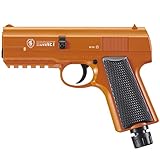
The orange finish is worth mentioning because appearance matters with defensive equipment. A bright color may make the launcher easier to distinguish from some conventional handguns at a glance, though it won't eliminate misidentification risk in a tense situation. The product is still a projectile launcher capable of causing injury, and it should be stored accordingly. The 18-or-older purchase requirement reinforces that this isn't casual toy equipment.
Thirty-Meter Range Adds Valuable Separation
The advertised 30-meter range is probably the feature that most clearly separates this launcher from ordinary pepper spray. A handheld aerosol usually depends on being much closer to the problem, while a projectile-based system is designed to place the irritant farther away. That extra distance can create more time and space without requiring physical contact. It also means the launcher must be handled with greater awareness because a projectile can travel well beyond conversational distance.
Distance isn't automatically an advantage in every setting, though. Indoors, hallways, furniture, walls, pets, family members, and limited sight lines can reduce the practical usefulness of long-range capability. Outdoors, wind and open space can affect powder or pepper-based projectiles after impact. A 30-meter specification therefore tells you what the launcher is designed to reach, not what every defensive encounter will look like.
The phrase protection against multiple threats at maximum distance appears in the supplied product description, but expectations should stay grounded. A launcher doesn't turn a chaotic situation into a predictable one simply because it can fire farther. Magazine capacity, projectile behavior, stress, legal rules, and environmental conditions all remain part of the equation. Long range is useful, but it isn't a substitute for judgment or preventive security measures.
Non-Blowback Operation Favors Simplicity
The non-blowback design is a practical feature that deserves more attention than it usually gets. Blowback action can add realism by moving a slide, but that movement consumes some of the available gas and introduces extra mechanical motion. A non-blowback system skips that theater and puts more emphasis on straightforward operation. For a defensive-style CO2 launcher, that tradeoff makes sense because efficiency matters more than mimicking firearm recoil.
Fewer moving components can also mean fewer parts competing for gas pressure during each shot. That doesn't automatically guarantee better reliability, but it gives the mechanism a simpler job. CO2 efficiency may benefit from not cycling a heavy slide, particularly during repeated firing. The drawback is that anyone expecting realistic blowback feedback won't get it here.
The simpler action also changes the character of practice. There’s less mechanical movement after each shot, so the experience can feel more utilitarian and less like a replica pistol. That isn't necessarily a weakness, because the product isn't being sold primarily as a realism-focused plinker. Functional simplicity fits its stated defensive role better than cosmetic theatrics would.
Multiple Projectile Types Add Flexibility
Compatibility with .43 caliber pepper rounds gives the launcher its main less-lethal identity. Pepper projectiles can create an irritant effect without requiring the launcher itself to be held within aerosol-spray distance. That can be useful in situations where maintaining separation matters. Still, irritant projectiles can affect unintended people or animals if the contents spread through ventilation or moving air.
The ability to use rubber balls adds a different type of option. Rubber projectiles rely on kinetic impact rather than irritant dispersion, which changes both the expected effect and the surrounding risks. Hard surfaces can also create unpredictable rebounds, so suitable practice environments and proper backstops matter. Less-lethal doesn't mean harmless, and rubber ammunition deserves the same serious handling mindset as any other projectile.
Powder balls sit somewhere between those ideas, depending on their specific contents and intended use. The important point is that projectile flexibility gives the launcher more than one operational role without requiring a different platform. That flexibility also demands discipline because ammunition types shouldn't be treated as interchangeable simply because they share a caliber. Labels, storage, compatibility, and local regulations all deserve attention.
380 FPS Gives The Specs Some Real Definition
The stated 380 FPS muzzle velocity provides a useful reference point for the launcher. Concrete numbers are easier to evaluate than marketing phrases about force or stopping power. Velocity helps explain why the platform is intended to operate at a meaningful distance rather than only across a room. It still doesn't describe energy by itself because projectile mass is also part of the physics.
A heavier rubber ball and a lighter powder projectile can behave differently even if launched from the same platform. That makes ammunition selection just as important as the advertised velocity. Trajectory, retained energy, and impact behavior can all change with projectile construction. The supplied specifications don't provide enough information to claim identical performance across every compatible round, so it would be misleading to pretend otherwise.
From a product-review perspective, the 380 FPS figure is most useful as a boundary marker. It tells you this isn't built around low-powered casual plinking, yet it also doesn't justify exaggerated claims about guaranteed incapacitation. A neutral reference from another airgun category is air rifles for hunting under $150, where velocity, projectile weight, range, and intended use are judged through a very different lens. The comparison mainly shows why raw FPS numbers need context before they mean much.
Pros That Make The Design Practical
The first clear strength is distance. A stated maximum range of 30 meters creates more separation than many handheld defensive tools can offer. That can reduce the pressure to move closer to danger simply to make a defensive tool relevant. The benefit is especially easy to understand in open spaces where line of sight is clear.
The second strength is projectile versatility. Pepper rounds, rubber balls, and powder balls give the launcher more flexibility than a platform restricted to one ammunition type. That makes training and storage planning less one-dimensional. It also lets the product occupy a broader less-lethal role without adding another launcher to the cabinet.
The third strength is the non-blowback CO2 system. Fewer moving parts can keep the operating feel straightforward, and the design avoids spending gas merely to imitate slide movement. That choice suits a tool centered on function rather than realism. It also means there's less mechanical drama happening between shots.
The bright orange body is another practical detail. Visual differentiation may reduce some confusion during storage or handling compared with an all-black replica-style pistol. It can't guarantee that another person will instantly identify the launcher correctly, though. Color helps with recognition, but responsible storage still matters more.
Weaknesses That Deserve Equal Weight
The biggest weakness is the mismatch with the search phrase 50 cal air pistol for self defense. This launcher is .43 caliber, not .50 caliber, so anyone specifically requiring compatibility with .50 caliber ammunition would be looking at the wrong platform. That isn't a defect in the product itself, but it is a major buying distinction. Caliber determines what ammunition can be used, and assumptions here can become expensive or unsafe.
The second drawback is dependence on CO2. Compressed-gas systems bring cartridge management, seal condition, storage temperature, and maintenance into the ownership routine. A launcher that sits untouched for months still needs periodic attention. Convenience is good, but compressed gas isn't magic.
Irritant ammunition creates its own weakness. Pepper and powder dispersion can be affected by airflow, ventilation, and enclosed spaces, making the result less tidy than product photography suggests. Indoor contamination can become a problem for everyone nearby, not only the intended threat. That tradeoff deserves serious thought in homes with children, pets, or small rooms.
Another limitation is the potential for firearm-like misidentification. The orange finish may help distinguish the launcher, but shape and posture still influence how other people perceive it. A defensive encounter already contains stress and uncertainty, and mistaken identification can make that worse. Less-lethal equipment isn't automatically less complicated from a legal or social standpoint.
Ease Of Deployment Is Only Part Of Readiness
The supplied description emphasizes easy and accurate deployment, which fits the product's simplified non-blowback design. A straightforward control layout can reduce fumbling during lawful practice and make basic familiarization less frustrating. Still, easy operation doesn't remove the need to understand storage condition, ammunition compatibility, and CO2 status. Mechanical simplicity only helps if the rest of the system is maintained.
Readiness also depends on access control. A projectile launcher with a listed 380 FPS velocity should never be treated like an ordinary household object. Locked storage and restricted access matter around children, visitors, or anyone unfamiliar with the equipment. The product's less-lethal positioning doesn't reduce that responsibility.
Practice introduces another consideration because different compatible projectiles may behave differently. Pepper rounds, rubber balls, and powder balls don't necessarily share identical trajectory or impact characteristics. Familiarity with one type doesn't automatically transfer perfectly to another. Manufacturer instructions and lawful practice conditions remain the sensible baseline.
Realistic Use Matters More Than Caliber Hype
The broader 50 cal air pistol for self defense category often encourages people to rank equipment by projectile diameter first. This Pepper Gun shows why that shortcut can be misleading because its .43 caliber format still comes with a listed 380 FPS velocity and 30-meter reach. Design, ammunition type, gas system, and intended role shape the experience just as much as bore size. Bigger isn't automatically more suitable.
The strongest case for this launcher rests on its range, ammunition flexibility, and simple action. Those features address clear frustrations: getting more separation than handheld spray, avoiding a blowback mechanism that consumes gas, and having several compatible projectile categories. The weaknesses are equally concrete, including CO2 dependence, irritant dispersion, caliber mismatch with .50 ammunition, and the possibility of misidentification. That's a much more useful picture than calling it powerful and leaving the details vague.
Home protection also benefits from layers that don't depend on firing anything. Secure locks, exterior lighting, alarms, cameras, reinforced entry points, and reliable communication can reduce the chance that a confrontation happens at all. A less-lethal launcher can occupy one role within a broader security setup, but it can't replace prevention or responsible storage. Its practical value stays easiest to understand when those limits remain visible.


12 Best 22 Pcp Air Rifle For Hunting of 2026 With Quiet Power

7 Best 22 Pcp Air Rifle Under 300 of 2026 For Backyard Pest Control

10 Best 22 Break Barrel Air Rifles of 2026 For Backyard Pest Control

10 Best 30 Caliber Pcp Air Rifle of 2026 For Medium Game

Top Best 177 Air Rifle Under 100: Budget-Friendly Picks for 2026

How to Safely Reload Shotgun Shells at Home

11 Best Co2 Air Rifle For Pest Control of 2026 To Ensure Humane Dispatch

12 Best Inexpensive Air Rifles of 2026 For Dependable Backyard Accuracy






