
Are Biometric Gun Safes Reliable in an Emergency?

There is no reason to panic about electronic locks failing, though expecting absolute perfection from any gadget is a mistake. Modern fingerprint safes are reliable for home defense, but they are not completely foolproof. They keep guns away from children while opening in a fraction of a second, yet real-world stress can still trip them up.
Success usually hangs on the scanner type and the state of your skin. Touch-style sensors like those on smartphones read quickly, while cheaper camera lenses often choke on sweat, moisture, or an awkward angle. Neglecting battery checks or registering only one finger also raises the risk of a lockout. Here is what actually causes these locks to fail and how to make sure yours opens on the first touch.
Understand How Modern Fingerprint Scanners Perform Day to Day
Biometric gun safes have come a long way from the finicky boxes sold a decade ago. Today, high-quality models open within half a second to one full second when you press your finger against the reader. That speed makes them a popular choice for nightstands, desks, and vehicle consoles where seconds count.
Most modern safes use one of two scanner styles. Older or budget models often rely on an optical sensor, which is a camera-based scanner that photographs your print through a clear window. Newer quick-access safes generally feature a capacitive sensor, which is a touch-screen style scanner that reads the tiny electrical charges across the ridges of your skin.
Touch-screen style scanners offer far higher everyday dependability than camera-based models. A camera-based scanner can get confused by dust, morning sunlight, or oily smudges left behind on the glass. A touch-screen style sensor reads the electrical map beneath your outer skin layer, which produces a clean reading almost every time your hand is dry and clean.
Under normal conditions, a quality fingerprint scanner provides rapid, quiet access without forcing you to hunt for small keys in the dark. You simply place your finger on the pad, hear a soft mechanical click, and the spring-loaded door pops open. But real emergencies rarely happen under ideal everyday conditions, which is why understanding how these scanners operate is so critical.
Identify What Triggers Scanner Rejection Before Panic Sets In
The biggest fear with any fingerprint safe is a false rejection, which means the safe fails to recognize the correct owner during a critical moment. When a sudden noise wakes you at two in the morning, your body changes instantly. Your heart races, your hands shake, and your palms push out cold sweat.
Moisture is the primary enemy of fingerprint hardware. When your hands sweat heavily or carry water from washing up, liquid fills the tiny microscopic valleys between the ridges of your skin. A camera-based scanner sees a blurry, solid dark smudge instead of a distinct print, while a touch-screen style scanner cannot measure the electrical current properly through the water barrier.
Surface dirt and everyday skin damage also cause sudden read failures. If you spent the afternoon doing mechanical work, working with wood stain, or doing yard chores, minor scrapes, peeling skin, or motor grease will alter your ridge pattern. The safe does not know your thumb is scratched. It simply detects that the pattern on the glass does not match the image saved in its digital memory chip.
Body mechanics change under severe stress as well. During calm practice, you calmly rest the center pad of your thumb flat against the glass. In a dark room with your pulse pounding, you are much more likely to jam your finger down at an awkward angle or tap the glass with your fingernail. When less than half of your registered print touches the glass, the computer board rejects the scan and keeps the locking bolts engaged.
Keep Your Power Sources Fresh and Know Your Emergency Overrides
Every biometric scanner relies on battery power to read prints and activate the internal motor that pulls the locking pins. When the power drains completely, the safe will not pop open automatically, because doing so would create a massive security risk. Instead, the electronic locking mechanism stays dead and locked until you supply power or use a manual tool.
To keep dead batteries from leaving you locked out, build a simple maintenance habit around these power checks:
- Use premium alkaline batteries: Always install fresh name-brand alkaline cells rather than cheap heavy-duty batteries or older rechargeable cells. Rechargeable cells often drop voltage abruptly without triggering the low-battery alert first.
- Listen for the low-voltage chime: Most digital safes beep repeatedly or flash a red light after an open cycle when power drops below safe operating levels. Replace the batteries the very first time you hear this alert.
- Locate the emergency power port: Many bedside lock boxes include an external micro-USB or USB-C port on the front face. If the internal batteries die completely, you can plug in a portable phone power bank to wake up the scanner and open the lid.
- Establish a six-month battery schedule: Swap out your internal batteries twice a year, such as when you adjust your clocks for daylight saving time, rather than waiting for the electronics to fail.
- Store backup keys outside the box: Never make the classic mistake of locking your physical override keys inside the biometric safe. Hide those keys in a secure, accessible location in another room.
Check Sensor Accuracy to Prevent Unregistered Hands From Getting In
Parents often worry that a curious child might find a way to pop the electronic lock. With reputable modern safes, the chance of an unregistered fingerprint opening the safe is vanishingly small. However, a major hidden danger exists straight out of the shipping carton.
Many manufacturers ship fingerprint safes in factory demo mode. In this default state, the safe is designed to open for any human finger, or even a palm or elbow, so buyers can inspect the mechanics before programming. If a gun owner buys a box, inserts batteries, hears the door pop open, and assumes the lock is working, the safe remains completely unsecured for any child who touches it.
Sensor quality also dictates how well the box resists physical manipulation. Cheap camera-based readers can sometimes be fooled if a shiny grease smudge from the owner is pressed down hard by an unregistered hand. Touch-screen style capacitive sensors do not rely on a photograph, so grease marks alone cannot trigger the lock.
Securing dangerous tools is just as urgent for high-velocity pellet guns and training replicas as it is for centerfire firearms. Parents often ask how fast do airsoft guns shoot and are they safe?, and the fundamental rule of household storage is identical across the board. Every high-power projectile launcher must stay completely out of reach of children, and verifying that your safe actually rejects unregistered prints is a non-negotiable safety step.
Program Your Fingerprints the Right Way for Clean Reads
Most scanner failures happen because the owner only recorded one quick print during an easy five-minute setup. To make sure your safe opens instantly under poor lighting and awkward body angles, program your scanner using this methodical process:
- Clean the glass reader and wash your hands: Wipe down the scanner glass with a soft, dry cloth to remove oils, and wash your hands thoroughly so your natural skin ridges are sharp and clear.
- Clear the memory completely: Follow the user manual to wipe all stored memory. This action removes the factory demo mode and resets the onboard circuit board to zero.
- Register your primary finger straight on: Place the meaty pad of your dominant thumb or index finger dead center on the sensor with light, natural pressure to record your base image.
- Re-register the same finger at varied angles: Do not just move on to another finger. Program that exact same dominant finger four to six separate times, tilting it slightly to the left, tilting it to the right, pressing with the upper tip, and pressing with the lower joint.
- Enroll your opposite hand: Register the index finger and thumb of your non-dominant hand using those same multi-angle steps. If your primary hand is pinned, injured, or holding a flashlight, your other hand can still open the safe.
- Verify your entry from your bedside posture: Turn off the bedroom lights, lie down in your normal sleeping spot, reach over in the dark, and confirm that the lock opens on your first try three times in a row.
Require Redundant Entry Options Before Relying on Any Box
No mechanical or electronic device is entirely immune to failure, which is why you should never trust a bedside lock box that relies solely on a fingerprint reader. A dependable security safe must give you multiple ways to retrieve your defensive gear if the biometric reader encounters an unexpected error.
Look for these mandatory redundant features before placing any safe into service:
- A physical high-security key override: The box must feature a physical keyway, such as a dimpled or laser-cut barrel key, that bypasses all electronics and pulls the locking bolt mechanically.
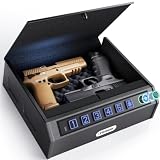
- A backlit digital keypad: A push-button keypad or digital PIN pad allows you to punch in a quick four-to-six-digit access code if your hands are wet, dirty, or wrapped in a bandage.
- A silent mode switch: You must have the ability to mute the internal confirmation beeper so opening the safe in an emergency does not give away your location.
- An interior illumination light: A soft internal LED light that switches on when the door springs open helps you identify your grip immediately without blinding your night-adjusted vision.
- Solid carbon steel construction: A heavy steel body with pre-drilled bolt-down holes ensures an intruder cannot simply grab the entire locked box off your nightstand and carry it away.
Select a Sturdy Quick-Access Safe Tailored to Your Storage Space
When choosing a bedside safe, pick a compact lock box built with solid carbon steel walls and a spring-assisted drop-down or pop-up door. These designs use internal gas struts or tension springs that push the heavy lid clear of the opening the millisecond the lock clears, saving you from prying at the seam with your fingernails.
Check the interior dimensions to make sure the box comfortably fits your specific defensive setup along with a spare magazine or accessories. If you keep high-velocity pellet pistols or gear like air guns for vermin stored near entry points for quick animal deterrence, look for dense interior egg-crate foam that cushions the barrel and prevents metal-on-metal rattles.
Finally, confirm that the safe mounts solidly to your furniture or structural framing. Even the most dependable biometric scanner offers little protection if a burglar can carry the entire container out the front door. Use heavy lag bolts through the internal mounting holes to anchor the base directly into a wall stud, floor joist, or heavy wooden nightstand frame.
- ARS Mark9.2
ARS Mark is a ranking system developed by bestairriflescopes.com. ARS Mark has no relationship or impact from any manufacturers or sales agent websites. Learn more
- BrandTRRKO

- ARS Mark8.5
ARS Mark is a ranking system developed by bestairriflescopes.com. ARS Mark has no relationship or impact from any manufacturers or sales agent websites. Learn more
- BrandBILLCONCH

- ARS Mark8.3
ARS Mark is a ranking system developed by bestairriflescopes.com. ARS Mark has no relationship or impact from any manufacturers or sales agent websites. Learn more
- BrandBILLCONCH

- ARS Mark7.7
ARS Mark is a ranking system developed by bestairriflescopes.com. ARS Mark has no relationship or impact from any manufacturers or sales agent websites. Learn more
- BrandAIRMuch

- ARS Mark7.6
ARS Mark is a ranking system developed by bestairriflescopes.com. ARS Mark has no relationship or impact from any manufacturers or sales agent websites. Learn more
- BrandBILLCONCH
Last update on 2026-10-19 / Affiliate links / Images, Product Titles, and Product Highlights from Amazon Product Advertising API
FAQs
Will a biometric safe open if my hand is sweaty, wet, or trembling?
Excessive moisture often causes touch-screen style and camera-based scanners to fail by masking your skin ridges. If your hands are shaking, you can still open the safe if you lay the flat pad of your finger firmly on the sensor rather than tapping it with your fingertip. For situations where your hands are covered in water or blood, using the backlit keypad or mechanical backup key is the most reliable option.
What happens if the safe batteries die while the door is locked?
When the internal batteries run completely dry, the electronic locking bolts stay in the locked position to keep unauthorized users out. You can open the safe by inserting your physical mechanical backup key into the manual keyway. Many newer models also feature an external emergency USB port on the front panel that lets you plug in a portable battery bank to power the keypad and scanner long enough to retrieve your items.
Can a child open a biometric safe with an unregistered finger?
A properly programmed biometric safe will never open for an unregistered finger. However, brand new safes straight out of the box frequently arrive in an unprogrammed factory demo mode that unlocks for any human touch. You must clear the memory and register your specific master prints so the internal computer board actively rejects everyone else.
How fast does a biometric lock open compared to a digital keypad?
A quality touch-screen style biometric reader typically releases the locking bolt in half a second to one second with a single touch. A digital keypad generally takes between two and four seconds because you have to locate the buttons and punch in a four-to-six-digit sequence. While the fingerprint reader is faster, having the keypad as a secondary backup gives you a critical alternative if your finger is dirty or injured.


Uncover the Best Big Bore Handgun Scope: Your 2026 Top Picks Guide

Best Fully Automatic Pellet Gun: The Top Pick in 2026

Top 9 Best Compact Pellet Gun for Squirrels: A 2026 Review
Best CO2 Pellet Gun for Small Game: Top Picks of 2026

Best Break Barrel Pellet Gun for Hunting - Top 8 Picks in 2026

2026 Best Chinese Pellet Gun: Expert Reviews and Top Picks
Top-Rated Picks: Best Bolt Action Pellet Gun Under 100 in 2026

Best Chronograph for Pellet Gun: Top-Rated Picks for 2026









