
2 Armasight Night Vision Goggles of 2026 For Sharp Spatial Awareness

A spec sheet can promise total nocturnal dominance, but stepping into pitch-black timber with the wrong optical angle quickly turns high-end glass into a disorienting hazard. Choosing an ultra-wide viewing window sounds ideal for tracking moving game, yet unexpected optical curvature along the perimeter can distort depth perception just as footing gets treacherous. On the flip side, settling for too narrow a sight picture creates a suffocating tunnel effect that forces constant, unnatural head swinging. When an expensive dual-tube setup is poorly matched to your pace, hours in the field bring severe eye strain, misjudged obstacles, and a front-heavy helmet that pulls relentlessly on your neck muscles.
Moving through the dark should feel natural, offering sharp spatial awareness where every ditch and distant woodline remains distinct without straining your vision. Getting there requires balancing your optical priorities before mounting up. Technical terrain favors a standard forty-degree lens for crisp edge-to-edge clarity, while open-country scanning rewards a fifty-one-degree window for peripheral detection. Securing an external battery pack on the rear helmet rail simultaneously extends cold-weather endurance and provides the counterweight needed to relieve forward tilt. The side-by-side breakdown below clarifies how each binocular configuration handles in the field so you can lock in the right viewing profile for your night operations.
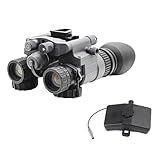
- ARS Mark9.7
ARS Mark is a ranking system developed by bestairriflescopes.com. ARS Mark has no relationship or impact from any manufacturers or sales agent websites. Learn more
- BrandArmasight
- ARS Mark7.3
ARS Mark is a ranking system developed by bestairriflescopes.com. ARS Mark has no relationship or impact from any manufacturers or sales agent websites. Learn more
- BrandArmasight
Last update on 2026-10-05 / Affiliate links / Images, Product Titles, and Product Highlights from Amazon Product Advertising API
What is the practical difference between the Armasight BNVD-40 and BNVD-51?
The primary difference is the optical lens assembly and field of view, with the BNVD-40 providing a standard 40-degree viewing angle and the BNVD-51 expanding your view to 51 degrees. The BNVD-40 maintains crisp edge geometry across the visual field, which helps prevent disorientation when walking across rough terrain. In contrast, the 51-degree system provides broader peripheral coverage to scan tree lines faster without constant head panning. Both models share the Gen 3 Pinnacle 1600+ image intensifier platform and include an external battery pack.
Does the BNVD-51 optical system cause edge distortion during movement?
Wider optical assemblies trade a degree of perimeter flatness for increased peripheral coverage, so the BNVD-51 can show slight optical softening at the far outer edges of your visual window. For general patrol and open field scanning, this wider optical profile enhances environmental awareness without obscuring obstacles. If your application demands absolute geometric flatness from edge to edge for fast tracking on foot, the BNVD-40 lens profile minimizes distortion better. Check your operational environment to decide whether peripheral awareness or edge-to-edge sharpness matters more for your night travel.
How does the external battery pack improve helmet balance?
The included battery pack mounts to the rear of your helmet shroud system to function as an active counterweight against the front-hanging goggles. Without a rear weight, dual-tube night vision goggles create forward leverage that pulls the helmet downward and strains neck muscles during long nocturnal operations. Positioning the power pack on the rear helmet rail balances the center of gravity and extends operating duration. Maintaining proper equilibrium on your head is just as critical for all-night comfort as choosing the right optic layout for better rifle balance.
What does the Gen 3 Pinnacle 1600+ specification mean for low-light clarity?
The Gen 3 Pinnacle 1600+ designation guarantees an autogated thin-film image intensifier tube rated for a minimum 1600 figure of merit. This architecture amplifies minimal ambient starlight or moonlight while maintaining a clean image free of excessive electronic noise. Autogating protects the tube components and stabilizes your visual picture when exposed to sudden light sources like muzzle flash or vehicle headlights. To see the exact tube parameters such as resolution and signal-to-noise ratio, verify the individual tube performance sheet included in the package.
Can you run Armasight BNVD goggles without the external battery pack attached?
Yes, Armasight BNVD systems operate using internal on-board battery power as well as through the auxiliary battery pack connection. Running solely on the internal compartment reduces helmet bulk when you need a streamlined setup for short observational intervals. Connecting the included battery pack is beneficial for freezing environments where cold exposure saps single cells rapidly. Verify the exact compartment battery size and total continuous runtime directly in the manufacturer documentation before long deployments.
Can you look through a daytime rifle scope while wearing these goggles?
No, dual-tube night vision goggles do not align directly behind conventional magnified daytime scopes due to eye relief restrictions and focal plane alignment. Goggles are designed for helmet-mounted navigation, IR aiming lasers, or passive sight alignment through night-vision-compatible red dot optics. If you hunt by scanning with head-mounted night vision and transitioning to a daytime optic, check out configurations designed for accurate holdovers to ensure fast target acquisition from your shoulder. Both BNVD models feature articulating pods that swing up independently when you need uninhibited access to your rifle optic.

10 Top Picks: Best Youth Air Rifles for 13-Year-Olds

12 Best Rifle Scopes For 5.56 Under 150 Dollars - (2026 Top Picks)

Top 10 Rifle Scopes for Coyote Hunting in 2026

12 Best Benchrest Rifle Scopes of 2026 For Tight Groups

Top 5 Airsoft Rifles: Unleash the Action in 2026
Unveil the Best Straight Wall Deer Rifles: Top Picks for 2026

Top Ammo Choices for Air-Powered Rifles: Boost Your Performance in 2026

Best Quick Detach Scope Rings for Accurate and Convenient Shooting







