
13 Best Celestron Spotting Scope of 2026 For Crisp Long-Range Views

A brisk morning breeze sweeps across the firing line as a shooter cranks the magnification ring past forty power, expecting to resolve a tiny bullet grouping downrange. Instead of clean paper edges, a murky violet blur bleeds across the target circle, washing out contrast just when fine detail matters most. Heavy barrel weight pulls downward against the mounting plate, causing the image to drift and tremble with every pulse of wind. Long-range observation quickly turns into an exercise in squinting through dim glass, battling neck fatigue over an awkward viewing angle, and wondering why an optic that promised massive reach delivers little more than purple fringing and soft focus.
True long-range clarity should feel effortless, giving you vivid color, sharp edges, and a relaxed posture that lets you watch a hillside or target for hours without eye strain. Cutting through the catalog clutter comes down to three practical choices: picking extra-low dispersion glass to keep views razor-sharp at high magnification, balancing objective lens size against the weight of your pack, and pairing the body angle to your shooting bench or tripod setup. The right combination eliminates optical haze and front-heavy wobble, securing bright images and rock-solid stability for every session out in the open.
- ARS Mark7.7
ARS Mark is a ranking system developed by bestairriflescopes.com. ARS Mark has no relationship or impact from any manufacturers or sales agent websites. Learn more
- BrandCelestron

- ARS Mark9.3
ARS Mark is a ranking system developed by bestairriflescopes.com. ARS Mark has no relationship or impact from any manufacturers or sales agent websites. Learn more
- BrandCelestron

- ARS Mark9.2
ARS Mark is a ranking system developed by bestairriflescopes.com. ARS Mark has no relationship or impact from any manufacturers or sales agent websites. Learn more
- BrandCelestron
- ARS Mark9.3
ARS Mark is a ranking system developed by bestairriflescopes.com. ARS Mark has no relationship or impact from any manufacturers or sales agent websites. Learn more
- BrandCelestron

- ARS Mark7.5
ARS Mark is a ranking system developed by bestairriflescopes.com. ARS Mark has no relationship or impact from any manufacturers or sales agent websites. Learn more
- BrandCelestron

- ARS Mark9.5
ARS Mark is a ranking system developed by bestairriflescopes.com. ARS Mark has no relationship or impact from any manufacturers or sales agent websites. Learn more
- BrandCelestron

- ARS Mark8.9
ARS Mark is a ranking system developed by bestairriflescopes.com. ARS Mark has no relationship or impact from any manufacturers or sales agent websites. Learn more
- BrandCelestron

- ARS Mark9.0
ARS Mark is a ranking system developed by bestairriflescopes.com. ARS Mark has no relationship or impact from any manufacturers or sales agent websites. Learn more
- BrandCelestron
- ARS Mark8.8
ARS Mark is a ranking system developed by bestairriflescopes.com. ARS Mark has no relationship or impact from any manufacturers or sales agent websites. Learn more
- BrandCelestron

- ARS Mark8.8
ARS Mark is a ranking system developed by bestairriflescopes.com. ARS Mark has no relationship or impact from any manufacturers or sales agent websites. Learn more
- BrandCelestron

- ARS Mark7.6
ARS Mark is a ranking system developed by bestairriflescopes.com. ARS Mark has no relationship or impact from any manufacturers or sales agent websites. Learn more
- BrandCelestron

- ARS Mark8.7
ARS Mark is a ranking system developed by bestairriflescopes.com. ARS Mark has no relationship or impact from any manufacturers or sales agent websites. Learn more
- BrandCelestron

- ARS Mark8.8
ARS Mark is a ranking system developed by bestairriflescopes.com. ARS Mark has no relationship or impact from any manufacturers or sales agent websites. Learn more
- BrandCelestron
Last update on 2026-09-27 / Affiliate links / Images, Product Titles, and Product Highlights from Amazon Product Advertising API
Does Celestron Regal M2 ED glass justify choosing it over the Ultima series?
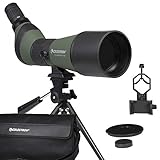
Yes, especially if you routinely view at magnifications above 40x. The Celestron Regal M2 80ED and Regal M2 100ED use extra-low dispersion (ED) objective lenses and fully multi-coated optics to prevent chromatic aberration, which keeps high-contrast edges from developing purple or yellow halos. By contrast, the Ultima 80 uses standard multi-coated optics that deliver bright images at lower powers but show softer contrast when dialed up toward the maximum 60x magnification on its 20-60x zoom eyepiece.
Should I choose an 80mm or 100mm objective lens over a 65mm model?
Choose an 80mm or 100mm objective lens if you prioritize bright viewing in dusk conditions, but select a 65mm body if pack weight is your primary concern. A compact model like the Celestron Ultima 65 Angled uses an 18-55x zoom eyepiece that is far easier to transport on foot. In contrast, larger apertures like the 20-60x80 TrailSeeker or the Ultima 100 with its 22-66x zoom eyepiece admit significantly more light, which delivers brighter views at extreme distances while requiring a more substantial carrying setup.
Is an angled body or a straight body better for target spotting?
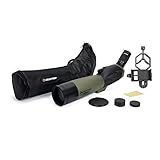
A straight body is generally better for rapid target acquisition from a shooting bench, whereas an angled body is superior for comfortable viewing at varying tripod heights. A straight design like the Celestron 52254 Ultima 80 mm lets you look directly down the sightline of your target, making it simple to spot bullet impacts alongside long-range hunting rifle scopes without adjusting your posture. An angled model like the Celestron LandScout 20-60x80 Angled allows you to set the tripod lower to the ground for improved wind stability and share the eyepiece with observers of different heights.
When is a Maksutov or Schmidt-Cassegrain scope better than a standard refractor?
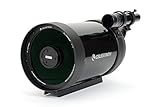
Choose a folded catadioptric design when you need substantial optical focal length packed into a short, durable body. The Celestron MAK 90mm provides 39x magnification with its included 32mm eyepiece, and the Celestron C5 Schmidt-Cassegrain provides 50x magnification with a 25mm eyepiece inside a compact, rubber-armored housing. Traditional refractor spotting scopes such as the TrailSeeker 20-60x80 are longer, but they offer continuous variable zooming without swapping dedicated telescope eyepieces.
How does a dual-focus system help maintain clarity at maximum zoom?
A dual-focus system allows you to bring a target into rough focus rapidly and then make microscopic adjustments to eliminate blur at high zoom. Models such as the Celestron Regal M2 80ED feature dual-focus knobs that let you overcome the shallow depth of field common to 60x magnification. Standard single-knob systems can feel coarse at extreme range, making it harder to snap fine feather detail or bullet holes into critical focus.
Why is tripod choice critical for high-magnification spotting scopes?
At magnifications between 50x and 75x, standard camera tripods transmit minute wind vibrations and hand touches that shake your entire field of view. A dedicated mount like the Celestron Heavy Duty Alt-Azimuth Tripod uses sturdy aluminum legs and slow-motion control handles to help you make micro-adjustments without shifting off target. Keeping the scope vibration-free is vital when verifying hits on distant steel alongside precision target optics.

10 Top Picks: Best Youth Air Rifles for 13-Year-Olds

12 Best Rifle Scopes For 5.56 Under 150 Dollars - (2026 Top Picks)

Top 10 Rifle Scopes for Coyote Hunting in 2026

12 Best Benchrest Rifle Scopes of 2026 For Tight Groups

Top 5 Airsoft Rifles: Unleash the Action in 2026

Unveil the Best Straight Wall Deer Rifles: Top Picks for 2026

Top Ammo Choices for Air-Powered Rifles: Boost Your Performance in 2026

Best Quick Detach Scope Rings for Accurate and Convenient Shooting







