
5 Best Crossbow Bolt Tips For Deer of 2026 With True Flight

A frosty November dawn turns sour the second a bolt leaves the rail at nearly four hundred feet per second. Instead of tracing a laser-straight path toward a broadside buck, wide blade edges catch the air, wind planing the broadhead off its mark. Other times, mechanical blades flutter open prematurely under violent acceleration, sapping critical kinetic energy and veering off course, leaving a sparse blood trail that disappears in the brush. Watching a clean opportunity vanish because a tip could not handle high-speed flight wastes precious days in the woods.
Climbing into the stand should come with quiet confidence that hunting bolts strike the exact point of impact dialed in during practice. Securing that true flight requires standard 100-grain weight for balanced trajectory, solid steel ferrules that smash through rib bone, and dependable blade retention or compact fixed profiles that resist air drag. When broadheads cut cleanly without drifting, recovery distances shrink and tracking stays straightforward. The crossbow bolt tips below are built to hold zero at blistering speeds and punch decisive, ethical wound channels on deer.

- ARS Mark9.6
ARS Mark is a ranking system developed by bestairriflescopes.com. ARS Mark has no relationship or impact from any manufacturers or sales agent websites. Learn more
- BrandArchery World

- ARS Mark9.4
ARS Mark is a ranking system developed by bestairriflescopes.com. ARS Mark has no relationship or impact from any manufacturers or sales agent websites. Learn more
- BrandAULTARCHEX

- ARS Mark9.2
ARS Mark is a ranking system developed by bestairriflescopes.com. ARS Mark has no relationship or impact from any manufacturers or sales agent websites. Learn more
- BrandAULTARCHEX
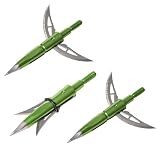
- ARS Mark9.2
ARS Mark is a ranking system developed by bestairriflescopes.com. ARS Mark has no relationship or impact from any manufacturers or sales agent websites. Learn more
- BrandFlying Arrow Archery

- ARS Mark7.6
ARS Mark is a ranking system developed by bestairriflescopes.com. ARS Mark has no relationship or impact from any manufacturers or sales agent websites. Learn more
- BrandKEAUP
Last update on 2026-10-21 / Affiliate links / Images, Product Titles, and Product Highlights from Amazon Product Advertising API
Are fixed or mechanical tips better for hunting deer with a crossbow?
Both designs work well for deer, but they handle high bolt velocity differently. Mechanical broadheads with 2 blades fly with a compact profile, which helps prevent wind planing before expanding on impact. Fixed blade options, such as 3-blade steel designs or tips built from 420 stainless steel, contain no moving parts and offer rigid structural durability through tissue and bone. Verify your bow setup and bolt alignment to decide whether an expandable 2-blade tip or a solid fixed blade delivers the truest flight path.
Will a 100-grain bolt tip fly to the same point of impact as practice field points?
A 100-grain hunting tip shares the exact weight of a standard 100-grain field point, which preserves your front-of-center balance. Even so, exposed blade surface area catches wind differently than a smooth practice point, particularly on wide fixed designs. Mechanical tips with folded blades fly very similarly to field points, while fixed blades may require sighting adjustments to group together. Verify point of impact before deer season begins, and explore other essential crossbow accessories to keep your setup tuned.
What cutting diameter gives the best balance between penetration and blood trails?
Cutting diameters on deer broadheads generally span from 1 inch on compact fixed heads up to 2 inches on mechanical designs. A 1-inch cutting diameter from a 3-blade steel tip drives deep with lower resistance, making it dependable against rib bones and quartering angles. A wide 2-inch cutting diameter on a 2-blade mechanical head opens an expansive entry hole that aids tracking, though it requires significant momentum to punch completely through. Choose the cutting diameter that aligns with your priority for total pass-through penetration versus wound width.
How do 420 stainless steel blades hold up against deer bone?
Rigid 420 stainless steel fixed blades resist edge curling and bending when striking deer ribs or shoulder joints. Solid steel tips and ferrules maintain alignment on impact, preventing the broadhead from breaking at the bolt insert. Softer blade materials can deform against bone, whereas 420 stainless steel construction holds its edge through hide and rib cages to reach the vitals intact.
Can broadheads labeled for compound bows be used on a crossbow?
Many 100-grain broadheads are labeled for both compound bows and crossbows, but mechanical blade retention requires careful verification. Crossbows produce rapid forward acceleration that can cause loosely held expandable blades to deploy mid-flight, drifting off target. Check manufacturer specifications to confirm that mechanical blades are rated to stay closed under high crossbow acceleration. Making sure your blades deploy only upon impact supports ethical shot placement, aligning with sustainable crossbow hunting practices.
How do 2-blade and 3-blade broadheads differ on deer?
The difference comes down to flight resistance and wound channel geometry. A 2-blade mechanical tip cuts a linear channel up to a 2-inch cutting diameter, maximizing the width of the entry slash while maintaining minimal air drag in flight. A 3-blade fixed broadhead with a 1-inch cutting diameter creates a three-way wound pattern that stays open rather than sealing flat. Both styles produce rapid, ethical recoveries on whitetail when matched properly to your crossbow bolt setup.


12 Best 22 Pcp Air Rifle For Hunting of 2026 With Quiet Power

7 Best 22 Pcp Air Rifle Under 300 of 2026 For Backyard Pest Control

10 Best 22 Break Barrel Air Rifles of 2026 For Backyard Pest Control

10 Best 30 Caliber Pcp Air Rifle of 2026 For Medium Game

Top Best 177 Air Rifle Under 100: Budget-Friendly Picks for 2026

How to Safely Reload Shotgun Shells at Home

11 Best Co2 Air Rifle For Pest Control of 2026 To Ensure Humane Dispatch

12 Best Inexpensive Air Rifles of 2026 For Dependable Backyard Accuracy






