
How to Set Up a Safe Crossbow Fishing Rig

Rigging a crossbow for the water is not something to stress over, provided you use the right parts to keep the line clear. The safest build pairs a moderate-draw bow with a front-mounted bottle retriever reel and solid fiberglass arrows fitted with safety slides. These small sliding rings hold the heavy line out in front of the bowstring during each shot, preventing sudden tangles that could snap an arrow back toward your hands.
Your exact setup depends on whether you adapt an existing bow or grab a dedicated fishing kit, along with the depth of your target water. Heavy deer hunting models hit shallow river bottoms too hard and bury arrows in mud, whereas lighter 80-pound bows provide plenty of punch without breaking lines. You also need to confirm that your bow has a lower accessory rail to lock the reel seat in place. Here is how to assemble each piece for clean, trouble-free shooting.
The Four Core Pieces of a Working Crossbow Fishing Rig
Shooting into water requires a completely different mechanical balance than shooting at targets on land. Water creates heavy physical drag, target fish move quickly beneath the surface, and an arrow attached to a cord behaves differently than a free-flying bolt. A standard target setup will not work here. To build an effective rig, you need four specific pieces of equipment working together.
First is the crossbow itself. You need a bow with manageable power rather than maximum speed. Pull weight measures how much muscular effort it takes to pull the bowstring back. For fishing, lower pull weights allow for smooth cocking on an unsteady boat deck and prevent your arrow from embedding into deep mud.
Second is the reel and line system. You cannot use thin monofilament line from an ordinary fishing pole. Crossbow fishing relies on heavy braided line, usually between 150 and 200 pounds in breaking strength. This line must feed out freely behind the bolt with zero friction, then wind back quickly when you retrieve your catch.
Third is the fishing bolt. Standard hollow carbon target arrows will shatter against the water surface or snap under the weight of a thrashing fish. Fishing bolts are made of solid fiberglass or heavy alloy. They carry a specialized point fitted with a barb, which is a backwards-facing metal point that locks into the fish so it cannot slide off during retrieval.
Fourth is the safety slide. This is a small sliding plastic or metal ring installed directly on the arrow shaft. It holds your heavy braided line out in front of the bow riser while the arrow rests in the cocking groove. Without this single small part, crossbow fishing becomes extremely dangerous.
- Moderate-power crossbow: A bow that pulls smoothly and shoots at sensible speeds for shallow water targets.
- Retriever reel system: A dedicated bottle or spool housing heavy braided line that pulls out without snagging.
- Solid fiberglass bolt: A dense, heavy shaft equipped with reversible barbs to hold fish securely.
- Safety slide ring: A sliding attachment on the bolt that keeps line safely forward of the bowstring.
Each of these four components must fit your specific bow style. When they match correctly, the arrow flies straight, enters the water cleanly, and returns to your hands without mechanical failures or line tangles.
Preventing Arrow Snap-Back and Cable Snags
The single greatest hazard in crossbow fishing is snap-back. Snap-back happens when the trailing fishing line catches on the bowstring, cables, or foot stirrup during the shot. When the string drives forward at high speed and the line catches on a metal corner, the arrow halts mid-air under intense tension. The heavy line stretches like an elastic band, snaps, and slings the heavy fiberglass bolt straight back toward the shooter.
Snap-back almost always happens when someone ties their fishing line directly to the back of an arrow nock. When you seat a tied-off arrow into the barrel, the line lays backward across the flight rail, resting directly between the bowstring and the latch. When you pull the trigger, the bowstring catches the loose cord, dragging it into the rail mechanism and causing an immediate tangle.
A safety slide prevents this dangerous mistake entirely. The slide is a ring that travels up and down the arrow shaft, stopped by a small screw or collar near the back nock. Before you load the bow, you push the slide all the way forward toward the broadhead barb. You tie your braided line directly to this sliding ring.
When you seat the arrow into the crossbow rail, the line stays out in front of the bow limbs and string. The line never crosses the flight track or the cocking groove. When you pull the trigger, the bowstring strikes only the arrow nock. The arrow moves forward through the slide until the rear stop collar catches the ring, pulling the line behind the arrow only after the shaft has completely cleared the bow frame.
You must inspect your arrow and line path before every single shot. Make sure the cord is not wrapped around the limb tips, the stirrup, or your reel handle. Look down at the flight groove and verify the safety slide sits ahead of the riser. Taking three seconds to confirm this clearance keeps you completely safe from line entanglements.
Choosing Your Reel Style and Proper Pull Weight
Picking the right reel style determines how easily you can handle line on a boat or muddy shoreline. Three main styles exist for water archery, but they offer very different levels of convenience and safety.
The simplest option is a hand-wrap spool. This is a round, grooved drum mounted under the bow where you wind the line by hand after every shot. It has no gears, buttons, or moving parts to break. The downside is speed. If you miss a fish, winding thirty feet of wet cord around a spool by hand takes considerable time, which slows down your shooting.
The second option is a spincast reel, similar to a heavy push-button fishing reel. These retrieve line quickly with a crank handle, but they carry a serious risk for beginners. You must remember to push the release button before every shot. If you forget to click the button, the spool remains locked. When you pull the trigger, the line dead-stops against the reel frame, risking immediate snap-back or broken equipment.
The safest and most practical choice is a retriever reel. A retriever reel is a bottle container that feeds line freely with zero drag. The braided cord sits stacked loosely inside an open plastic bottle. When you shoot, the line simply spills out of the bottle neck with no gears, buttons, or resistance. To retrieve, you squeeze a hand lever that clamps two internal rollers together, pulling the cord back into the container smoothly.
Alongside the reel, you must consider bow power. Many hunters wonder if they can use their standard whitetail hunting gear for water shooting. While a high-powered crossbow for hunting produces incredible speed, that energy works against you on the water. A 400-foot-per-second deer bow with a 200-pound pull weight hits the water with far too much shock.
Excessive power blows arrows through fish, shatters shafts against submerged rocks, and drives points three feet deep into river mud. Once buried in river silt, retrieving your bolt without snapping the heavy cord becomes nearly impossible. Short, narrow limbs help you move around tight boat decks much like a compact crossbow for tight blinds, but moderate power remains the primary priority.
A pull weight between 80 and 120 pounds provides ideal performance for water shooting. That power level pushes a heavy fiberglass bolt deep enough to pierce carp or gar at normal depths of two to four feet, yet leaves the arrow easy to pull free from weed beds and shallow mud.
Step-by-Step Rigging from Stock to Arrow Tip
Rigging your setup correctly takes only a few tools and careful attention to line path. Follow these steps to assemble a clean, reliable water rig.
- Attach the reel mount to the Picatinny rail: Locate the Picatinny rail, which is the grooved accessory track under the bow barrel. Slide your metal reel seat onto this track and tighten the locking bolts firmly with an Allen wrench. The mount should sit rock-solid with no wobble.
- Mount the retriever reel: Slide the base of your retriever reel into the reel seat. Tighten the locking rings until the bottle aligns straight with the bow stock, making sure the handle clears your grip hand comfortably.
- Install the line guide rod: Attach the forward line guide rod to the front of your riser or rail mount. This guide acts like an extended wire loop that holds the cord outward, keeping the line completely clear of the limbs and wheel cables during release.
- Pack the braided line into the bottle: Feed your 200-pound braided line through the front of the reel and push it loosely into the bottle chamber. Never wrap line tightly around an internal spool; feed it in loosely so it stacks naturally and pulls out without resistance.
- Rig the safety slide onto your bolt: Slide the plastic safety slide onto the fiberglass arrow from the front point, letting it rest against the rear stop collar. Thread the end of your braided line through the hole on the slide and tie it off with an eye knot or secure figure-eight knot. Cut off any excess tag end cleanly.
- Perform a manual clearance check: Pull a few feet of line from the reel bottle, lead the line through the front guide loop, and connect the bolt to your flight track. Push the safety slide forward so it rests beyond the front of the bow limbs before locking the arrow into the latch.
When you finish these steps, pull the line by hand from the front of the arrow to confirm it feeds out of the bottle smoothly. If you feel any snagging, open the bottle and loosen the packed cord before heading onto the water.
What to Look for in a Dedicated Crossbow Fishing Setup
If you prefer not to modify a deer hunting rig, buying a dedicated fishing setup saves time and simplifies mounting. Dedicated kits are designed specifically for wet environments, short shooting distances, and quick arrow retrieval.
Look for a model with an 80-pound pull weight. An 80-pound build generates plenty of force to drive barbed points through tough fish scales, but the bowstring remains easy to pull back by hand or with a cocking lever while standing in a moving boat. The light pull weight also prevents broken arrows when shooting into rocky stream beds.
Check that the frame includes pre-installed line guides and standard mounting tracks under the front barrel. Having built-in attachment points means you do not have to drill into your stock or buy aftermarket brackets to seat your reel. Compact limb frames with short wheel-to-wheel lengths are much easier to swing over boat gunwales and around brushy banks.
Finally, inspect the arrows included with the kit. A good starter package supplies heavy, solid bolts fitted with reversible wire barbs. These barbs hold rough fish firmly during the retrieve, but loosen with a quick twist of the point so you can slide your catch off into the cooler without damaging your gear.
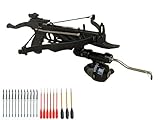
- ARS Mark9.0
ARS Mark is a ranking system developed by bestairriflescopes.com. ARS Mark has no relationship or impact from any manufacturers or sales agent websites. Learn more
- BrandW WILLIAM TELL ARCHERY

- ARS Mark7.8
ARS Mark is a ranking system developed by bestairriflescopes.com. ARS Mark has no relationship or impact from any manufacturers or sales agent websites. Learn more
- BrandW WILLIAM TELL ARCHERY

- ARS Mark7.5
ARS Mark is a ranking system developed by bestairriflescopes.com. ARS Mark has no relationship or impact from any manufacturers or sales agent websites. Learn more
- BrandW WILLIAM TELL ARCHERY
Last update on 2026-10-18 / Affiliate links / Images, Product Titles, and Product Highlights from Amazon Product Advertising API
FAQs
Can I use my standard deer hunting crossbow for bowfishing?
You can adapt a hunting bow, but its high speed and heavy pull weight create significant disadvantages on the water. Extreme power shatters arrow shafts against hard bottoms, snaps braided lines, and buries points too deep into bottom silt. If you choose to adapt a hunting crossbow, use a reel with a line guide and always install safety slides on heavy fiberglass arrows.
What breaking strength line works best for crossbow fishing?
Crossbow fishing requires braided line rated between 150 and 200 pounds of breaking strength. Standard fishing line snaps instantly under the sudden shock of a bow release. Heavy braided cord handles high release speeds, resists fraying against sharp weeds or rocks, and lets you muscle large fish out of heavy cover.
Can I shoot regular carbon target arrows with a fishing point?
No, you should never shoot hollow carbon arrows for water fishing. Carbon shafts are too light to penetrate water cleanly, and the hydraulic force of hitting the water can shatter hollow arrows instantly. Always use solid fiberglass or heavy alloy bolts fitted specifically for bowfishing points and safety slides.


12 Best 22 Pcp Air Rifle For Hunting of 2026 With Quiet Power

7 Best 22 Pcp Air Rifle Under 300 of 2026 For Backyard Pest Control

10 Best 22 Break Barrel Air Rifles of 2026 For Backyard Pest Control

10 Best 30 Caliber Pcp Air Rifle of 2026 For Medium Game
Top Best 177 Air Rifle Under 100: Budget-Friendly Picks for 2026

How to Safely Reload Shotgun Shells at Home

11 Best Co2 Air Rifle For Pest Control of 2026 To Ensure Humane Dispatch

12 Best Inexpensive Air Rifles of 2026 For Dependable Backyard Accuracy






