
8 Best Suppressor Height Sights of 2026 For Red Dot Co-Witness

Factory iron sights sit far too low. The moment a shooter threads on a can or mounts a slide optic, standard blades vanish behind aluminum housings and thick steel bodies. When an optic battery dies or lens tint obscures a target in harsh rain, losing that visual reference point creates an immediate safety compromise. Forcing the wrong replacement dovetail into the slide can alter your point of impact, snag holsters, or leave distracting window clutter that fights the illuminated red dot during rapid fire.
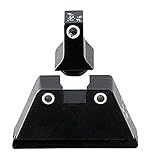
A proper backup setup restores confidence by tucking neatly into the bottom edge of the glass. Solving the clearance puzzle requires matching exact front and rear blade heights to the optic deck, checking slide cut compatibility across factory patterns, and choosing between glare-reducing black serrations or glowing tritium vials. Getting those dimensions right creates a reliable lower-third co-witness that keeps every shot predictable if electronics suddenly cut out. Here is how the top configurations stack up side by side.

- ARS Mark8.3
ARS Mark is a ranking system developed by bestairriflescopes.com. ARS Mark has no relationship or impact from any manufacturers or sales agent websites. Learn more
- BrandBrass hunter

- ARS Mark9.6
ARS Mark is a ranking system developed by bestairriflescopes.com. ARS Mark has no relationship or impact from any manufacturers or sales agent websites. Learn more
- BrandTrijicon

- ARS Mark7.9
ARS Mark is a ranking system developed by bestairriflescopes.com. ARS Mark has no relationship or impact from any manufacturers or sales agent websites. Learn more
- BrandTrijicon
- ARS Mark9.1
ARS Mark is a ranking system developed by bestairriflescopes.com. ARS Mark has no relationship or impact from any manufacturers or sales agent websites. Learn more
- BrandTrijicon

- ARS Mark7.6
ARS Mark is a ranking system developed by bestairriflescopes.com. ARS Mark has no relationship or impact from any manufacturers or sales agent websites. Learn more
- BrandBrass hunter

- ARS Mark9.4
ARS Mark is a ranking system developed by bestairriflescopes.com. ARS Mark has no relationship or impact from any manufacturers or sales agent websites. Learn more
- BrandXS Sight Systems

- ARS Mark7.2
ARS Mark is a ranking system developed by bestairriflescopes.com. ARS Mark has no relationship or impact from any manufacturers or sales agent websites. Learn more
- BrandTSA

- ARS Mark7.9
ARS Mark is a ranking system developed by bestairriflescopes.com. ARS Mark has no relationship or impact from any manufacturers or sales agent websites. Learn more
- BrandTrijicon
Last update on 2026-09-25 / Affiliate links / Images, Product Titles, and Product Highlights from Amazon Product Advertising API
Will suppressor height sights clear my suppressor and co-witness through an optic?
Yes, suppressor height sights elevate your sight line over the body of a sound suppressor and provide a usable backup sight picture through an optic window. Factory-height sights sit flush with the slide, meaning an attached suppressor can completely obstruct your view of the target, and a slide-mounted reflex sight blocks the factory blades behind its housing. Tall iron sights raise the front blade and rear notch high enough to clear the cylinder of a silencer while delivering a co-witness through your optic window. Unlike variable magnification optics like a Leupold LPVO that feature etched reticles, pistol red dots rely entirely on battery power, making elevated backup irons vital if electronics fail.
Should I pick plain black serrated sights or tritium night sight lamps?
It depends on whether your priority is minimizing window clutter or maintaining standalone low-light alignment. Plain black serrated rear sights reduce light reflection and prevent visual distractions, keeping your eye focused entirely on the illuminated red dot reticle. In contrast, setups with tritium lamps, photoluminescent front rings, or contrasting colors like green front lamps paired with orange rear lamps provide visible references in pitch-black environments. If your red dot is your primary aiming reference in daylight and darkness, black serrated blades deliver the cleanest sight picture, while tritium lamps give you illuminated backup capability if the optic goes dead in the dark.
What blade heights are needed to clear an optic deck?
Blade height requirements depend on the depth of your slide cut and the thickness of your optic base, but dedicated sets often feature specific tall dimensions such as a .315-inch front blade and a .394-inch rear assembly. Sights featuring a .315-inch high serrated front and .394-inch flat rear provide the clearance necessary to see over silencers and tall optic bases. Deeply milled direct-milled slides sit closer to the bore and may require less height, while optic adapter plates elevate the red dot housing and demand taller assemblies. Always check the exact deck height of your optic and plate against the manufacturer sight specifications before purchasing.
Do tall sights fit both standard slides and optics-ready cuts like Glock MOS or S&W M&P?
Not always, because rear dovetail position, slide width, and optic cut dimensions differ between standard slides and factory optics-ready systems. Some tall sight sets are engineered specifically for optics-ready platforms like the S&W M&P C.O.R.E., M2.0 Optics Ready, and Metal Series. Other sight sets are made to fit Glock MOS models across Gen 1 through Gen 5 or Gen 6 platforms, including models like the G17, G19, G19X, G45, and G47. A standard dovetail sight can sometimes overhang an optics-ready cut or interfere with a mounting plate, so verify that the sight part number lists your exact slide model.
Will installing suppressor height sights change my point of impact?
Taller sights maintain proper elevation when installed as a calibrated set, but they slightly increase mechanical offset at close range. Because the sights sit higher above the center of the pistol bore than factory blades, your shots will strike slightly lower than your aiming point at close distances before converging at your zero. Calibrated assemblies, including matched front blades and rear sight units, maintain a balanced trajectory so you do not experience unexpected windage or elevation shifts. Confirm your zero on target after installation to verify where your specific ammunition impacts.
How do I confirm compatibility across different Glock models and generations?
Check the manufacturer fitment listing to match your slide width and generation before installing a new sight set. Many suppressor height sight sets fit across standard Glock frames from models 17 through 39, including models like the 19, 19X, 22 through 24, and 31 across Gen 1 through 5 plus MOS configurations. However, subcompact or slimline slides use narrower dovetail cuts that will not accept standard-frame sights. Check whether the sight listing specifies standard slide dovetails, factory optics-ready cuts, or universal frame compatibility before mounting.

10 Top Picks: Best Youth Air Rifles for 13-Year-Olds

12 Best Rifle Scopes For 5.56 Under 150 Dollars - (2026 Top Picks)

Top 10 Rifle Scopes for Coyote Hunting in 2026

12 Best Benchrest Rifle Scopes of 2026 For Tight Groups

Top 5 Airsoft Rifles: Unleash the Action in 2026
Unveil the Best Straight Wall Deer Rifles: Top Picks for 2026

Top Ammo Choices for Air-Powered Rifles: Boost Your Performance in 2026

Best Quick Detach Scope Rings for Accurate and Convenient Shooting







