
12 Best Telescopes For Stargazing of 2026 With Crisp Planetary Views

Box art often promises crystal-clear views of distant galaxies, but entry-level scopes with exaggerated magnification claims usually deliver nothing more than jittery, blurry smudges. A spindly plastic tripod shivers every time fingers touch the focuser, knocking bright targets completely out of the frame. Trying to balance an overcomplicated mount in pitch darkness while hunting faint coordinates under light-polluted skies quickly turns an exciting night into a cold, frustrating chore that leaves equipment gathering dust in a closet.
Backyard astronomy should feel inspiring and straightforward, letting family gather around to marvel at sharp lunar craters and Saturn's rings within minutes of stepping outside. Reaching that clarity comes down to choosing generous light-gathering aperture and a rigid mount rather than chasing hollow power ratings. Focusing on an 80mm to 90mm refractor or a 114mm to 130mm reflector paired with intuitive alt-azimuth controls or smartphone-assisted star alignment keeps targets steady without endless fiddling. The options below deliver steady, brilliant views so your next clear night produces genuine wonder instead of lost objects.

- ARS Mark7.8
ARS Mark is a ranking system developed by bestairriflescopes.com. ARS Mark has no relationship or impact from any manufacturers or sales agent websites. Learn more
- BrandEACONN

- ARS Mark9.7
ARS Mark is a ranking system developed by bestairriflescopes.com. ARS Mark has no relationship or impact from any manufacturers or sales agent websites. Learn more
- BrandGskyer
- ARS Mark9.3
ARS Mark is a ranking system developed by bestairriflescopes.com. ARS Mark has no relationship or impact from any manufacturers or sales agent websites. Learn more
- BrandMEEZAA
- ARS Mark9.3
ARS Mark is a ranking system developed by bestairriflescopes.com. ARS Mark has no relationship or impact from any manufacturers or sales agent websites. Learn more
- BrandGskyer
- ARS Mark8.9
ARS Mark is a ranking system developed by bestairriflescopes.com. ARS Mark has no relationship or impact from any manufacturers or sales agent websites. Learn more
- BrandCelestron

- ARS Mark8.8
ARS Mark is a ranking system developed by bestairriflescopes.com. ARS Mark has no relationship or impact from any manufacturers or sales agent websites. Learn more
- BrandHETEKAN
- ARS Mark8.7
ARS Mark is a ranking system developed by bestairriflescopes.com. ARS Mark has no relationship or impact from any manufacturers or sales agent websites. Learn more
- BrandCelestron
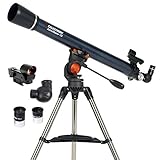
- ARS Mark8.7
ARS Mark is a ranking system developed by bestairriflescopes.com. ARS Mark has no relationship or impact from any manufacturers or sales agent websites. Learn more
- BrandCelestron

- ARS Mark8.5
ARS Mark is a ranking system developed by bestairriflescopes.com. ARS Mark has no relationship or impact from any manufacturers or sales agent websites. Learn more
- BrandMEEZAA
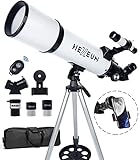
- ARS Mark8.0
ARS Mark is a ranking system developed by bestairriflescopes.com. ARS Mark has no relationship or impact from any manufacturers or sales agent websites. Learn more
- BrandKoolpte
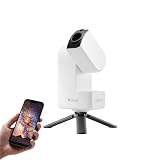
- ARS Mark7.9
ARS Mark is a ranking system developed by bestairriflescopes.com. ARS Mark has no relationship or impact from any manufacturers or sales agent websites. Learn more
- BrandZWO

- ARS Mark7.1
ARS Mark is a ranking system developed by bestairriflescopes.com. ARS Mark has no relationship or impact from any manufacturers or sales agent websites. Learn more
- BrandWOSPORTS
Last update on 2026-10-05 / Affiliate links / Images, Product Titles, and Product Highlights from Amazon Product Advertising API
Can you view lunar craters, Saturn rings, and Jupiter moons from a suburban backyard?
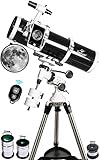
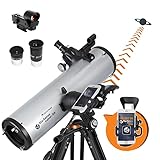
Yes, telescopes designed for moon and planet viewing, including 70mm, 80mm, and 90mm refractors as well as 114mm and 130mm reflectors, can resolve bright planetary targets under typical suburban skies. Optical tubes like the Celestron AstroMaster 70AZ explicitly target moon and planet viewing where artificial light pollution does not obscure bright solar system targets. Larger apertures like the Celestron StarSense Explorer LT 114AZ Newtonian and the Gskyer 130EQ gather more incoming light, revealing sharper surface details on the moon and distinct separation around the moons of Jupiter. Check local atmospheric visibility and verify the included eyepiece focal lengths on the product listing before observing.
Is an 80mm refractor or a 130mm reflector better for a beginner?
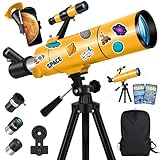
It depends on whether you prefer minimal maintenance or greater light gathering for fainter night sky targets. An 80mm refractor, such as the 80mm aperture 600mm refractor with a backpack or the MEEZAA 80mm aperture 500mm refractor, uses a sealed optical tube that requires no mirror alignment and packs easily for travel. A 130mm reflector, such as the Celestron StarSense Explorer DX 130AZ Newtonian or the Gskyer 130EQ, provides a wider primary mirror to capture more light from faint star clusters, but reflector mirrors require periodic optical collimation. Beginners seeking a quick grab-and-go setup often choose an 80mm or 90mm refractor, while those prioritizing light collection for dim objects benefit from a 130mm reflector.
Do you need smartphone guidance or app control to locate night sky targets?
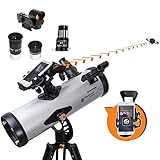
Smartphone guidance is not mandatory, but it helps locate targets quickly across light-polluted or unfamiliar skies. Models such as the Celestron StarSense Explorer DX 130AZ and LT 114AZ use smartphone-guided docking systems that match the camera perspective with night sky coordinates to direct your manual aiming. Manual telescopes without mobile integration require star-hopping using standard finder scopes and sky charts. If you prefer automated pointing and imaging, smart systems like the ZWO Seestar S30 Pro feature app-controlled astrophotography to track celestial coordinates automatically without manual star-hopping.
What is the difference between an AZ mount and an EQ mount for stargazing?
An alt-azimuth (AZ) mount moves up, down, left, and right, making it the simplest mount design for beginner observation. Telescopes like the Gskyer 600x90mm AZ, the Koolpte 80mm/600mm AZ refractor, and the Celestron AstroMaster 70AZ use AZ mounts that maneuver like standard camera tripods without any special polar positioning. An equatorial (EQ) mount, used on models such as the Gskyer 130EQ, tilts along the rotational axis of the Earth so you can track drifting stars by adjusting a single axis control. An EQ mount aids long tracking sessions, but an AZ mount sets up faster and requires no polar alignment before you start viewing.
Do beginner telescopes come with sighting accessories for manual aiming?
Yes, entry-level astronomy telescopes typically include an optical finderscope or a zero-magnification reflex sight to help center targets before you look through the primary eyepiece. While marksmen coordinate optics using iron sights for cowitness with red dot sights on sporting equipment, stargazing reflex finders project a tiny illuminated dot onto a clear sight window to point your optical tube without magnification. Refractor packages such as the MEEZAA 90mm aperture 800mm refractor supply matching tripods and phone adapters to assist target acquisition. Check the included accessory list on the product page to verify which sighting accessory comes with your telescope.
Can a compact smart telescope capture deep-sky astrophotography without manual alignment?
Yes, dedicated smart telescopes automate celestial targeting and image capture through internal computing and motorized mounts. The ZWO Seestar S30 Pro smart telescope provides app-controlled astrophotography, automatically handling tracking, target centering, and digital exposure collection through a smartphone interface. Unlike traditional visual telescopes that require manual optical focusing, manual target centering, and direct eyepiece viewing, an automated smart scope produces digital imagery of deep-sky objects directly on your screen. Verify your mobile operating system version against the manufacturer app requirements to ensure complete wireless compatibility.


12 Best 22 Pcp Air Rifle For Hunting of 2026 With Quiet Power

7 Best 22 Pcp Air Rifle Under 300 of 2026 For Backyard Pest Control

10 Best 22 Break Barrel Air Rifles of 2026 For Backyard Pest Control

10 Best 30 Caliber Pcp Air Rifle of 2026 For Medium Game

Top Best 177 Air Rifle Under 100: Budget-Friendly Picks for 2026

How to Safely Reload Shotgun Shells at Home

11 Best Co2 Air Rifle For Pest Control of 2026 To Ensure Humane Dispatch

12 Best Inexpensive Air Rifles of 2026 For Dependable Backyard Accuracy






