
Safe Crossbow Hunting Tips for Beginners

Most newcomers assume a crossbow handles just like a shoulder rifle simply because it has a stock and a scope. That assumption causes painful mistakes, because these tools have exposed, moving parts and strict distance limits. Real safety comes down to two rules: always keep your fingers tucked below the rail and keep your shots inside 40 yards. A snapping string can break a thumb in an instant, and arrows lose speed far faster than bullets.
How you prepare also depends on your hunting spot and gear. Sitting in a tight ground blind requires open space so the wide limbs do not strike the fabric, while tree stands require careful hauling with a hoist line. Cocking methods differ too, since a handheld rope aid takes steady physical balance while a built-in crank winds slowly. Local game laws also govern legal hunting points. Here is how to handle your setup safely before opening day.
Keep your fingers below the rail on every shot
Beginners often hold a crossbow like a traditional hunting rifle. A rifle stock lets you wrap your support hand around the barrel or rest your thumb up along the side without issue. A crossbow does not work that way. The bowstring travels down the rail (the grooved track where the arrow sits) with hundreds of pounds of release force. If your thumb or fingertip pokes above that track when you pull the trigger, the string will strike your hand at high speed. This mistake causes severe cuts, broken bones, and deep tissue damage.
Modern crossbows feature molded plastic safety wings or flared foregrips designed to keep your fingers down. These wings act as a physical ceiling between your hand and the moving bowstring. In the excitement of spotting a deer, your grip can easily shift upward if you do not pay close attention. Developing safe muscle memory during practice is the only reliable way to keep your hand safe in the field.
Use this hand-placement checklist before you touch the safety switch:
- Feel the underside of the safety wings against the tops of your knuckles before settling your grip.
- Point your forward thumb straight down the stock toward the target rather than wrapping it around the side.
- Squeeze the forearm grip firmly into the palm of your support hand so your fingers cannot slide upward under recoil.
- Look down with your eyes to visually verify that your thumb sits completely below the rail before looking through your scope.
Cold weather makes hand awareness even harder. Thick winter hunting gloves dull your sense of touch, making it difficult to feel whether your thumb has crept past the safety flange. Practice handling your crossbow wearing the exact gloves you plan to wear during the late season. If your gloves are too bulky to fit cleanly beneath the safety wings, switch to a thinner pair with textured rubber palms that give you positive control without extra padding.
Cock and unload your bow evenly for consistent accuracy
A crossbow relies on balanced limb tension to send an arrow flying straight. If you pull the bowstring back by hand without a cocking aid, one hand will naturally pull slightly harder than the other. This draws the center of the string a fraction of an inch to the left or right inside the trigger mechanism. Even a tiny imbalance places uneven pressure on the limbs, causing your arrows to hit inches off target downrange.
Always use a cocking rope (a cord with handles used to pull the string back evenly) or an integrated crank. A cocking rope cuts the felt pull weight in half and centers the string perfectly along the rail. Follow these steps every single time you cock your crossbow:
- Place your hunting boot firmly inside the foot stirrup on flat, solid ground so the bow cannot slip upward.
- Hook the dual pulleys of your cocking rope onto the bowstring, making sure the hooks face downward or outward away from the flight rail.
- Place the center rope loop into the rear groove of the crossbow stock behind the scope mount.
- Stand straight up using the strength of your legs and core, drawing the handles smoothly toward your chest until the string clicks firmly into the trigger latch.
- Look at the safety mechanism to confirm that it shifted into the safe position automatically, as most modern models are designed to do.
- Slide your arrow along the rail until the nock sits flush against the bowstring, resting securely under the arrow retention spring.
Unloading your crossbow at the end of a hunt requires just as much caution. Never dry fire your bow (pulling the trigger without an arrow loaded). Firing an empty bow forces the limbs and cams to absorb all that violent energy instead of transferring it into an arrow. This can crack limbs, snap cables, and fling sharp composite fragments straight toward your face.
The simplest way to unload a standard crossbow is to shoot a dedicated discharge arrow into a portable target bag or a soft patch of dirt when you return to your vehicle. Some modern hunting models eliminate this chore entirely. Hunters looking for easier evening routines often choose bows with safe de-cocking mechanisms that let you crank the string forward under controlled tension without firing an arrow.
Keep your hunting shots inside forty yards for success
Because a crossbow has a shoulder stock and a magnified scope, many first-time hunters assume it behaves like a rifle that shoots flat across long distances. In reality, a crossbow is still archery gear. An arrow is much heavier and travels much slower than a rifle bullet, which means gravity pulls it downward in a steep arc the moment it clears the stirrup.
At 20 yards, an arrow flies with a relatively flat path. Once the arrow passes 30 yards, it loses forward momentum and begins to drop rapidly. If a buck stands at 38 yards and you estimate the distance at 32 yards, your arrow will drop right under its chest. Always carry an optical laser rangefinder in the woods, and measure fixed landmarks around your stand, such as prominent trees or trail intersections, before game arrives.
Distance also creates another major problem known as string jumping. The sound of a crossbow firing travels through the air at roughly 1,100 feet per second. Even fast crossbow arrows travel well under 450 feet per second. The loud snap of the bow limbs reaches the animal's ears long before the arrow arrives.
When a wild deer hears an abrupt, metallic sound, its natural survival reflex is to drop its chest toward the ground to load its legs for a leap. At 20 or 25 yards, the arrow covers the distance so quickly that the deer barely moves before impact. At 40 or 50 yards, the animal has plenty of time to drop or spin, turning what looked like a good vital shot into a gut hit or a complete miss. Keeping your hunting shots inside 35 or 40 yards gives you the best chance of making a clean, ethical harvest.
Crosswinds also punish long-distance crossbow shots. Crossbow arrows carry broadheads and stabilizing vanes that act like small sails when crosswinds push against them. A gentle ten-mile-per-hour crosswind that barely moves a rifle bullet can easily push an arrow four to six inches off target at 40 yards. Limiting your hunting range protects you from wind drift and keeps your shot right inside the vital zone.
Check limb clearance before pulling the trigger every time
When a crossbow rests in its cocked position, the limbs pull tight and narrow toward the stock. The instant you squeeze the trigger, those flexible limbs snap violently outward to their original uncocked width. If either limb tip hits a solid object during that forward stroke, the impact can splinter the limb, throw the arrow wildly off course, and send broken parts flying toward your eyes.
Ground blinds are common trouble spots for beginners. You might look through your scope and see a perfectly clear window opening toward the target, forgetting that the limbs sit lower and spread much wider than your optic line of sight. If the limb catches the blind fabric or hits a rigid fiberglass support rod, it can tear the blind and damage your bow. Choosing compact gear engineered for tight blinds helps reduce this footprint, but you must still pay close attention to your surroundings.
Tree stands present similar clearance dangers. The trunk of the tree behind your seat, the metal shooting rail in front of you, or a nearby branch can easily sit inside the limb expansion zone. Before you settle into your stand, run through this clearance checklist:
- Measure the bow width when uncocked at home so you know its full, resting width from tip to tip.
- Sit in your tree stand or blind chair and slowly raise the crossbow to shoulder height, pointing it toward every expected shooting lane.
- Look past the scope and confirm there is at least three to four inches of empty space beyond each limb tip.
- Hang your backpack, grunt calls, and binoculars behind you so no loose gear dangles into the path of the bow limbs.
- Trim back any thin twigs or brush that sit within your shooting arc, following local wildlife land rules.
If an animal walks into an angle where a tree trunk or blind window sits too close to your limbs, do not force the shot. Shift your entire body position smoothly to create clearance, or simply let the animal pass. Taking a shot with restricted limb space puts your safety and your equipment at severe risk.
Match your broadheads to practice points before opening day
Many beginners spend weeks shooting smooth metal field points into foam targets with great success, only to struggle when they screw on hunting broadheads right before the season starts. Broadheads (the sharp hunting blades screwed onto the arrow tip) interact with the air differently than smooth practice tips.
Broadheads fall into two primary designs: fixed blades and mechanical blades. Fixed broadheads feature solid, exposed steel blades that stay rigid at all times. Because these blades cut through the air during flight, they act like miniature rudders. If your arrows are slightly out of balance or your bowstring does not travel perfectly level, fixed blades catch the wind and steer the arrow off target. Mechanical broadheads carry blades that stay folded tight against the body during flight and open on impact, making them fly much closer to the path of a smooth field point.
Weight matching is critical when switching from target practice to hunting. If you practice with 100-grain field points, you must shoot 100-grain broadheads. Changing tip weight alters the balance of the arrow and drastically changes how quickly the arrow drops at hunting distances. A heavier tip makes the arrow nose-dive sooner, while a lighter tip changes how the arrow flexes as it leaves the rail.
Follow this preparation routine before taking your hunting arrows into the woods:
- Screw your broadheads tightly onto the arrows, checking that the tips spin true on a flat surface without any visible wobble.
- Flex-test carbon arrows before every shooting session by gently bending each arrow shaft between your hands while listening closely for faint cracking sounds.
- Discard any arrow that makes a creaking noise or shows hairline cracks, because damaged carbon shafts can shatter when fired.
- Shoot at least one practice arrow fitted with your chosen broadhead into a broadhead-rated foam target to confirm your scope crosshairs hit where you aim.
- Inspect the broadhead after practice to ensure the blades remain sharp and undamaged before placing it in your hunting quiver.
Choose matched broadheads built for crossbow speeds
Selecting the right hunting heads for your crossbow comes down to matching the broadhead design to the high energy of modern archery equipment. Crossbows push arrows with far more initial force than standard vertical bows. Broadheads built for lower speeds can fail when launched from a crossbow, either by opening prematurely in mid-air or bending upon contact.
When shopping for broadheads, confirm that the package explicitly rates them for high-speed crossbow shooting. For mechanical broadheads, check the blade retention method. Stiff retention collars, strong bands, or internal spring clips ensure the blades stay locked inside the body during launch and flight. For fixed broadheads, look for thick, durable stainless steel blades that resist bending when passing through hide and muscle.
Verify that the broadhead weight matches your practice arrows exactly, with 100-grain heads serving as the standard balance point for most crossbow setups. Look for standard screw-in threads that seat flush against your arrow inserts without needing special adapters. Review your local state wildlife agency regulations before buying. State hunting rules often dictate minimum blade cutting diameters, minimum bow pull weights, and whether mechanical broadheads are legal for big game hunting in your area.

- ARS Mark9.4
ARS Mark is a ranking system developed by bestairriflescopes.com. ARS Mark has no relationship or impact from any manufacturers or sales agent websites. Learn more
- BrandAULTARCHEX
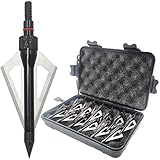
- ARS Mark7.7
ARS Mark is a ranking system developed by bestairriflescopes.com. ARS Mark has no relationship or impact from any manufacturers or sales agent websites. Learn more
- BrandLeeMui

- ARS Mark7.6
ARS Mark is a ranking system developed by bestairriflescopes.com. ARS Mark has no relationship or impact from any manufacturers or sales agent websites. Learn more
- BrandKEAUP
Last update on 2026-10-21 / Affiliate links / Images, Product Titles, and Product Highlights from Amazon Product Advertising API


12 Best 22 Pcp Air Rifle For Hunting of 2026 With Quiet Power

7 Best 22 Pcp Air Rifle Under 300 of 2026 For Backyard Pest Control

10 Best 22 Break Barrel Air Rifles of 2026 For Backyard Pest Control

10 Best 30 Caliber Pcp Air Rifle of 2026 For Medium Game

Top Best 177 Air Rifle Under 100: Budget-Friendly Picks for 2026

How to Safely Reload Shotgun Shells at Home

11 Best Co2 Air Rifle For Pest Control of 2026 To Ensure Humane Dispatch

12 Best Inexpensive Air Rifles of 2026 For Dependable Backyard Accuracy






