
How Far Should You Sight In a Rifle?

A shooter unzips a rifle case at the bench, catches the sharp scent of gun oil, and stares down the range wondering which target board to set up. Scoped hunting rifles hit their sweet spot at 100 yards, while defensive carbines with red dot sights run best with a 50-yard zero. Sighting in at these marks keeps your bullet on a steady path without landing inches too high or low.
The right distance for your trip depends on whether you have a magnifying scope or an unmagnified dot, what you plan to hunt or protect, and how far your local shooting lanes stretch. A deer hunter watching a wide clearing needs a different setup than someone practicing quick home-defense drills at an indoor range. Here is how to pick the right distance for your setup and get your rounds on paper without wasting a box of ammo.
Sighting Distances for Scopes and Hunting Rifles
Choosing how far to sight in a rifle depends on your firearm, the optic mounted to it, and how you plan to use it. Centerfire hunting rifles and long-range precision setups perform best with a 100-yard zero. This 100-yard distance serves as the standard for bolt-action rifles firing cartridges like .308 Winchester, .30-06 Springfield, or 6.5 Creedmoor.
The reason 100 yards works so well comes down to bullet trajectory, which is the curved flight path of the bullet through the air. A bullet never flies in a straight line. Gravity pulls it toward the ground the moment it leaves the barrel. Because a magnified scope sits an inch or two above the barrel, the barrel is angled slightly upward relative to your sight line. The bullet climbs upward through your sight line, arches at its peak, and then falls back down.
For standard hunting calibers, 100 yards sits near the top of that gentle arch. When you set your zero at 100 yards, you adjust your sight so the aim point matches where the bullet lands at that exact distance. Between 50 and 70 yards, the bullet travels roughly half an inch to an inch above your crosshairs. At 150 yards, it drops only an inch or two. At 200 yards, the bullet drops about three to four inches below your aim point.
Most big game animals, like white-tailed deer, have a vital heart and lung zone roughly eight to ten inches across. With a 100-yard zero, you place crosshairs directly on the center of the chest at 50, 100, or 200 yards. You do not need to calculate holdover, which means aiming slightly higher to make up for bullet drop. The bullet lands inside the vitals across that entire distance.
Smaller rimfire rifles, like those chambered in .22 LR, require a shorter distance. Rimfire bullets travel much slower and drop steeply past 50 yards. Sighting in a rimfire rifle at 50 yards, or even 25 yards for target shooting, keeps your shots centered. If you mount red dot sights for target rimfires, a 25-yard or 50-yard zero matches how those small calibers perform.
Setting a centerfire hunting scope at 25 yards and leaving it there causes missed shots. Because the bullet is still climbing steeply at 25 yards, it will fly six to ten inches high at 150 yards, sailing clean over the animal.
Why 50 Yards Is the Sweet Spot for Red Dot Carbines
Defensive carbines and modern sporting rifles, such as AR-15 rifles, have a very different physical layout than hunting rifles. The straight stock places your cheek high on the rifle. Because of this layout, a red dot sight must sit elevated on a riser, putting the center of the optic roughly 2.5 to 2.8 inches above the center of the barrel. This gap is known as height over bore.
Because the optic sits high above the barrel, the barrel must angle upward to meet your line of aim. This mechanical setup makes a 50-yard zero the sweet spot for carbines firing 5.56 NATO or .223 Remington ammunition.
When you zero a red dot at 50 yards, the bullet crosses your aiming dot on its way up at 50 yards. The bullet keeps rising slightly, reaching the top of its arch about 1.5 to 2 inches above your point of aim around 100 to 125 yards. As gravity pulls the bullet back down, it passes through your aiming dot line a second time right around 200 yards. This is often called the 50-yard and 200-yard zero.
This creates a predictable point-blank window. From 10 yards out to roughly 225 yards, your bullet never strikes more than two inches above or below where your red dot rests. In a defensive situation or shooting drill, you do not have to pause to calculate distance. You put the aiming dot on center mass and squeeze the trigger.
A 50-yard zero also pairs smoothly with backup iron sights. Sighting through your optic glass to align with your metal sights is known as co-witnessing. When you set your red dot and your backup iron sights for co-witnessing to the same 50-yard line, both systems share the same point of impact if your battery runs out.
Dot size matters when zeroing at 50 yards. Aiming dot size is measured in MOA, which indicates how much target area the dot covers. A fine 2 MOA aiming dot covers about one inch of target at 50 yards, leaving the bullseye clearly visible for precise shooting. A larger 4 MOA dot covers two inches at 50 yards, which is quick to spot in close quarters but covers more of the bullseye when zeroing.
How to Zero at 25 Yards First to Save Ammunition
Walking up to a 100-yard target with a newly mounted optic often leads to missed paper. If the sight is slightly off in the mount, rounds miss the board entirely, wasting ammunition. Starting on a 25-yard target gives you an easy way to get your rifle on paper before moving out to your final distance.
Use these steps to get on target smoothly:
- Clear the firearm and check the mount: Remove the magazine, cycle the bolt open, and inspect the chamber with your eyes and finger to confirm it is empty. Check that mounting screws are tightened with an inch-pound torque tool, and confirm thread-locking fluid keeps screws from shaking loose under recoil.
- Bore sight the rifle: Bore sighting means roughly lining up the barrel with the target before shooting live rounds. On a bolt-action rifle, remove the bolt and look straight down the bore at a 25-yard bullseye, then turn your optic dials until the reticle rests on that same spot. On rifles where you cannot see through the barrel, use a laser alignment tool in the chamber or muzzle.
- Fire a three-shot group at 25 yards: Rest the rifle firmly on sandbags or a shooting bench. Align your aiming dot on the bullseye and squeeze the trigger smoothly three times. Never adjust dials after a single shot, because one pulled shot tricks you into making bad adjustments. A three-shot group shows the true center of your rifle's impact.
- Adjust your windage and elevation dials: Elevation dials move bullet impact up or down, while windage dials move bullet impact left or right. Most scopes adjust by 1/4 MOA per click, which equals about 1/4 inch at 100 yards. At 25 yards, that click moves the bullet only 1/16 of an inch. If your shots land two inches low and one inch left, you will need 32 clicks up and 16 clicks right.
- Move to your final distance and confirm: Once your shots cluster in the bullseye at 25 yards, move your target out to 50 yards for a red dot or 100 yards for a hunting rifle. Fire one more three-shot group to confirm bullet placement, and make final small adjustments.
Before firing your final confirmation shots at full distance, run through this quick checklist:
- Rifle forearm and stock supported firmly on stable sandbags or a bench rest.
- Optic mount bolts checked so there is zero play on standard Picatinny or 20mm slotted accessory rails.
- Loaded with the exact ammunition brand and bullet weight you intend to use in the field.
- Steady breathing pattern with a smooth trigger pull during your natural pause.
- Target backing paper checked so it hangs flat without flapping in the wind.
What to Look for in Sighting Tools and Red Dot Optics
Using the right tools makes sighting in your rifle straightforward and saves ammunition. Bore sighting tools project a straight laser beam from your barrel or chamber directly onto a target. This allows you to align your reticle before firing live rounds. Look for alignment tools with snug barrel adapters that seat securely in the muzzle without wobbling, since any loose fit throws off your laser point.
When selecting a red dot sight, consider the optic housing style. Enclosed tube sights seal the electronic emitter between two glass lenses, shielding the aiming dot from rain, dust, and mud. Open-window sights feature an exposed single lens that provides a wide viewing window for rapid target transitions, though dirt can block the exposed emitter in bad weather.
Aiming dot size also plays a big role in your accuracy. A compact 2 MOA aiming dot gives you a sharp reference point that covers only one inch of target at 50 yards, making it easy to zero your rifle with tight shot groups. Finally, look for positive click dials for windage and elevation that hold their position under heavy recoil, along with motion-sensing auto-on features that wake the optic when moved and sleep when still to save battery life.

- ARS Mark8.4
ARS Mark is a ranking system developed by bestairriflescopes.com. ARS Mark has no relationship or impact from any manufacturers or sales agent websites. Learn more
- BrandN/A

- ARS Mark-
ARS Mark is a ranking system developed by bestairriflescopes.com. ARS Mark has no relationship or impact from any manufacturers or sales agent websites. Learn more
- BrandGun Video

- ARS Mark-
ARS Mark is a ranking system developed by bestairriflescopes.com. ARS Mark has no relationship or impact from any manufacturers or sales agent websites. Learn more
- BrandAWETHE

- ARS Mark-
ARS Mark is a ranking system developed by bestairriflescopes.com. ARS Mark has no relationship or impact from any manufacturers or sales agent websites. Learn more
- BrandTRUGLO
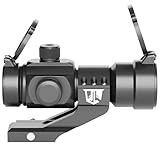
- ARS Mark-
ARS Mark is a ranking system developed by bestairriflescopes.com. ARS Mark has no relationship or impact from any manufacturers or sales agent websites. Learn more
- BrandOZARK ARMAMENT
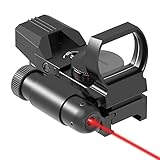
- ARS Mark-
ARS Mark is a ranking system developed by bestairriflescopes.com. ARS Mark has no relationship or impact from any manufacturers or sales agent websites. Learn more
- BrandFeyachi

- ARS Mark-
ARS Mark is a ranking system developed by bestairriflescopes.com. ARS Mark has no relationship or impact from any manufacturers or sales agent websites. Learn more
- BrandBayattoo
Last update on 2026-10-01 / Affiliate links / Images, Product Titles, and Product Highlights from Amazon Product Advertising API
FAQs
Can I zero my rifle at an indoor 25-yard range and leave it there?
You can use a 25-yard target to get your rifle on paper, but leaving it zeroed there causes problems at longer distances. Because the bullet is still rising quickly at 25 yards, centerfire rifle rounds will strike several inches high at 100 yards. If you only have access to a 25-yard lane, check your ammunition ballistics chart so you can adjust your group to land slightly low at 25 yards, which helps approximate a true 50-yard or 100-yard zero.
Why do my bullets hit lower than my aiming dot at very close ranges?
This happens because of height over bore, which is the physical distance between the center of your rifle barrel and the center of your optic window. Because your sight sits higher than the barrel, the bullet leaves the muzzle below your aim line and has not climbed up to meet the dot yet. When shooting targets inside ten yards, you must aim an inch or two higher than your intended impact point to compensate for this offset.
Do I need to sight in my rifle again if I switch ammunition brands?
Yes, you should always fire a confirmation group whenever you switch ammunition brands or bullet weights. Different cartridges use varying powder charges, bullet shapes, and weights, which change how fast the bullet leaves the barrel and how it arcs through the air. Even two boxes of ammunition with the same bullet weight from different makers can land an inch or two apart at 100 yards.


12 Best 22 Pcp Air Rifle For Hunting of 2026 With Quiet Power

7 Best 22 Pcp Air Rifle Under 300 of 2026 For Backyard Pest Control

10 Best 22 Break Barrel Air Rifles of 2026 For Backyard Pest Control

10 Best 30 Caliber Pcp Air Rifle of 2026 For Medium Game

Top Best 177 Air Rifle Under 100: Budget-Friendly Picks for 2026

How to Safely Reload Shotgun Shells at Home

11 Best Co2 Air Rifle For Pest Control of 2026 To Ensure Humane Dispatch

12 Best Inexpensive Air Rifles of 2026 For Dependable Backyard Accuracy






