
How Far Should You Sight In an AR-15?

Sighting in an AR-15 at 50 yards works best for almost everyone. That target distance changes only if your local range lacks the space or if you plan to shoot mostly past 200 yards. At 50 yards, the bullet path crosses your line of sight on the way out and hits dead-on again near 200 yards. That setup keeps your shots within about two inches of your aiming point across everyday distances without any guesswork.
A few practical details will help you make the final call. Indoor shooting lanes often stop at 25 yards, which makes a closer target necessary simply because of the room you have. Using a magnified scope rather than a non-magnified red dot sight can also make a 100-yard target a cleaner choice for small groups. Here is how each common distance behaves downrange and how to pick the right match for your rifle.
A Fifty Yard Zero Gives You The Flattest Path
When setting up an AR-15, shooters frequently debate four distances: 25, 36, 50, and 100 yards. Sighting in, also called zeroing, simply means adjusting your sight so your aiming point matches where the bullet lands on paper. Choosing the right distance comes down to how flat the bullet travels across normal target ranges. For most rifle owners, a 50-yard zero provides the most versatile and forgiving bullet path you can choose.
A 50-yard zero works exceptionally well because of how a standard 5.56 NATO or .223 Remington round travels. When you zero dead center at 50 yards, the bullet leaves the barrel, climbs through your line of sight, and reaches its highest crest around 100 yards. At that 100-yard peak, the bullet sits only about an inch to an inch and a half above your aiming dot (the glowing reticle dot in your optic). As it continues downrange, gravity pulls it back down, crossing your sight line a second time near 200 yards.
This path means you can place your aiming dot directly in the center of a target anywhere from 25 yards out to 225 yards without doing mental math. The bullet stays within about two inches above or below your aim point across that entire span. For range practice, home defense drills, and practical matches, that small margin produces reliable hits.
The other common distances carry specific trade-offs:
- The 36-yard zero: Popular in military training, this zero keeps bullets on a torso target out to 300 yards. But between 150 and 200 yards, the bullet arcs four to five inches above your aim point. Hitting a small steel plate or varmint at 175 yards requires aiming well below the target to avoid shooting over it.
- The 100-yard zero: Bench shooters with magnified scopes often prefer 100 yards because the bullet never rises above the sight line. It touches the reticle at its highest point and only drops from there. But at 200 yards the bullet already drops several inches, requiring holdovers when using a non-magnified red dot.
- The 25-yard zero: Many indoor ranges only reach 25 yards, so beginners naturally start there. But zeroing dead-on at 25 yards creates a steep arc downrange. The bullet climbs seven to nine inches high between 150 and 200 yards, and does not drop back down until roughly 375 yards, causing high misses outdoors.
Bullets Travel in an Arc Instead of Straight Lines
A common misconception is that a rifle bullet fires out of the muzzle like a flat laser beam. In reality, every bullet travels along a curved trajectory (the curved flight path of the bullet through the air). Gravity pulls the bullet toward the ground the moment it leaves the barrel.
To make a bullet hit where your eye points, the rifle takes advantage of geometric angles. On a standard AR-15, your sight sits higher than the barrel. The space between the center of the barrel and the center of your optic lens is known as height over bore (the vertical gap between the center of the barrel and the sight). On an AR-15, this gap usually measures about 2.5 to 2.8 inches.
Because the optic sits above the barrel, the barrel cannot point completely parallel to your sight line. If it did, the bullet would start more than two inches low and drop farther away forever. To solve this, the barrel angles slightly upward relative to the sight. When fired, the bullet starts below your eye line, climbs through your line of sight, crests a few inches high, and drops back through your sight line a second time as it slows down.
Shooters call the first crossing the near zero and the second crossing the far zero. With a 50-yard near zero, 200 yards is your far zero. With a 36-yard near zero, the far zero sits around 300 yards. Knowing this prevents confusion. If your rifle hits several inches high at 100 yards after zeroing at a short range, your optic did not come loose: the bullet is simply riding the high crest of its natural arc.
Close Targets Require Aiming Two Inches Higher
Shooting inside 15 yards often confuses new AR-15 owners. You can zero your sight to dead center at 50 yards, step up to a target at 7 yards, put the aiming dot directly on the bullseye, and fire. When you check the target, the hole sits roughly two inches below your aim point.
This offset happens because of height over bore at close quarters. Inside your near zero distance, the bullet is still on its initial climb from the barrel toward your line of sight. Because your optic sits about 2.5 inches above the barrel, the bullet leaves the muzzle below your sight line and only covers part of that gap over the first 7 to 10 yards.
To hit small targets up close, you must use holdover. Holdover means placing your aiming point slightly higher on the target than where you want the bullet to strike. If you want to hit the middle of an index card at 5 yards, place your red dot near the top edge. At 25 yards, the bullet has climbed closer, so you only aim about an inch high. By 50 yards, you can aim dead center.
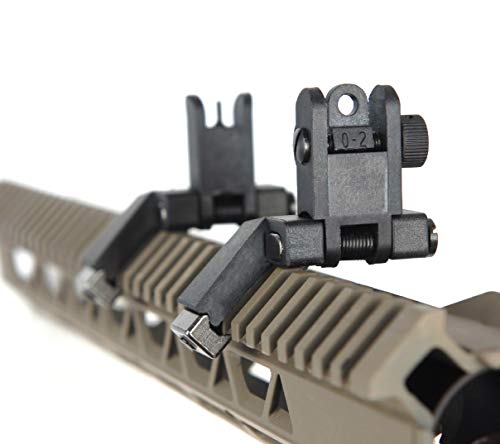
This rule applies to every sight on an AR-15. Whether you use an open-window reflex sight, an enclosed tube optic, or iron sights that cowitness with red dot sights, the mechanical height over bore remains nearly identical. Co-witness simply means you can look through your optic glass and see your backup iron sights lining up right with your reticle. Because backup iron sights sit at the same height as the red dot, they produce the exact same low impact up close.
Five Clear Steps Walk Your Shots Into Bullseye
Sighting in your rifle does not require burning through boxes of expensive ammunition. By using a stable shooting position and making systematic adjustments, you can lock in a dependable zero in fifteen rounds or fewer. Always start with safety: remove the magazine, lock the bolt back, and inspect the chamber visually and with your finger to verify the rifle is completely unloaded before making bench preparations.
Follow these five steps at the range:
- Check and torque your mounting hardware. Secure the optic mount onto the standard Picatinny or 20mm slotted accessory rails on your upper receiver. Apply a drop of medium-strength thread-locking fluid to the screw threads, and tighten them down using an inch-pound torque tool according to the maker's specifications. Hand-tightening with a simple wrench often leaves screws too loose under recoil or too tight, which can strip the aluminum threads.
- Lock into a rock-solid firing rest. Never sight in while standing, kneeling, or resting elbows on a bench. Place the rifle in a shooting sled, rest the handguard on firm sandbags, or use a bipod paired with a rear squeeze bag under the stock. Keep the rifle barrel from touching hard surfaces, as direct barrel contact changes natural barrel vibration and scatters your shots.
- Start on paper at 25 yards. Even if your goal is a 50-yard zero, place your first target at 25 yards. Factory optic dials often point several inches away from the bore out of the box. Starting at 50 or 100 yards can cause your first shots to miss the paper backer completely. Starting at 25 yards guarantees you get on paper quickly.
- Fire one three-shot group. Aim at the center bullseye and squeeze the trigger smoothly three times. Never adjust your dials after a single shot, because a flinch or pulled trigger can mislead you. A three-shot group shows a consistent pattern. Use the center of that group to guide your adjustments.
- Make your click adjustments and confirm at distance. Remove the turret caps to reveal your adjustment dials. Click adjustment refers to the small dial turns on a sight that shift bullet impact on target. Most sights use Minute of Angle (MOA) measurements, where 1 MOA equals roughly one inch at 100 yards, a half-inch at 50 yards, and a quarter-inch at 25 yards. If your dial moves 0.5 MOA per click, each click shifts the impact 1/8 inch at 25 yards. Turn your elevation dial (up and down) and windage dial (left and right) toward the bullseye. Once centered at 25 yards, move the target to 50 yards, fire another three-shot group to confirm, and tighten your turret caps.
Simple Chamber Tools Save Ammunition During Setup
Zeroing your AR-15 goes much faster when you use alignment tools before firing live rounds. Rather than guessing where bullets will hit on a blank target backer, simple accessories help you align your sight at home or on the bench.
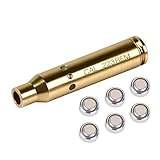
A laser bore sight is one of the most effective tools for initial setup. A bore sight is a laser tool slipped into the chamber to point your sight close to center before firing. Shaped like a standard rifle cartridge, this brass or aluminum unit slides into the chamber. When the chamber closes, a red laser projects down the barrel onto a wall or target backer. You can look through your red dot or iron sights and turn your adjustment dials until your aiming dot aligns with the laser. Doing this at 25 yards ensures your first live shot lands close to the center ring.
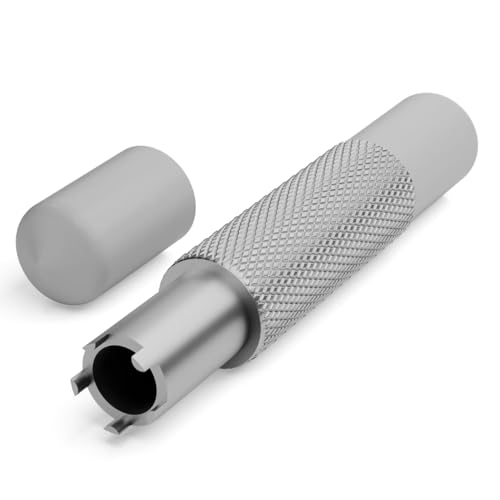
If you use backup iron sights alongside your red dot, a dedicated front sight adjustment tool is another valuable addition. AR-15 front sight posts use spring-loaded detent pins that lock the post in place. Trying to turn the post with a nail or pliers can slip, scratching the rifle finish. A dedicated tool fits over 4-prong and 5-prong front sight posts, pressing the pin down and rotating the post smoothly in one movement.
When choosing sights and setup tools, look for features that make zeroing straightforward:
- Clear, tactile adjustment clicks: Look for dials that give audible and tactile feedback with every turn, so you know exactly how many clicks you moved.
- Appropriate dot size: A crisp 2 MOA aiming dot covers about two inches at 100 yards and one inch at 50 yards, which allows precise shot placement. Larger 4 to 6 MOA dots are fast for close defensive shooting but can cover too much of a bullseye target during zeroing.
- Caliber-matched fit: Make sure any chamber laser matches your rifle chambering, such as .223 Remington and 5.56mm NATO, so it sits squarely in the bore without tilting.
- Durable metal construction: Select adjustment tools and optic mounts made from steel or machined aluminum that clamp securely onto standard accessory rails without flexing under recoil.

- ARS Mark9.0
ARS Mark is a ranking system developed by bestairriflescopes.com. ARS Mark has no relationship or impact from any manufacturers or sales agent websites. Learn more
- BrandCVLIFE

- ARS Mark8.8
ARS Mark is a ranking system developed by bestairriflescopes.com. ARS Mark has no relationship or impact from any manufacturers or sales agent websites. Learn more
- BrandVisiofire
- ARS Mark8.8
ARS Mark is a ranking system developed by bestairriflescopes.com. ARS Mark has no relationship or impact from any manufacturers or sales agent websites. Learn more
- BrandMidTen

- ARS Mark8.8
ARS Mark is a ranking system developed by bestairriflescopes.com. ARS Mark has no relationship or impact from any manufacturers or sales agent websites. Learn more
- BrandEZshoot
- ARS Mark8.8
ARS Mark is a ranking system developed by bestairriflescopes.com. ARS Mark has no relationship or impact from any manufacturers or sales agent websites. Learn more
- BrandIORMAN
- ARS Mark8.6
ARS Mark is a ranking system developed by bestairriflescopes.com. ARS Mark has no relationship or impact from any manufacturers or sales agent websites. Learn more
- BrandPIHSSFULL

- ARS Mark8.6
ARS Mark is a ranking system developed by bestairriflescopes.com. ARS Mark has no relationship or impact from any manufacturers or sales agent websites. Learn more
- BrandAISUNOUTDOOR

- ARS Mark8.6
ARS Mark is a ranking system developed by bestairriflescopes.com. ARS Mark has no relationship or impact from any manufacturers or sales agent websites. Learn more
- BrandFeyachi

- ARS Mark8.0
ARS Mark is a ranking system developed by bestairriflescopes.com. ARS Mark has no relationship or impact from any manufacturers or sales agent websites. Learn more
- BrandGeneric
Last update on 2026-10-01 / Affiliate links / Images, Product Titles, and Product Highlights from Amazon Product Advertising API


12 Best 22 Pcp Air Rifle For Hunting of 2026 With Quiet Power

7 Best 22 Pcp Air Rifle Under 300 of 2026 For Backyard Pest Control

10 Best 22 Break Barrel Air Rifles of 2026 For Backyard Pest Control

10 Best 30 Caliber Pcp Air Rifle of 2026 For Medium Game

Top Best 177 Air Rifle Under 100: Budget-Friendly Picks for 2026

How to Safely Reload Shotgun Shells at Home

11 Best Co2 Air Rifle For Pest Control of 2026 To Ensure Humane Dispatch

12 Best Inexpensive Air Rifles of 2026 For Dependable Backyard Accuracy






