
How to Adjust Mosin Nagant Sights Accurately

Missing the bullseye with an old military surplus rifle is completely normal and easy to fix. Getting your shots on target comes down to two simple mechanical adjustments: tap the front sight sideways in its base slot to correct left or right aim, and slide the rear sight bar to change vertical impact. Because these historic rifles lack modern click dials, gentle alignment prevents you from accidentally damaging the metal.
A few small factors will change your exact process. Mosin rifles were originally sighted in at the factory with the spike bayonet attached, so shooting without one often shifts where the bullet hits. Many rifles also shoot several inches high even at the lowest notch, which may require adding a small sleeve to heighten the front pin. Others prefer swapping the rear sight leaf entirely for a no-drill optic mount. The steps below show you how to line everything up safely and center your target.
Why Your Mosin-Nagant Shoots High and Off Target
When you take a vintage Mosin-Nagant rifle to the range, your shots rarely hit the center of the paper on your first attempt. Most shooters find that their rifle hits several inches to the right and anywhere from six to twelve inches higher than where they aimed at 100 yards. This is not a defect in your barrel, nor does it mean your rifle is broken. It is a direct result of how Soviet arsenals set up these rifles decades ago.
Soviet soldiers were trained to shoot with their cruciform spike bayonet locked onto the muzzle. The heavy metal bayonet adds weight to the end of the barrel and changes how the steel flexes when a shot is fired. Every gun barrel whips and flexes in a wave-like motion as the bullet travels toward the muzzle. The Russian factory armorers zeroed the iron sights so that the bullet left the muzzle at the peak of that wave with the bayonet attached. When you remove the bayonet, the barrel flexes differently. That change in vibration usually pushes the point of impact (where the bullet hits) straight to the right.
The vertical problem comes from military combat doctrine. The rear sight slider starts at a setting marked with the number 1, which represents 100 meters (about 109 yards). However, Soviet infantry tactics relied on a battle zero designed to hit a human torso anywhere between point-blank range and 300 meters. The trajectory of the 7.62x54R cartridge arches upward before dropping back down. At 100 yards, the bullet is still near the top of its flight path. If you aim directly at the bullseye of a standard target at 100 yards, your shots will naturally land high on the backer.
Fixing these issues requires mechanical adjustments to the original steel sights. A standard military rifle like the Model 1891/30, M38, or M44 has no modern adjustment screws, no optical lenses, and no click dials. You make all changes by sliding the rear sight bar or moving the metal front sight post inside its base. Knowing how these parts interact keeps you from wasting ammunition or damaging a historic firearm.
Adjusting Left and Right Aim (Windage) at the Front Sight
Always clear the firearm before you touch the sights. Open the bolt, pull it all the way back, look inside the magazine well, and check the chamber with your finger to confirm no ammunition is present. Keep all live cartridges away from your work bench while making adjustments.
Left or right aim (windage) on a Mosin-Nagant is adjusted entirely at the front sight. The hooded front sight post rests inside a dovetail (a sliding metal slot cut into the base on top of the barrel). To move your bullet group left or right, you must drift (tap sideways) that inner post assembly across the dovetail slot.
The most important rule for adjusting a front sight is that you must move the sight in the opposite direction from where you want your bullet group to go. Another way to remember this is to chase the error. If your rifle is hitting too far to the right, you must tap the front sight post to the right. If your rifle is hitting too far to the left, you tap the front sight to the left.
- Set a starting mark on the sight base. Use a sharp pencil or a fine brass marker to draw a straight line across the seam between the drifting post and the stationary base. This witness mark shows you exactly how much the sight moves when you tap it. Without this mark, it is nearly impossible to tell if the sight moved a tiny fraction of an inch or did not move at all.
- Support the rifle muzzle securely. Place the rifle on a padded gun vise or a solid sandbag on a stable bench. The metal base under the sight must rest on a firm wooden block so the force of your hammer moves the sight post rather than bending the barrel or marring the finish.
- Apply a drop of penetrating oil. Surplus rifles often have decades of dried cosmoline grease or mild surface rust locked inside the sliding metal slot. Let a drop of oil soak into the edges of the slot for five minutes before applying force.
- Tap the sight base gently with a brass punch. Place the flat tip of a brass punch against the lower shoulder of the sliding inner base inside the hood. Never strike the thin vertical post itself, as it can bend or snap. Strike the punch with a light tap from a small hammer. Moving the sight just 1/32 of an inch shifts your point of impact roughly two to three inches at 100 yards.
- Fire a three-shot confirmation group. Step back to your shooting rest, load three rounds, and fire at your target with the same steady aim point. Check the target to see how far the group moved. Repeat small taps until your shots center horizontally on the target.
Adjusting Up and Down Aim (Elevation) on the Range
Up and down aim (elevation) is handled by two parts: the sliding ramp on the rear sight leaf and the height of the front sight post. On the rear sight, you will see a flat metal leaf stamped with numbers from 1 to 20 on an M91/30 rifle. A spring-loaded slider grips the sides of this leaf. Squeezing the small buttons on the slider lets you push it forward or backward along the ramp.
Sliding the rear bar forward pushes the rear leaf upward on its ramp. When the rear sight sits higher, you must tilt the rifle muzzle up to line up the sights, which raises where the bullet hits downrange. Pulling the slider all the way back toward the buttstock drops the rear sight to its lowest position. This lowest setting is your baseline for 100-meter shooting.
The main frustration for Mosin owners is that even with the rear slider pushed completely back against the stop, the rifle often still shoots eight inches high at 100 yards. When the rear sight cannot go any lower, the only way to lower your shots is to make the front sight post taller. A taller front sight forces you to point the muzzle slightly downward to align the top of the post with the rear notch.
- Add height to the front post with a temporary sleeve. Take a small piece of black wire insulation stripped from a standard 14-gauge household electrical wire, or use a tiny piece of black heat-shrink tubing. Cut a piece about 3/8 of an inch long and slip it over the thin front sight post so it sticks up above the metal tip.
- Warm the tubing carefully. If using heat-shrink tubing, pass the flame of a lighter near the tubing for one second so it contracts tightly around the metal post. Do not melt it or overheat the surrounding metal.
- Trim the sleeve to zero the rifle. Fire three shots at 100 yards. Your shots should now hit low on the target because the post is much taller. Take a razor blade and carefully shave a small sliver off the top of the tubing. Fire another group. Continue shaving tiny slices off the sleeve until your bullet group climbs up into the center ring.
- Handle rifles that shoot too low. If your rifle hits lower than your aim point at 100 yards, your front sight post is too tall. In this case, raise the rear sight slider forward to notch 2 or notch 3 to see if that centers the group. If you want the rifle to zero at the lowest rear notch, take a fine flat needle file and gently stroke the top of the bare metal front post. Remove only two or three light passes of metal at a time. Once metal is filed off, it cannot be put back.
Essential Tools for Mosin Sight Adjustments
Surplus steel can be brittle or easily marked by modern hardened tools. Using the wrong tool can deform the sliding slot, peel away original bluing, or ruin the sight hood. The correct equipment lets you make precise, repeatable changes at the shooting bench without scratching historical metal surfaces.
- Brass drift punch: Brass is softer than steel. A 1/4-inch brass rod transfers the strike energy into the sight base without leaving dings, flat spots, or gouges in the vintage steel.
- Small non-marring hammer: An 8-ounce or 12-ounce hammer with a brass, polymer, or nylon head gives you enough controlled impact to overcome friction without sending heavy shocks through the barrel. Never use a standard household steel claw hammer.
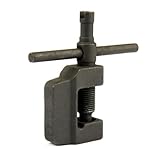
- Dedicated front sight clamp tool: A specialized C-clamp tool fits around the front sight hood and barrel. Turning a threaded screw presses against the sliding base, moving the sight smoothly sideways with high precision and zero hammering.
- Fine pencil or non-permanent scribe: Used to draw clear alignment marks across the sight seam so you can measure movements as small as a pencil line width.
- Penetrating lubricant: A small squeeze bottle of penetrating oil breaks down dried grease and loosens stubborn metal parts that have remained untouched for over half a century.
- Black heat-shrink tubing and razor blade: An inexpensive way to solve high-shooting rifles without permanently modifying the original military steel parts.
Modern Sight Upgrades: Fitting a Red Dot or Scout Mount
Tuning original iron sights is rewarding, but surplus open sights present real limits. The rear sight notch is narrow, the front post is thin, and aging eyes often struggle to keep both sights and a 100-yard target in sharp focus at the same time. If adjusting the factory posts does not deliver the accuracy you want, replacing the rear sight assembly with a modern optic setup is a practical alternative.
You do not need to drill holes into the receiver or damage the rifle to install an optic. Many shooters use a no-drill scout mount that fits directly into the existing rear sight base. You drive out the small cross pin holding the rear sight leaf, remove the flat leaf and its leaf spring, and drop an aluminum adapter rail into the empty channel. Cross pins and set screws lock the rail firmly in place against the original military base. If you ever want to return the rifle to its original historical condition, you simply remove the rail and reinstall the factory rear leaf and pin.
This rail conversion provides a standard Picatinny or 20mm slotted accessory rail positioned forward of the rifle bolt. Because the rail sits over the chamber rather than over the receiver, you cannot mount a traditional short eye relief rifle scope. Instead, this forward position is ideal for an open-window sight (a red dot) or an enclosed tube sight with unlimited eye relief. Lining up an aiming dot on your target removes the challenge of balancing front and rear sight alignment. You simply place the illuminated dot where you want the bullet to hit and squeeze the trigger.
If you enjoy using physical sights alongside modern glass, studying the best iron sights for cowitness with red dot sights explains how backup sights line up through the optic window for continuous aiming. When selecting an optic or adapter rail for a Mosin-Nagant, check that the mount includes heavy-duty stop pins and uses an inch-pound torque tool with medium-strength thread-locking fluid during installation. The stout recoil of the full-power 7.62x54R military cartridge produces sharp backwards acceleration, and quality mounting hardware prevents your optic from shifting off zero after every string of fire.

- ARS Mark10.0
ARS Mark is a ranking system developed by bestairriflescopes.com. ARS Mark has no relationship or impact from any manufacturers or sales agent websites. Learn more
- BrandSoviet Army

- ARS Mark-
ARS Mark is a ranking system developed by bestairriflescopes.com. ARS Mark has no relationship or impact from any manufacturers or sales agent websites. Learn more
- BrandCombat Optical

- ARS Mark7.2
ARS Mark is a ranking system developed by bestairriflescopes.com. ARS Mark has no relationship or impact from any manufacturers or sales agent websites. Learn more
- BrandGotical

- ARS Mark-
ARS Mark is a ranking system developed by bestairriflescopes.com. ARS Mark has no relationship or impact from any manufacturers or sales agent websites. Learn more
- BrandTACFUN

- ARS Mark-
ARS Mark is a ranking system developed by bestairriflescopes.com. ARS Mark has no relationship or impact from any manufacturers or sales agent websites. Learn more
- BrandGotical

- ARS Mark-
ARS Mark is a ranking system developed by bestairriflescopes.com. ARS Mark has no relationship or impact from any manufacturers or sales agent websites. Learn more
- BrandTACFUN
- ARS Mark-
ARS Mark is a ranking system developed by bestairriflescopes.com. ARS Mark has no relationship or impact from any manufacturers or sales agent websites. Learn more
- BrandTACFUN
Last update on 2026-09-30 / Affiliate links / Images, Product Titles, and Product Highlights from Amazon Product Advertising API
FAQs
Which way do I move the front sight if my Mosin shoots left?
You must tap the front sight post to the left. When adjusting a front sight, always move the post in the same direction as the error on the paper target. Shifting the front post left forces your barrel to point further right when you line up the sights, centering your group.
Why does my Mosin-Nagant shoot so high at 100 yards?
Military arsenals sighted these rifles for long-range combat rather than flat paper targets at short range. The factory battle zero was engineered so that aiming at a soldier's belt line would hit the torso out to 300 meters. At 100 yards, the arched bullet trajectory is still near its highest point above your line of sight.
Do I really need to shoot with the bayonet attached?
You do not need to attach the bayonet if you adjust the sights yourself. While Soviet factories zeroed the rifles with bayonets extended, drifting your front sight post slightly sideways will easily compensate for the missing muzzle weight. Once you adjust the front sight without the bayonet, the rifle will hit dead center every time you shoot bare-muzzled.


12 Best 22 Pcp Air Rifle For Hunting of 2026 With Quiet Power

7 Best 22 Pcp Air Rifle Under 300 of 2026 For Backyard Pest Control

10 Best 22 Break Barrel Air Rifles of 2026 For Backyard Pest Control

10 Best 30 Caliber Pcp Air Rifle of 2026 For Medium Game

Top Best 177 Air Rifle Under 100: Budget-Friendly Picks for 2026

How to Safely Reload Shotgun Shells at Home

11 Best Co2 Air Rifle For Pest Control of 2026 To Ensure Humane Dispatch

12 Best Inexpensive Air Rifles of 2026 For Dependable Backyard Accuracy






