
How Do You Aim a Shotgun with a Bead Sight?

An orange clay disk launches across the open sky, and a shooter instinctively squints one eye to line up the brass ball at the muzzle. The reality is that you point a shotgun rather than aiming it like a rifle. Resting your cheekbone firmly against the wood allows you to keep both eyes open, focus completely on the moving target, and let the front bead float softly in your lower vision.
Your approach changes depending on what you want to hit. Flying targets demand a smooth swing where you never look directly at the metal, while stationary targets like a turkey call for centering the bead flat along the barrel. Some shotguns even feature a second middle bead to help verify your eye height before calling for a bird. Setting your cheek in the exact same spot every time is what turns that simple bead into a reliable pointer.
Pointing Versus Aiming: The Cost of Staring at the Bead
New shotgun shooters often struggle because they treat a shotgun like a rifle. On a rifle, you align a rear sight notch with a front post, close your non-dominant eye, and focus sharply on the front blade. Trying that same technique with a shotgun bead on a moving clay pigeon or an upland bird almost always leads to a miss behind the target.
Rifles fire a single projectile at stationary or slow targets, requiring careful aiming. Shotguns work differently. A shotgun throws a spreading cloud of pellets at targets moving swiftly across your field of view. Shotgun shooting is therefore an act of pointing rather than aiming. You point a shotgun with your upper body just like pointing your index finger at an airplane. When you point your finger, you look at the plane, never at your fingernail.
Staring hard at the front bead causes two immediate problems. First, focusing on the bead destroys your depth perception and peripheral vision. Second, locking your eye onto the bead signals your brain that the sight picture is finished, which causes your swing to halt. A moving bird travels several feet in the split second between pulling the trigger and the pellets arriving downrange. If your barrel stops swinging, your shot pattern passes uselessly behind the target.
The front bead serves only as a soft reference point in your lower peripheral vision. Your conscious mind and sharp visual focus must stay locked on the leading edge of the target. As long as your head sits properly on the stock, your hands will steer the barrel where your eyes are looking.
Eye Alignment and Cheek Placement: Turning Your Eye into the Rear Sight
Because a standard shotgun lacks a rear sight notch, beginner shooters often ask how they can know the barrel is straight. The answer is simple: your dominant eye serves as the rear sight. Unlike setting up iron sights for cowitness on a tactical firearm where two physical sights align, a shotgun relies entirely on where your head rests against the stock.
If your eye sits too high above the barrel, your shot pattern lands high. If your head tilts to either side, your pellets drift off target. To hit consistently, your eye must arrive at the exact same spot behind the receiver on every mount. You accomplish this through a repeatable cheek weld, which means resting your cheekbone firmly against the gun stock.
Before practicing your gun mount at home, confirm that the shotgun is completely unloaded. Open the action, verify that the chamber and magazine tube are empty, and remove all live ammunition from the room. Stand in a balanced shooting stance and practice bringing the stock smoothly up to your cheek.
Follow this checklist to verify proper head placement and eye alignment:
- Bring the stock up to your cheek first: do not drop your head down to the gun; lift the shotgun so the comb presses firmly into the pocket beneath your cheekbone.
- Sight down the rib (the raised flat metal strip running along the barrel): your dominant eye should look straight down the center line of the rib.
- Look for a flat plane: the rib should appear almost completely flat, like looking down a level sidewalk, rather than looking down at an angled ramp.
- Keep both eyes wide open: two open eyes preserve your natural peripheral vision and depth perception, making it easier to track target speed.
- Check the bead position in your peripheral view: the bead should rest lightly at the end of the barrel without drawing your direct focus.
When your cheek weld is solid, your eye naturally aligns with the rib. You do not need to check whether the barrel is straight because your cheek locks the rear sight in place.
Tracking Moving Targets: Mounting, Swinging, and Setting Your Lead
Hitting a moving target with a bead sight requires a smooth, continuous sequence. If you rush your shot or jerk the barrel, your shot pattern will scatter off line. Successful shotgun shooting turns your upper body into a moving turret that pivots smoothly from the hips.
- Lock your visual focus onto the target before moving the gun. When a clay launches or a bird flushes, keep your eyes pinned to it. Pick a specific spot, such as the leading edge of the clay or the head of the bird. Do not glance at the receiver, your hands, or the bead. Let your eyes track the flight line so your brain can calculate speed and angle.
- Mount the shotgun smoothly along the target path. Push the muzzle forward along the flight path while raising the stock to your cheek. Keep your eyes on the target throughout the entire mount. The recoil pad should meet your shoulder pocket at the exact instant your cheekbone settles against the comb. At this point, the bead enters your peripheral vision naturally.
- Swing through the target to set your lead. Lead means shooting slightly ahead of a moving target so the target flies directly into the expanding shot pattern. Rotate your torso rather than swinging with just your arms. Start the barrel slightly behind or directly on the target, swing smoothly through it, and pull the trigger when you see daylight between the bead and the front edge of the target.
- Maintain follow-through after the shot. Follow-through is vital for consistent hits. Keep swinging the barrel along the target line even after pressing the trigger. If you stop the gun as the shot fires, your pellets will pass behind the target. Keep the gun moving, keep your cheek on the stock, and watch the target break before lowering the muzzle.
Two-Bead Shotguns, Slugs, and Correcting High Misses
Some shotguns feature two beads along the rib rather than a single front bead. These setups include a tiny mid-bead halfway down the barrel and a larger bead at the muzzle. A mid-bead provides a quick check of your eye alignment before you call for a target or step into the field.
When you mount a dual-bead shotgun correctly, the front bead should sit directly on top of the smaller mid-bead. This alignment creates a stacked figure-eight or snowman shape. If the front bead sits high above the mid-bead with open space between them, your cheek is resting too high on the comb, which makes the gun shoot high. If the mid-bead hides the front bead, your head is pressed too low, causing your shot pattern to strike low.
Stationary targets require a different technique. When hunting wild turkeys with extra-full chokes or shooting solid lead slugs at deer, you treat the shotgun much more like a rifle. Because the target is not moving, you do not need forward lead or a moving swing. Instead, align the front bead flat against the top center of the receiver groove, center the bead directly on your aiming spot, and squeeze the trigger smoothly without moving your head.
The most common reason shooters miss targets high is lifting their cheek off the stock right before pulling the trigger. This happens when you try to peek early to see the target break. Lifting your cheek even a quarter of an inch raises your eye, which tilts the muzzle upward and sends your shot pattern flying harmlessly over the target. Keep your cheekbone firmly pressed to the wood through the entire shot.
Choosing a Replacement Bead Sight for Better Visibility
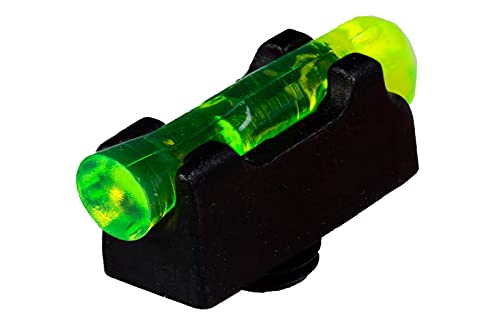
Standard shotguns typically ship with a small brass or silver bead pressed or threaded into the barrel. While a simple metal bead works fine under clear skies, it can easily disappear against dark timber, heavy brush, or dim evening light. Upgrading to a high-visibility fiber-optic front bead solves this problem by collecting ambient light into a bright, colorful dot.
These sights use light-gathering acrylic pipes that glow in red, green, or orange. Because the glowing dot stands out against dark backgrounds, your peripheral vision registers barrel position instantly without pulling your conscious focus away from the target.
When choosing a replacement front bead, check several key details before buying:
- Mounting method: Some sights attach magnetically to the steel rib, while others screw directly into the factory bead thread hole. Magnetic bases allow quick attachment without tools, while threaded replacements offer a permanent fit that withstands heavy recoil.
- Thread size compatibility: Shotgun makers use various thread sizes, including fine imperial threads like 3-56 or 6-48, as well as metric sizes like 3mm. Check your shotgun manual to confirm your barrel thread pitch before purchasing a threaded bead.
- Rib width: For clip-on or magnetic sights, measure the width of your barrel rib with a precise ruler or calipers. Rib widths differ between narrow field shotguns and wider competition models.
- Profile height: Choose a low-profile base that keeps the glowing pipe at the same height as your factory bead. A sight base that sits too high changes your point of impact and causes you to shoot lower than intended.

- ARS Mark9.0
ARS Mark is a ranking system developed by bestairriflescopes.com. ARS Mark has no relationship or impact from any manufacturers or sales agent websites. Learn more
- BrandHIVIZ

- ARS Mark9.0
ARS Mark is a ranking system developed by bestairriflescopes.com. ARS Mark has no relationship or impact from any manufacturers or sales agent websites. Learn more
- BrandHIVIZ

- ARS Mark8.8
ARS Mark is a ranking system developed by bestairriflescopes.com. ARS Mark has no relationship or impact from any manufacturers or sales agent websites. Learn more
- BrandHIVIZ

- ARS Mark8.8
ARS Mark is a ranking system developed by bestairriflescopes.com. ARS Mark has no relationship or impact from any manufacturers or sales agent websites. Learn more
- BrandDead Ringer
- ARS Mark8.6
ARS Mark is a ranking system developed by bestairriflescopes.com. ARS Mark has no relationship or impact from any manufacturers or sales agent websites. Learn more
- BrandHIVIZ

- ARS Mark8.4
ARS Mark is a ranking system developed by bestairriflescopes.com. ARS Mark has no relationship or impact from any manufacturers or sales agent websites. Learn more
- BrandNumrich

- ARS Mark7.8
ARS Mark is a ranking system developed by bestairriflescopes.com. ARS Mark has no relationship or impact from any manufacturers or sales agent websites. Learn more
- BrandTRUGLO

- ARS Mark4.6
ARS Mark is a ranking system developed by bestairriflescopes.com. ARS Mark has no relationship or impact from any manufacturers or sales agent websites. Learn more
- BrandWilliams
Last update on 2026-10-01 / Affiliate links / Images, Product Titles, and Product Highlights from Amazon Product Advertising API
FAQs
Should you shoot a shotgun with both eyes open?
Yes, you should keep both eyes open when shooting a shotgun with a bead sight. Keeping both eyes open gives you complete depth perception, helps you judge target speed accurately, and prevents tunnel vision. If you have cross-eye dominance where your non-shooting eye takes over, try placing a small patch of translucent tape on your shooting glasses over the non-dominant eye rather than squinting or closing it completely.
How should the bead look over the top of the barrel?
The bead should appear to sit directly on the top surface of the rib without any visible gap. When your cheek rests firmly on the stock, you should see a thin, flat line along the metal rib with the bead resting on the far edge. If the bead appears to hover high above the rib, your head is positioned too high on the comb and your shot pattern will land above the target.
Why do shots keep flying over the top of the target?
Shots usually fly over the target because the shooter lifts their cheek off the stock right as they pull the trigger. Peeking to watch the target break raises your eye, which instantly angles the barrel upward. Keep your cheekbone glued firmly to the stock comb throughout the shot and swing, letting your eyes watch the target break without lifting your head.


12 Best 22 Pcp Air Rifle For Hunting of 2026 With Quiet Power

7 Best 22 Pcp Air Rifle Under 300 of 2026 For Backyard Pest Control

10 Best 22 Break Barrel Air Rifles of 2026 For Backyard Pest Control

10 Best 30 Caliber Pcp Air Rifle of 2026 For Medium Game
Top Best 177 Air Rifle Under 100: Budget-Friendly Picks for 2026

How to Safely Reload Shotgun Shells at Home

11 Best Co2 Air Rifle For Pest Control of 2026 To Ensure Humane Dispatch

12 Best Inexpensive Air Rifles of 2026 For Dependable Backyard Accuracy






