
How to Align a Peep Sight on a Compound Bow?

Most archers assume a crooked peep sight means an immediate trip to a shop to compress the bow. That is rarely true for slight turns, because you can usually nudge the D-loop (the small rope loop where your release aid clips) or slide in a small string tuner to rotate the peep straight toward your eye.
The best approach depends on whether the peep uses rubber tubing or sits bare in the strands, and how far it turned sideways. Tube setups often just need a quick check for slack or binding. Bare peep sights on brand-new strings often twist as the material settles, while severe quarter-turns will eventually require a bow press (a clamp that relieves string tension safely) to add a half-twist to the main cord. Simple checks can help you fix the twist safely at home.
String Stretch and Release Torque Twist Your Peep Sight
A peep sight is a small aiming ring set inside the bowstring. When you pull your compound bow to full draw, your eye looks through this opening to align your front sight pins with the target. If the ring rotates sideways, you stare at string strands instead of your target. This issue comes down to two normal mechanical causes: natural string stretch and release torque.
Modern compound bowstrings consist of two synthetic thread bundles twisted together under high tension. When your string is new, or after sitting unused for months, those fibers stretch and settle. As fibers stretch, the spiral twist rate along the string shifts. Even a tiny stretch spins your peep sight away from your eye. Temperature changes also matter. If your bow sits in a hot truck or cold morning air, string wax softens or hardens, shifting string tension.
The second cause is torque from your release aid. Most archers clip their release onto a D-loop, which is a small rope loop where your release aid clips on. When you draw, your hand naturally pivots against your cheek or jawbone. If your D-loop knots are slightly loose or pull sideways, that twisting force travels straight up into the peep sight. Learning how to use a bow sight with steady accuracy requires a wide, round window, so clearing this rotation is your first step.
Nudge the D-Loop to Correct Minor Peep Rotation
When your peep sight is only slightly crooked, nudging the D-loop is the quickest correction. If the opening sits tilted between ten and forty-five degrees off center at full draw, adjusting the D-loop can straighten it without touching your bow limbs.
The D-loop pulls straight back toward your face as you anchor. Because the knots clamp firmly onto the center serving (the protective thread tightly wrapped around the bowstring), changing the resting angle of the loop forces the string to turn as you apply draw pressure. Follow these steps to adjust your loop by hand:
- Check the peep angle at full draw. Stand safely before a target backstop with an arrow nocked, draw your bow, and anchor your hand. Notice whether the peep sight leans left or right.
- Let down smoothly and inspect the D-loop knots. These knots are tied tightly around the center serving right behind your arrow nock point.
- Grip the base of the D-loop using a pair of needle-nose pliers or dedicated loop pliers. Hold the bow riser steady with your other hand.
- Nudge the D-loop knots slightly around the serving in the direction you need the peep sight to rotate. If your peep points right at full draw, turn the D-loop slightly left.
- Draw the bow again to verify alignment. The pull of your release aid will force the string to follow the D-loop, squaring the peep ring to your eye.
- Snug the knots firmly by inserting pliers inside the loop and opening the jaws. This locks the knots so they do not slip while shooting.
Slide Peep Tuner Spacers to Rotate Your Peep
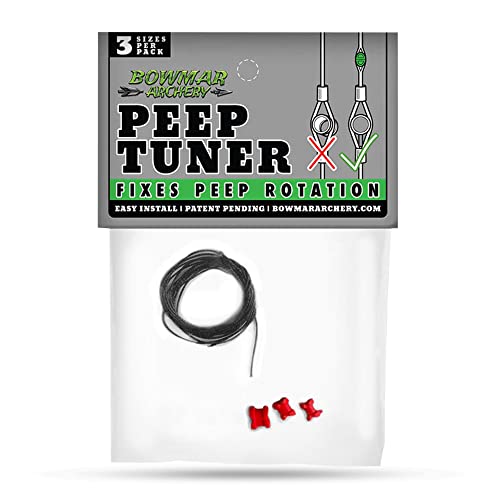
If adjusting the D-loop does not rotate the peep sight far enough, a peep tuner is an effective next step. A peep tuner is a small plastic wedge placed between string strands, usually sitting an inch or two above or below the peep sight. It allows you to correct stubborn rotation at home without needing a bow press.
Peep tuners work by gently separating the two strand bundles that form the bowstring. Inserting a small wedge between those bundles alters the balance of tension across individual fibers. That small shift forces the peep ring to rotate around its central axis. Follow these steps to install a peep tuner safely:
- Inspect your string to see which edge of the peep needs to turn forward. You want the opening to appear as a round circle rather than an oval slot.
- Select the proper spacer from your kit. Most sets include small, medium, and large wedges. Always start with the smallest wedge to avoid spreading fibers more than necessary.
- Find the natural split where the string divides into two color bundles, either two inches above or below your peep sight.
- Press the plastic wedge between the strand bundles using your fingers. Never use sharp metal tools like knives or screwdrivers, because metal edges can cut fibers.
- Slide the wedge along the string to fine-tune rotation. Sliding closer to the peep sight produces a larger turn, while sliding further away produces a smaller turn.
- Draw your bow safely to confirm that the opening faces squarely toward your eye. When the sight window is round, leave the tuner in place.
Inspect Rubber Peep Tubing for Proper Tension and Cracks
Many hunting bows rely on a self-aligning peep sight fitted with flexible rubber tubing. The top end connects to the peep ring, while the bottom connects to your downward bow cable. Every time you draw, the tubing stretches tight and pulls the peep sight straight. This design guarantees alignment, provided the tubing remains in good condition.
If your tube-style peep begins turning sideways or fluttering, use this quick checklist:
- Check tube length: At rest, the rubber tube should have just enough slack to avoid bending the string. If the tube is too loose, it will not build enough tension to pull the peep straight at full draw. If cut too short, it places extreme tension on the string, robs arrow speed, and can snap.
- Inspect for cracks and dry rot: Rubber tubing degrades over time from sunlight, heat, and wax. Bend the tubing gently near the attachment posts. If you spot tiny cracks, white chalky dust, or stiff spots, replace the tubing immediately.
- Verify the cable anchor connection: Check the clip or serving tie that secures the bottom of the tube to the downward cable. If that connector slips down, the pull angle flattens out, and the peep will stop turning vertical.
- Replace worn tubing proactively: Replacing your tubing once every year prevents mid-season breaks that could ruin a hunt or cause painful slaps to your hand.
If you prefer a tubeless setup, pair your bow with the best bow sight for treestand hunting to maintain clear visibility without relying on rubber parts that can snag on tree branches.
Add Half Twists in a Bow Press for Major Misalignment
When your peep sight faces completely sideways or backward, small adjustments like nudging a D-loop or sliding a tuner cannot resolve the issue. Major rotations of ninety to one hundred eighty degrees require adding or removing twists in the bowstring itself. Performing this task requires a bow press, which is a clamp tool that relieves string tension safely by pressing the bow limbs inward.
Compound bowstrings are twisted under tension during manufacturing. The twist count controls resting alignment. Adding a half-twist to the bowstring loop rotates the peep roughly one hundred eighty degrees. This is why technicians always work in half-twists rather than full twists. A full twist simply spins the string back to where you started, leaving the peep facing the same crooked direction.
Adjusting the string on a bow press involves removing one end loop from the cam peg. Adding a half-twist to the top loop turns the peep sight one direction. Removing a half-twist turns it the other way. If a half-twist on the top loop moves the peep too far, a technician can place that half-twist into the bottom loop instead. Because the bottom loop is further away, it produces a subtler shift at eye level.
Safety is critical whenever using a bow press. Modern compound bow limbs store immense kinetic energy. Never attempt to press a bow using makeshift tools like ratchet straps, pipe clamps, or car jacks. A slipping limb can cause severe injuries and destroy your bow. If you do not own an approved bow press, visit an archery pro shop where a technician can add twists safely.
Avoid Prying Strands and Never Dry Fire Your Bow
Straightening a peep sight is simple when you use the right steps, but rushing the process can ruin your bowstring or create dangerous hazards. Keep these precautions in mind whenever you work on your archery equipment:
- Never pry string strands with metal objects: Using keys, screwdrivers, or knife blades to separate strands cuts micro-fibers. Even one severed strand weakens the entire bundle, which can cause the string to snap under heavy draw weight.
- Never drag strands across peep grooves under tension: Peep sights feature string grooves that cradle the fiber bundles. Forcing strands across the peep while the bow is strung creates heavy friction. This friction burns away protective wax and frays the synthetic thread.
- Never dry fire your bow to check your sight window: Dry firing means releasing the bowstring without an arrow loaded. Without an arrow to absorb the energy, that force crashes directly into the limbs, cams, and string. Dry firing can crack limbs, warp cams, and tear strings apart.
- Check for loose serving thread: The serving is the protective thread wrapped tightly around high-wear sections of the bowstring. If the serving thread holding your peep sight or D-loop unravels, the peep will slide up and down or wander unpredictably.
- Confirm your anchor point before adjusting the bow: Sometimes a peep sight appears crooked simply because your hand position shifted. If your jaw does not rest firmly against the same bone reference point, your eye angle changes, making a straight peep look tilted.
Choose Simple Alignment Tools to Keep Bowstrings Straight Reliably
Maintaining a straight peep sight comes down to having durable sighting accessories installed on your bowstring. A few simple parts make it easy to keep your sight picture round and clear, whether you practice target shooting in your backyard or prepare for an archery hunting trip.
When selecting accessories to solve string rotation, look for slide-in string tuners made from molded plastic. The best spacers feature smooth, rounded edges that sit between fiber bundles without abrading the string. Choosing multi-size spacer sets lets you pick the exact wedge thickness needed to correct misalignments without adding noticeable weight.
If you prefer self-aligning peep setups, select flexible rubber or silicone tubing that resists dry rot. For tubeless peeps, choose models machined from lightweight aluminum with angled string channels, typically between thirty-seven and forty-five degrees to match your draw angle. Smooth string grooves minimize friction, protecting your bowstring from wear while keeping your sight window centered and clear on every shot.

- ARS Mark9.4
ARS Mark is a ranking system developed by bestairriflescopes.com. ARS Mark has no relationship or impact from any manufacturers or sales agent websites. Learn more
- BrandLuoyer

- ARS Mark9.4
ARS Mark is a ranking system developed by bestairriflescopes.com. ARS Mark has no relationship or impact from any manufacturers or sales agent websites. Learn more
- BrandG5 Outdoors
- ARS Mark8.8
ARS Mark is a ranking system developed by bestairriflescopes.com. ARS Mark has no relationship or impact from any manufacturers or sales agent websites. Learn more
- BrandBowmar Archery

- ARS Mark8.8
ARS Mark is a ranking system developed by bestairriflescopes.com. ARS Mark has no relationship or impact from any manufacturers or sales agent websites. Learn more
- BrandTRUGLO

- ARS Mark8.6
ARS Mark is a ranking system developed by bestairriflescopes.com. ARS Mark has no relationship or impact from any manufacturers or sales agent websites. Learn more
- BrandSOPOGER

- ARS Mark8.6
ARS Mark is a ranking system developed by bestairriflescopes.com. ARS Mark has no relationship or impact from any manufacturers or sales agent websites. Learn more
- BrandSOPOGER

- ARS Mark8.4
ARS Mark is a ranking system developed by bestairriflescopes.com. ARS Mark has no relationship or impact from any manufacturers or sales agent websites. Learn more
- BrandSPG

- ARS Mark7.4
ARS Mark is a ranking system developed by bestairriflescopes.com. ARS Mark has no relationship or impact from any manufacturers or sales agent websites. Learn more
- BrandHDWGGD
Last update on 2026-10-01 / Affiliate links / Images, Product Titles, and Product Highlights from Amazon Product Advertising API


12 Best 22 Pcp Air Rifle For Hunting of 2026 With Quiet Power

7 Best 22 Pcp Air Rifle Under 300 of 2026 For Backyard Pest Control

10 Best 22 Break Barrel Air Rifles of 2026 For Backyard Pest Control

10 Best 30 Caliber Pcp Air Rifle of 2026 For Medium Game

Top Best 177 Air Rifle Under 100: Budget-Friendly Picks for 2026

How to Safely Reload Shotgun Shells at Home

11 Best Co2 Air Rifle For Pest Control of 2026 To Ensure Humane Dispatch

12 Best Inexpensive Air Rifles of 2026 For Dependable Backyard Accuracy






