
How To Bore Sight A Scope At Home

A freshly mounted optic sits firmly in its rings on the workbench, but looking through the glass offers no clue where that first bullet will land. Bore sighting fixes this before burning expensive ammunition: secure the unloaded rifle in a solid rest, spot a target down the hollow barrel, and dial the scope crosshairs to match that exact mark. That simple alignment ensures your first shot hits the paper backer.
How you line things up depends on the firearm action. Bolt-action rifles let you slide the bolt out and sight through the barrel with your naked eye, while closed-action rifles need a simple laser insert or muzzle tool. Setting your target at twenty-five yards keeps bullet drop out of the equation. Here are the clear steps to get your crosshairs lined up safely before heading out to shoot.
How do I set up and clear the firearm safely?
Safety comes before everything else. You will look directly into optics and work around the muzzle of your firearm. Before placing your rifle on the bench, remove the ammunition magazine completely. Open the action, pull the bolt back, and look directly into the chamber. Feel inside the chamber with your finger to guarantee no live cartridge remains inside. Store all live ammunition boxes and loose rounds in another room.
Once the gun is completely unloaded, secure it so it cannot move. If the firearm shifts while you adjust your optics, your sight alignment will fail. A tiny wobble at the bench turns into feet of error downrange. Use a solid rifle vise, a pair of heavy sandbags, or a padded shooting rest on a sturdy table.
Inspect your optic mounting hardware before you start aligning crosshairs. Check that your scope rings sit square on your standard Picatinny or 20mm slotted accessory rails. Use an inch-pound torque tool to tighten mounting screws to the manufacturer rating, and apply thread-locking fluid so firearm recoil does not shake the optic loose later. Finally, hang a high-contrast target 25 yards away on a safe backer.
Check your setup with this simple safety checklist:
- Remove the magazine and empty the chamber completely.
- Inspect the empty chamber with your eyes and finger.
- Move all live ammunition into a separate room.
- Lock the rifle into a firm bench rest or sandbags.
- Tighten mounting screws with an inch-pound torque tool.
- Hang a bold, high-contrast target 25 yards away.
Can I bore sight a rifle without buying special tools?
You do not need specialty gear if you own a bolt-action rifle. A bolt-action rifle allows you to look straight down the barrel from the rear of the receiver. The bore is the hollow inside of the barrel, and your eye can align that hollow tube with a distant target remarkably well. This visual method costs nothing and gets your shots landing on target paper reliably.
Set up your rifle in your rest and follow these numbered steps:
- Remove the bolt from the rifle. Open the bolt, pull it rearward, and press the release lever on the side of the receiver to slide the bolt completely out of the gun.
- Look straight through the bore. Place your eye several inches behind the empty receiver opening and look through the hollow inside of the barrel toward your 25-yard target. You will see a small, round circle of light.
- Center the bullseye in the barrel. Shift your gun rest until the target bullseye sits dead center in that circle of light. Check that the gap between the target circle and the barrel edge looks even all the way around.
- Look through the optic without bumping the rifle. Carefully lift your head up to the scope glass. Look at the reticle, which is the crosshairs or aiming dot inside your optic.
- Adjust your scope dials to match the bore. Turn the windage (the left-to-right adjustment click dial) and elevation (the up-and-down adjustment click dial) until the crosshairs sit directly on the target bullseye.
- Drop back down to verify. Look down the barrel bore once more to confirm the rifle did not move, then look through the scope again to verify that your crosshairs still rest on the bullseye.
Take your time when lifting your head. Bumping the stock with your cheek is the most common mistake. If the gun moves at all, realign the barrel with the target before turning your dials.
How do I bore sight a closed action rifle?
Many firearms do not give you a straight view down the barrel. Semi-automatic rifles, lever-action guns, pump-action rifles, and handguns have closed receivers or internal hammer parts that block your view. For these guns, you need a bore sighting tool that projects an aiming point from the muzzle or chamber.
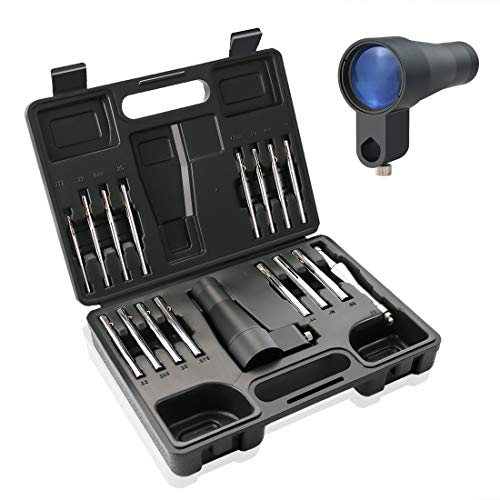
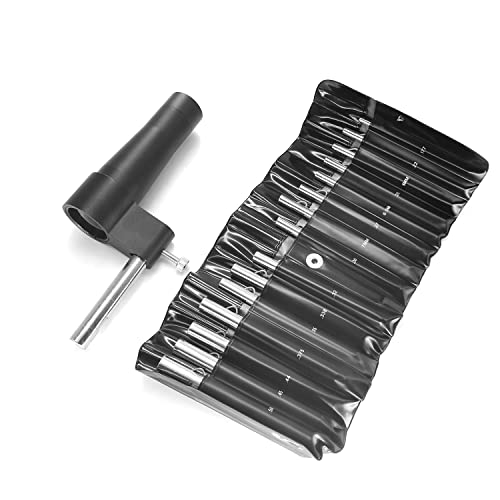
There are two main tool styles. Laser bore sighters project a red or green dot onto a distant target. Optical bore sighters use an arbor, which is an expanding metal rod inserted into the muzzle, holding an optical grid box directly in front of the scope objective lens. Both tools show where the hollow inside of the barrel points without firing a shot.
Follow these steps when using a muzzle bore sighting tool:
- Select the proper adapter or arbor. Choose the expanding adapter from your kit that matches your barrel diameter, attach it to the tool stem, and snug it in place.
- Insert the tool into the muzzle. Slide the arbor into the front of the barrel so it seats firmly against the crown with zero wobble. A loose arbor will sag and give a false reading.
- Turn on the unit and aim at the target. Switch on the laser and direct the beam at your 25-yard target, or view the internal grid if using an optical arbor tool.
- Align the optic crosshairs to the tool. Look through your scope eyepiece at the reticle. Turn your left-to-right and up-and-down adjustment click dials until the crosshairs rest squarely over the laser dot or center grid mark.
- Remove the tool immediately. Once your crosshairs sit on the dot, switch the tool off and slide it out of the muzzle. Put the tool away in its case before bringing ammunition near the bench.
Leaving a muzzle tool in the barrel is an extreme safety hazard. Firing a live round with an arbor inside the muzzle will destroy the barrel and cause severe injury. Make removing the tool an automatic safety habit every time.
Which way do I turn the scope adjustment dials?
Turning scope dials confuses many shooters because scopes are built to adjust bullet impacts during live fire, not reticles during bench setup. Your optic features two dials under protective caps or exposed as finger-turn turrets. The top dial controls elevation, which is your up-and-down adjustment click dial. The side dial controls windage, which is your left-to-right adjustment click dial.
Scope dials have arrows labeled UP and R for right. During live-fire shooting, turning toward UP raises your bullet impact on paper. But when bore sighting at your bench, the gun is stationary and no bullets are flying. You are physically moving the reticle (the crosshairs or aiming dot) to meet the point where the barrel already points.
When you turn the elevation dial toward UP, the crosshairs move downward in your sight picture. When you turn the windage dial toward R, the crosshairs move left. If your crosshairs sit higher than your laser dot, turn elevation toward UP to lower them. If your crosshairs sit to the right of your laser dot, turn windage toward R to pull them left toward the dot.
If your optic uses an aiming dot instead of crosshairs, dot size affects your sight picture. Dot size is measured in MOA, which stands for minutes of angle. MOA measures how much of the target the dot covers. A fine 2 MOA dot covers about 2 inches at 100 yards, or half an inch at 25 yards, which gives you a sharp aiming point for precision shooting. A larger 4 to 6 MOA dot covers more space, making it faster to pick up for close-range defense but slightly harder to align on small target spots.
Turn your dials slowly and count the clicks. Never force a dial if it starts to feel stiff. Forcing a turret past its internal travel limits can strip adjustment threads inside the optic housing and ruin your scope.
Why must I still fire live rounds after?
Bore sighting only gets your initial shots onto paper. It does not replace live-fire zeroing. Zeroing means adjusting the dot so your shots land exactly where the dot points at a set distance, such as 25 yards for handguns or 50 to 100 yards for hunting rifles. Bore sighting provides a reliable starting baseline, but it cannot account for real-world ballistics.
A laser travels in an absolute straight line, but a real bullet does not. Gravity pulls a fired bullet downward in an arc. Burning gunpowder also creates barrel whip, micro-vibrations, and recoil forces that subtly steer the bullet as it exits the muzzle. Different ammunition brands and bullet weights also impact targets at noticeably different points.
Take your bore-sighted rifle to a shooting range to finish zeroing. Fire a three-shot group at 25 yards. Your bullets should land on the paper backer within a few inches of your aiming point. Measure the distance from the group center to the bullseye, and click your windage and elevation dials to walk the bullet impact to the center. Once centered at 25 yards, move out to 100 yards for final adjustments. If your rifle uses an enclosed tube sight or open-window reflex sight, you can also practice lining up your backup iron sights through the optic glass to establish a dependable secondary sighting reference.
What should I look for in a bore sighter?
Choosing a bore sighter depends on the firearms you own and where you plan to align your optics. If you mount scopes on semi-automatic rifles, lever-action carbines, shotguns, or handguns, a quality bore sighting kit saves hours of range frustration and prevents wasted boxes of costly ammunition.
Pay close attention to how the tool mounts to your barrel. Universal muzzle kits use interchangeable rubber or metal adapters that expand inside the muzzle to fit calibers ranging from small .17 rimfire barrels up to large 12-gauge shotguns. Check that the adapters provide a tight, square seat against the crown so the tool does not droop. Laser color also matters. Red lasers work well across indoor rooms, while bright green lasers remain visible outdoors in daylight. Push-button switches and rechargeable power options make regular bench setup much simpler than managing loose button cells.

- ARS Mark9.2
ARS Mark is a ranking system developed by bestairriflescopes.com. ARS Mark has no relationship or impact from any manufacturers or sales agent websites. Learn more
- BrandVisiofire

- ARS Mark9.0
ARS Mark is a ranking system developed by bestairriflescopes.com. ARS Mark has no relationship or impact from any manufacturers or sales agent websites. Learn more
- Brandmoloxo

- ARS Mark9.0
ARS Mark is a ranking system developed by bestairriflescopes.com. ARS Mark has no relationship or impact from any manufacturers or sales agent websites. Learn more
- BrandDespwolf

- ARS Mark8.8
ARS Mark is a ranking system developed by bestairriflescopes.com. ARS Mark has no relationship or impact from any manufacturers or sales agent websites. Learn more
- BrandCVLIFE

- ARS Mark8.8
ARS Mark is a ranking system developed by bestairriflescopes.com. ARS Mark has no relationship or impact from any manufacturers or sales agent websites. Learn more
- BrandMCREHOTZ

- ARS Mark8.8
ARS Mark is a ranking system developed by bestairriflescopes.com. ARS Mark has no relationship or impact from any manufacturers or sales agent websites. Learn more
- BrandCVLIFE
- ARS Mark8.8
ARS Mark is a ranking system developed by bestairriflescopes.com. ARS Mark has no relationship or impact from any manufacturers or sales agent websites. Learn more
- BrandCVLIFE

- ARS Mark8.6
ARS Mark is a ranking system developed by bestairriflescopes.com. ARS Mark has no relationship or impact from any manufacturers or sales agent websites. Learn more
- BrandEZshoot
- ARS Mark8.4
ARS Mark is a ranking system developed by bestairriflescopes.com. ARS Mark has no relationship or impact from any manufacturers or sales agent websites. Learn more
- Brandxaegistac
- ARS Mark7.8
ARS Mark is a ranking system developed by bestairriflescopes.com. ARS Mark has no relationship or impact from any manufacturers or sales agent websites. Learn more
- BrandCOSMOING
Last update on 2026-10-01 / Affiliate links / Images, Product Titles, and Product Highlights from Amazon Product Advertising API
FAQs
How far away should my target be during bore sighting?
A distance of 25 yards is the standard initial distance for bore sighting rifles and shotguns. At 25 yards, you can easily spot your target bullseye through the barrel or see a laser dot on paper. This distance also closely matches the point where a bullet's upward flight path intersects your optic sightline.
Can I bore sight a handgun with a red dot sight?
Yes, you can bore sight a handgun red dot using a universal muzzle laser or an arbor kit sized to your barrel caliber. Aligning the dot with the laser at 15 to 25 yards puts your aiming point on paper for your first live shots. If you are mounting an optic on a target pistol, finding an accurate red dot for target pistols like the Ruger Mark series pairs smoothly with a quick bench bore sighting routine.
What should I do if my scope dials run out of clicks?
If your windage or elevation dial stops clicking before your reticle aligns with the bore, stop turning immediately to avoid stripping internal gears. This problem almost always indicates that your scope base, mounting rings, or adapter plate are misaligned on the receiver. Loosen your mounting screws, verify that the rings sit flat on the rail, and check that your scope tube is not pinched.
What happens if I forget to remove the bore sighter before shooting?
Leaving a bore sighter inside the barrel when firing a live round creates a catastrophic barrel obstruction. The high-pressure gas behind the bullet will rupture the barrel steel, destroy the firearm, and cause severe personal injury. Always slide the tool out of the muzzle and store it in its case before bringing live ammunition near your firearm.


12 Best 22 Pcp Air Rifle For Hunting of 2026 With Quiet Power

7 Best 22 Pcp Air Rifle Under 300 of 2026 For Backyard Pest Control

10 Best 22 Break Barrel Air Rifles of 2026 For Backyard Pest Control

10 Best 30 Caliber Pcp Air Rifle of 2026 For Medium Game
Top Best 177 Air Rifle Under 100: Budget-Friendly Picks for 2026

How to Safely Reload Shotgun Shells at Home

11 Best Co2 Air Rifle For Pest Control of 2026 To Ensure Humane Dispatch

12 Best Inexpensive Air Rifles of 2026 For Dependable Backyard Accuracy






