
How to Bore Sight at 25 Yards to Hit Paper

To bore sight at 25 yards, lock the unloaded firearm in a steady rest and adjust the sight until the aiming dot matches the center of the barrel. That initial alignment reliably puts your first shot on paper, though the exact method changes depending on whether you look directly through an open chamber or project a beam with a laser tool. Doing this beforehand saves expensive ammunition and spares you the frustration of shooting blindly.
Your optic height also changes the picture. Because the glass sits higher than the barrel, leaving the dot an inch or two above the bore line at close range prevents overcorrecting. Outdoor sunlight matters as well, since bright daylight can wash out a small red beam before you can spot it on target. Here is how to complete the setup safely and line up your sights with confidence.
Safety Checks and Bench Setup
Setting up your rifle or handgun before bore sighting prevents accidents and keeps you from chasing false adjustments. If your firearm moves even a fraction of an inch while you turn dials, your work at twenty-five yards will not carry over to the target. Take a few minutes to prepare your bench before looking through your glass.
- Remove all live ammunition: Take every magazine out of the firearm and move all live rounds to another room. Check the chamber with your eyes and your finger to confirm it is empty.
- Clear your line of sight: Make sure the path between your bench and the 25-yard target is clear of obstacles and people. Always treat the muzzle as if it could fire, even when you know the gun is unloaded.
- Lock the firearm into a sturdy rest: Place your gun into a bench vise, shooting rest, or firm sandbags. The firearm must stay completely level and motionless without your hands touching it.
- Level your reticle: Look through your optic to confirm the aiming dot or crosshairs sit level. An optic mounted at a tilt causes horizontal shifts whenever you adjust vertical elevation dials.
A wobbly bench or soft rifle rest is the primary reason bore sighting fails. If you bump the gun while turning a dial, re-center the rifle in the rest before you touch another knob.
Choosing Between Visual Sighting and Laser Tools
You do not always need special gear to bore sight a firearm. The method you choose depends on the design of your action and whether you can look straight down the inside of the barrel with your naked eye.
Visual bore sighting costs nothing and works well on bolt-action rifles. You remove the bolt from the receiver, look through the back of the action, and center a distant target through the barrel tube. You can also do this on an AR-style rifle by pulling the rear takedown pin, removing the bolt carrier group, and looking through the upper receiver. This method requires an unobstructed line from breech to muzzle, so it does not work on closed-receiver lever guns, pump actions, or semi-automatic handguns.
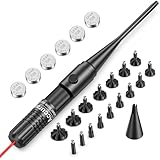
Laser bore sighters solve that problem by projecting a visible beam straight down the barrel. Cartridge-style units look like regular brass ammunition and chamber directly into the breech. Universal muzzle tools attach to the front of the barrel using expanding arbors that fit snug inside the rifling. If you use backup iron sights alongside your optic, you can also align iron sights for cowitness with red dot sights during this bench session so both aiming points match.
How to Align Your Sight at 25 Yards Step by Step
Follow these steps to align your red dot or scope to your barrel at twenty-five yards. Take your time with each step so you only have to do this once before heading to the firing line.
-
Set up a high-contrast target backer at twenty-five yards.
Hang a grid target with a bold bullseye or reflective tape at the center. Reason: Daylight can wash out red laser dots, so a dark bullseye or reflective tape helps you spot the beam quickly at distance.
-
Clamp your unloaded firearm securely in the rest.
Rest the rifle on solid bags or clamp it into a vise so it points directly toward the target without your support. Reason: You need both hands free to turn optic dials without nudging the barrel off target.
-
Center the target through the bore or activate your laser.
If sighting visually, look down the barrel and center the bullseye in the circle of the bore. If using a laser tool, switch it on and place the laser dot on the bullseye. Reason: Establishing the bore center creates the baseline that your optic needs to match.
-
Look through your optic without moving the firearm.
Look through the glass while keeping the gun completely still. Note where your aiming dot sits compared to the laser point or centered bullseye. Reason: Checking this gap shows you exactly which dials need turning.
-
Adjust the elevation dial until the vertical gap closes.
Turn the up-and-down adjustment dial on top of your optic to bring the aiming dot level with your target reference. Reason: Matching vertical alignment first makes it simpler to judge your horizontal line.
-
Adjust the windage dial to eliminate horizontal error.
Turn the side adjustment dial to align your aiming dot directly over the laser beam or visual center. Reason: Centering the horizontal plane prevents your live rounds from drifting off the paper to the left or right.
-
Verify your alignment one last time.
Look down the bore or check that the laser is still on the bullseye, then look back through your glass. Reason: Turning stiff optic turrets can twist the rifle slightly in the rest, throwing your adjustments off.
Accounting for Height Over Bore at 25 Yards
A common mistake at twenty-five yards is forcing the aiming dot to sit directly on top of the laser beam. While that looks aligned, it ignores height over bore, which is the physical gap between the center of your barrel and the center of your optic lens.
A rifle barrel sends a bullet out along one line, while your sight sits one to two and a half inches higher. Because light travels in a straight line while bullets travel in an arc, the sight line and the barrel line must intersect downrange. If you place a red dot directly on top of a laser beam at twenty-five yards on a rifle with a tall mount, your barrel angles downward relative to the sight. When you later shoot at one hundred yards, your bullets will strike much lower than expected.
To set a reliable baseline at twenty-five yards, check the gap between your barrel center and your optic window. For standard hunting rifles with low scope rings, having the reticle sit about half an inch above the laser beam gives a practical starting point. For modern sporting rifles where the optic sits two inches above the bore, adjust your aiming dot so it hovers roughly an inch above the laser dot. This keeps the sight line close to parallel with the barrel.
Moving from Bore Sighting to Live-Fire Zeroing
Bore sighting gets your firearm pointed close enough to hit paper, but it never replaces live-fire zeroing. A bore sight only aligns straight lines. It cannot account for bullet drop, powder charge, barrel vibration, or recoil.
Before loading a single live round, take your bore sighting tool out of the firearm. If you used a cartridge-style laser, eject it and put it away. If you used a muzzle-end arbor kit, remove it from the barrel tip immediately. Leaving an arbor or tool in the muzzle creates a severe barrel obstruction that can destroy the firearm and cause injury when fired.
Once the barrel is clear, fire a careful three-shot group at your 25-yard target from a supported rest. For small-caliber pistols, such as when zeroing a red dot sight for a Ruger Mark pistol, a steady rest shows your exact cluster right away. Measure the distance from the center of your group to the bullseye, then adjust your dials to walk the group onto the bullseye. Most optics adjust in quarter-inch clicks at one hundred yards, which equals one-sixteenth of an inch per click at twenty-five yards.
What to Look for in a Bore Sighting Tool
If you plan to buy a bore sight tool, look for practical features that fit the firearms you own. Cartridge-style laser sighters chamber like regular brass, providing consistent centering inside the chamber. If you shoot multiple calibers, however, purchasing individual cartridge units gets expensive. A universal arbor kit with interchangeable plastic or rubber adapters fits many different barrel diameters, from small rimfire bores up to 12-gauge shotguns.
Check the laser color and switch design as well. Green lasers remain much easier to see in bright daylight at twenty-five yards than red lasers. Look for tools with a simple push-button or rotary power switch. A dedicated switch preserves battery life and saves you from fumbling with small batteries while working at your bench.

- ARS Mark8.8
ARS Mark is a ranking system developed by bestairriflescopes.com. ARS Mark has no relationship or impact from any manufacturers or sales agent websites. Learn more
- BrandARKSight

- ARS Mark-
ARS Mark is a ranking system developed by bestairriflescopes.com. ARS Mark has no relationship or impact from any manufacturers or sales agent websites. Learn more
- BrandSAWKE

- ARS Mark8.0
ARS Mark is a ranking system developed by bestairriflescopes.com. ARS Mark has no relationship or impact from any manufacturers or sales agent websites. Learn more
- BrandGotical

- ARS Mark-
ARS Mark is a ranking system developed by bestairriflescopes.com. ARS Mark has no relationship or impact from any manufacturers or sales agent websites. Learn more
- BrandMOSANDON

- ARS Mark-
ARS Mark is a ranking system developed by bestairriflescopes.com. ARS Mark has no relationship or impact from any manufacturers or sales agent websites. Learn more
- BrandSAWKE
- ARS Mark-
ARS Mark is a ranking system developed by bestairriflescopes.com. ARS Mark has no relationship or impact from any manufacturers or sales agent websites. Learn more
- BrandEZshoot

- ARS Mark-
ARS Mark is a ranking system developed by bestairriflescopes.com. ARS Mark has no relationship or impact from any manufacturers or sales agent websites. Learn more
- BrandMOSANDON

- ARS Mark-
ARS Mark is a ranking system developed by bestairriflescopes.com. ARS Mark has no relationship or impact from any manufacturers or sales agent websites. Learn more
- Brandmoloxo

- ARS Mark-
ARS Mark is a ranking system developed by bestairriflescopes.com. ARS Mark has no relationship or impact from any manufacturers or sales agent websites. Learn more
- BrandEZshoot

- ARS Mark-
ARS Mark is a ranking system developed by bestairriflescopes.com. ARS Mark has no relationship or impact from any manufacturers or sales agent websites. Learn more
- BrandEZshoot

- ARS Mark-
ARS Mark is a ranking system developed by bestairriflescopes.com. ARS Mark has no relationship or impact from any manufacturers or sales agent websites. Learn more
- BrandCVLIFE

- ARS Mark-
ARS Mark is a ranking system developed by bestairriflescopes.com. ARS Mark has no relationship or impact from any manufacturers or sales agent websites. Learn more
- BrandEZshoot

BoreSighter for 223/9MM/7.62X39MM/30-30/30-06/.25/270/243/308/7MM/45ACP Colt Caliber Rifle Scope Handgun Brass Red
View on Amazon- ARS Mark-
ARS Mark is a ranking system developed by bestairriflescopes.com. ARS Mark has no relationship or impact from any manufacturers or sales agent websites. Learn more
- BrandStrongTools

- ARS Mark-
ARS Mark is a ranking system developed by bestairriflescopes.com. ARS Mark has no relationship or impact from any manufacturers or sales agent websites. Learn more
- BrandFeyachi

- ARS Mark-
ARS Mark is a ranking system developed by bestairriflescopes.com. ARS Mark has no relationship or impact from any manufacturers or sales agent websites. Learn more
- BrandEZshoot
Last update on 2026-10-01 / Affiliate links / Images, Product Titles, and Product Highlights from Amazon Product Advertising API
Frequently Asked Questions
Can I bore sight a firearm without buying a laser tool?
Yes, you can visually bore sight any firearm that lets you see straight through the barrel from the breech. Bolt-action rifles and break-action shotguns work well once you remove the bolt or open the action. Closed-receiver firearms like lever guns, pump shotguns, and semi-automatic pistols need a laser tool because the receiver blocks your view.
Should my red dot sit directly on top of the laser beam at 25 yards?
On rifles with tall optic mounts, your aiming dot should usually sit about an inch above the laser beam rather than directly on it. This offset accounts for the physical gap between the optic lens and the barrel center. Setting the reticle slightly above the laser at close range keeps the sight line closer to parallel with the barrel.
Why did my first live shot hit a different spot than the laser?
A laser travels in a perfectly straight line, but live bullets drop from gravity and react to barrel vibration. Bore sighting only aligns the mechanical axis of the barrel to your sight so you hit the paper backer on your first shot. You still need live rounds to set your final zero for your specific ammunition.
What should I do if the red laser is hard to see in bright sunlight?
Bright sunlight can wash out a red laser beam at twenty-five yards. You can make the beam visible by placing a piece of retro-reflective tape or a dark target on your backer board. You can also bore sight in lower light, such as early morning or indoors, or use a brighter green laser tool.


12 Best 22 Pcp Air Rifle For Hunting of 2026 With Quiet Power

7 Best 22 Pcp Air Rifle Under 300 of 2026 For Backyard Pest Control

10 Best 22 Break Barrel Air Rifles of 2026 For Backyard Pest Control

10 Best 30 Caliber Pcp Air Rifle of 2026 For Medium Game

Top Best 177 Air Rifle Under 100: Budget-Friendly Picks for 2026

How to Safely Reload Shotgun Shells at Home

11 Best Co2 Air Rifle For Pest Control of 2026 To Ensure Humane Dispatch

12 Best Inexpensive Air Rifles of 2026 For Dependable Backyard Accuracy






