
How to Sight In a BB Gun in 20 Minutes

Rest the gun firmly at five yards. Chasing single stray shots while standing creates endless frustration, so prop the frame on a folded towel, shoot a three-shot cluster, and move the sight where you want the BBs to go. Firing from a steady surface shows where the barrel actually points instead of tracking natural hand wobble.
The exact adjustments depend on whether the airgun has basic open notch sights or a modern red dot, since glass optics use turn dials while iron sights slide along tiny notches. Shooting distance also changes your results, because smooth steel BBs drift quickly in the breeze past fifteen or twenty feet. Firm support from a table keeps the gun still so you can correct your aim with confidence. Here is how to line everything up step by step.
Setting Up a Safe Backstop at Five Yards
Before you touch an adjustment screw or load a single shot, you need your target set up at the right distance with a proper backstop. Five yards, which is exactly fifteen feet, is the golden distance for zeroing any standard BB gun. At five yards, the steel ball leaves the muzzle with enough speed to fly relatively flat, but it has not traveled far enough for air currents or smoothbore wobble to push it off course. If you try to zero your gun at fifteen or twenty yards right out of the box, your shots will scatter all over the paper, and you will never know whether your sights are off or the wind simply carried the shot.
Steel BBs behave very differently from soft lead pellets or firearm bullets. Because they are hard steel spheres, they do not crush or deform when they hit an object. Instead, they bounce straight back toward you if they strike hard wood, drywall, patio stone, or thick sheet metal. Setting up your zeroing lane safely requires just a few basic precautions:
- Pick a flat, safe target distance of five yards: Measure out fifteen feet from the tip of your barrel to the face of your target. This distance keeps your groups compact so you can read your sight adjustments clearly.
- Use a dedicated trap or a packed cardboard box: A metal airgun catch trap or a heavy cardboard box stuffed tightly with old towels, denim jeans, or layers of thick cardboard will stop steel BBs in their tracks without throwing ricochets back at you.
- Hang a fresh paper target with a bold center mark: Use a target with high contrast, such as a black bullseye on clean white paper. You need to see the tiny puncture holes clearly from your shooting seat without walking up to the target after every single pull of the trigger.
- Ensure a wide, empty safety zone behind the trap: Position your backstop against a dirt berm, a brick wall, or an open, fenced yard where no people, pets, or vehicle glass can cross the line of fire.
- Put on safety glasses before loading: Every person in the yard or garage must wear eye protection. Steel BBs can rebound off cardboard frame clips, clothes pins, or target stands at surprising speeds.
Why You Must Rest the Gun on a Solid Surface
The single biggest mistake backyard shooters make is trying to sight in a gun while standing up and holding it off-hand. When you stand freehand, your arms shake, your shoulders get tired, your breathing moves the barrel, and your finger pulls the trigger with slight sideways pressure. These natural human movements can easily shift the muzzle by an inch or two at short range. If you miss the bullseye while standing, you have no way of knowing whether the sights are crooked or your hands simply wobbled as the sear released.
To eliminate your own body movement, you must support the airgun on a rock-solid, flat surface. You do not need fancy shooting range equipment to do this. A sturdy picnic table, a folding work bench, or even a porch rail can serve as your shooting platform. Sit comfortably in a chair so your body is relaxed, with both feet flat on the ground. You should never feel like you are stretching your neck or hunching your back to look through the sights.
Place a steady rest on the table to cradle the gun. A pair of rolled bath towels, a small canvas bag filled with dry rice, or a heavy backpack works just as well as a commercial shooting bag. Rest the forearm of the stock on the bag, and let the bottom of your shooting hand or the pistol grip rest gently on the table. Do not clamp the barrel down directly on hard wood or metal, because the sudden jump of the spring or CO2 blast can bounce the barrel off a hard surface and throw the shot high. Let the soft cloth cushion the gun, hold the grip with light, steady pressure, and let the rest hold the weight of the rifle.
How to Sight In Your BB Gun in Five Simple Steps
Zeroing is a step-by-step process of eliminating guesswork. Instead of moving the dials after every stray shot, follow this systematic routine to find your true center of impact quickly.
- Rest the airgun securely and center your sights on the bullseye.
Reason: Supporting the gun on a soft sandbag or rolled towel removes your body tremor, guaranteeing that every shot reflects where the barrel is actually pointed rather than your hand wobble. - Fire three shots at the exact same aiming point without moving the gun or touching the sights.
Reason: A single shot can easily be a stray flyer caused by a deformed BB or a slight flinch, but a three-shot cluster reveals the true mechanical pattern of your barrel. - Locate the center of the three-shot cluster on your paper target.
Reason: You must adjust your sights based on the middle of your group of holes, not on an individual hole that may have landed an inch away from the other two. - Move your rear sight notch or red dot adjustment dials toward the group of holes.
Reason: Moving the rear sight or dot reticle in the direction of the error shifts your aiming point directly over where the barrel is currently throwing the BBs. - Fire a second three-shot confirmation group at the center bullseye.
Reason: This second group confirms whether your adjustments moved the impact point directly into the bullseye before you finish your session.
Which Way to Turn Your Sights or Red Dot Dials
Adjusting sights confuses almost everyone at first because different sight styles follow different rules. The good news is that the mechanics are straightforward once you understand how the sight lines up with the target.
If your BB gun has open iron sights, you have a front post near the muzzle and a rear notch near your eye. You almost always make your adjustments on the rear sight. The universal rule for open sights is simple: move the rear sight in the direction you want the holes to move on the target. If your three-shot group landed two inches to the left of the bullseye, you need your shots to move right, so you slide or screw your rear notch to the right. If your shots landed low, raise the rear sight notch up. If you are learning how open sights interact with glass optics, understanding the best iron sights for cowitness with red dot sights can show you how iron posts align directly through the center of a viewing window.
Red dot sights use two dials protected by screw caps. The dial on top controls elevation, which is the up-and-down adjustment. The dial on the side controls windage, which is the left-to-right adjustment. Most red dot dials feature small arrows stamped into the metal marked "UP" and "R" (Right). These markings tell you which way turning the dial will move the point of impact on the paper. For instance, if your three-shot cluster is landing low and to the left of your bullseye, you must turn the top dial toward "UP" and the side dial toward "R".
Because you are shooting at a short distance of five yards, sight adjustments feel very sensitive. Standard red dot dials are built for firearms at 50 or 100 yards, where one click moves the shot a fraction of an inch. At five yards, a single click moves the hit by a microscopic distance, so you may need to turn the dial five to ten audible clicks to see a noticeable shift on your paper. Make gradual adjustments, keep track of how many clicks you turn, and resist the urge to crank the screws all the way to their stopping points.
Understanding the Accuracy Limits of Smoothbore BB Guns
If you fire three shots from a rested BB gun and the holes do not touch each other, do not panic. Your gun is not broken, and your sights are probably fine. BB guns behave very differently from match pellet rifles or firearms because of the way their barrels and ammunition are built.
A standard BB gun features a smoothbore barrel, which is simply a polished steel tube with no spiral rifling grooves inside. When a firearm bullet or lead pellet shoots down a rifled barrel, the grooves spin the projectile like a well-thrown football, cutting cleanly through the air on a straight line. A round steel BB, by contrast, floats down a smooth barrel like a knuckleball. It can pick up random air turbulence the moment it exits the muzzle, causing it to curve slightly in any direction. Here is what to keep in mind when measuring your groups:
- A one-to-two-inch group at five yards is completely normal: Most smoothbore BB guns will shoot a cluster roughly the size of a bottle cap or a half-dollar coin at fifteen feet. Expecting all three shots to go through the exact same hole will only lead to frustration.
- Steel BBs vary in size and coating: Inexpensive zinc-plated steel BBs often have microscopic surface dimples and size variations that cause unexpected flyers. Sticking to clean, reputable brands keeps your clusters more consistent.
- CO2 pressure drops as the cartridge gets cold: Rapid firing cools the 12-gram CO2 cylinder rapidly, causing a drop in internal gas pressure. Lower pressure makes each successive BB fly slightly slower, causing your hits to drop lower on the target. Space your shots ten to fifteen seconds apart to keep the gas warm.
- Spring-piston guns vibrate during the shot: Lever-action BB guns use a heavy internal spring and piston to compress air. That spring snaps forward with noticeable vibration before the BB leaves the barrel. Holding the gun with a light, uniform grip ensures that this recoil pulse does not bounce the barrel inconsistently.
Gear That Makes Sighting In Easier and Safer
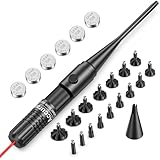
Dialing in your sights becomes much faster when you have the right gear supporting your session. A caliber-specific red laser bore sighter is one of the most convenient tools you can add to your kit. These compact devices fit directly into .177 caliber barrels, projecting a bright red aiming reference beam straight out of the muzzle onto your target wall. By aligning your iron notch or red dot directly onto the projected laser point before firing, you can get your sights on paper on your very first shot without wasting ammunition or guessing where wild shots went.
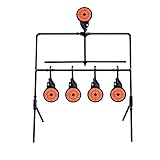
Pairing your airgun with an open-window red dot reflex sight can also transform your backyard plinking. Modern dot sights mount easily onto standard Picatinny or 20mm slotted accessory rails, replacing tiny, hard-to-see iron notches with a bright, crisp aiming dot. When shopping for an optic for backyard target shooting, look for a model that offers multiple reticle brightness settings, clear coated glass, and sturdy left-to-right and up-and-down adjustment click dials that hold their zero under spring recoil. Finally, a heavy-duty steel BB trap with internal baffles or spinner plates is essential. A well-built metal trap captures steel spheres safely inside its housing, virtually eliminating rebounds and keeping your shooting area completely clean.

- ARS Mark9.0
ARS Mark is a ranking system developed by bestairriflescopes.com. ARS Mark has no relationship or impact from any manufacturers or sales agent websites. Learn more
- BrandUUQ

- ARS Mark8.8
ARS Mark is a ranking system developed by bestairriflescopes.com. ARS Mark has no relationship or impact from any manufacturers or sales agent websites. Learn more
- BrandEZshoot

- ARS Mark8.8
ARS Mark is a ranking system developed by bestairriflescopes.com. ARS Mark has no relationship or impact from any manufacturers or sales agent websites. Learn more
- BrandHighwild

- ARS Mark8.6
ARS Mark is a ranking system developed by bestairriflescopes.com. ARS Mark has no relationship or impact from any manufacturers or sales agent websites. Learn more
- BrandEZshoot

- ARS Mark8.6
ARS Mark is a ranking system developed by bestairriflescopes.com. ARS Mark has no relationship or impact from any manufacturers or sales agent websites. Learn more
- BrandTipfun

- ARS Mark8.6
ARS Mark is a ranking system developed by bestairriflescopes.com. ARS Mark has no relationship or impact from any manufacturers or sales agent websites. Learn more
- BrandFeyachi

- ARS Mark8.4
ARS Mark is a ranking system developed by bestairriflescopes.com. ARS Mark has no relationship or impact from any manufacturers or sales agent websites. Learn more
- BrandMidTen
- ARS Mark8.4
ARS Mark is a ranking system developed by bestairriflescopes.com. ARS Mark has no relationship or impact from any manufacturers or sales agent websites. Learn more
- BrandKNINE OUTDOORS
- ARS Mark8.4
ARS Mark is a ranking system developed by bestairriflescopes.com. ARS Mark has no relationship or impact from any manufacturers or sales agent websites. Learn more
- BrandEZshoot
Last update on 2026-10-02 / Affiliate links / Images, Product Titles, and Product Highlights from Amazon Product Advertising API
FAQs
Why do my BBs keep scattering instead of forming a tight group?
BB guns have smooth barrels without spiral rifling grooves, so round steel BBs drift through the air like knuckleballs. In addition, rapid firing cools down CO2 powerlets, causing pressure to drop and making shots land lower. Shooting from an unsteady hand position also adds body tremor to the flight path. Rest your gun on a soft bag, fire slowly, and accept that a one-inch spread at five yards is normal mechanical performance.
Can I sight in my BB gun at 20 or 30 yards?
You should not zero a standard smoothbore BB gun at extended distances like twenty or thirty yards. Lightweight steel BBs lose speed rapidly, drop significantly, and get blown sideways by the lightest outdoor breeze past seven to ten yards. Setting your sights at five yards gives you a flat trajectory that works reliably across the normal backyard plinking distance of ten to thirty feet.
Should I adjust my sights after every single shot?
Never move your sights after firing just one shot. A single errant hole could be a flyer caused by a slight trigger jerk, a wind gust, or a minor imperfection in the steel BB. Always fire three shots at the exact same aiming spot, find the center of that three-shot cluster, and base your dial adjustments strictly on that group.
What should I do if my red dot dial stops turning?
If an adjustment dial stops clicking or offers heavy resistance, you have reached the physical end of the internal screw travel. Forcing the dial further will strip the threads or dislodge the internal prism assembly, permanently ruining the sight. Back the dial off several clicks, verify that your optic is clamped level on its accessory rail, and confirm that the barrel itself is not bent or misaligned in the receiver.


12 Best 22 Pcp Air Rifle For Hunting of 2026 With Quiet Power

7 Best 22 Pcp Air Rifle Under 300 of 2026 For Backyard Pest Control

10 Best 22 Break Barrel Air Rifles of 2026 For Backyard Pest Control

10 Best 30 Caliber Pcp Air Rifle of 2026 For Medium Game

Top Best 177 Air Rifle Under 100: Budget-Friendly Picks for 2026

How to Safely Reload Shotgun Shells at Home

11 Best Co2 Air Rifle For Pest Control of 2026 To Ensure Humane Dispatch

12 Best Inexpensive Air Rifles of 2026 For Dependable Backyard Accuracy






