
How to Sight In a Rifle Scope Without Wasting Ammo

Start close and adjust three-shot groups. Looking through the open barrel to line up your target gets the rifle on paper right away. Firing a steady cluster of three rounds reveals the true point of impact, letting you turn the scope dials with certainty instead of chasing unpredictable misses.
Dialing in the rifle depends on your distance to the target, the click values on your adjustment knobs, and a steady rest. Most scopes move the bullet impact one-quarter of an inch per click at one hundred yards, meaning each click moves only one-sixteenth of an inch at twenty-five yards. Using the exact same brand and weight of ammunition also keeps your pattern predictable from start to finish. Here is how to center your crosshairs step by step.
Before You Shoot: Bench Prep and Mounting Checklist
Preparing your rifle at home saves time and cartridges at the range. Loose screws or a crooked scope will ruin your shooting session before you fire your first round. Go through these setup checks on your workbench:
- Clear the firearm: Drop the magazine and open the bolt to confirm the chamber is empty. Always verify the rifle is unloaded before handling the optic.
- Check mounting screws: Place your rifle in a secure rest and inspect the mount fasteners along the standard Picatinny or 20mm slotted accessory rails. Use an inch-pound torque tool to tighten every screw to the optic maker's listed rating, as loose rings allow the optic to slide under recoil.
- Apply thread-locking fluid: Add a small drop of blue thread-locking compound to each screw thread. Firearm vibration shakes dry screws loose over time, but thread locker holds them firmly in place without permanently locking the hardware.
- Set your eye relief: Rest your cheek naturally on the stock with your eyes closed, then open them. Slide the scope forward or backward in the rings until you see a crisp sight picture without any dark ring around the edges.
- Level the reticle crosshairs: If your crosshairs tilt sideways, your up-and-down adjustments will steer your shots left or right. Place a small leveling bubble on the rifle receiver and another on your top turret cap to confirm both sit flat.
- Build a stable shooting rest: Use sturdy sandbags, a front bipod with a rear squeeze bag, or a solid shooting sled. Firing offhand or resting the rifle on a soft jacket allows body movement to blur your mechanical results.
If you run a tactical rifle with secondary sights, look at iron sights for cowitness with red dot optics so backup hardware does not block your glass.
The Step-by-Step Process to Sight In Your Scope
Zeroing a rifle scope means adjusting the internal crosshair so your bullets hit where you aim at a chosen distance. Follow these numbered steps in sequence to get on target with minimal ammunition:
- Bore sight your rifle at 25 yards: Look down the bore of a bolt-action rifle to center the target, or use a laser bore sight tool. Dial your crosshairs directly over the target center or laser dot.
Reason: Aligning the barrel and optic beforehand ensures your first live round strikes the paper backer rather than flying into the dirt berm. - Set up a paper target at 25 yards: Place a clean paper target with clear grid lines exactly twenty-five yards downrange from your bench rest.
Reason: Starting at close range minimizes wind drift and bullet drop, making it nearly impossible for an aligned rifle to miss the target entirely. - Fire a steady three-shot group at the center bullseye: Settle the rifle into your rest, breathe out smoothly, and squeeze the trigger three times while aiming at the exact same point for every shot.
Reason: A single errant shot can come from a trigger flinch, but three shots cluster together to reveal the rifle's true mechanical point of impact. - Measure the distance from the group center to the bullseye: Walk downrange with a ruler and measure the vertical gap and horizontal gap between the center of your three-shot cluster and the bullseye.
Reason: Measuring the physical gap replaces guesswork and tells you exactly how many inches your bullet impact needs to shift. - Adjust your elevation and windage turrets for 25 yards: Turn your scope knobs to move the bullet impact toward the bullseye, remembering that adjustments at 25 yards require four times as many clicks as adjustments at 100 yards.
Reason: Applying calculated dial adjustments shifts the reticle straight onto your bullet group instead of relying on random dial spinning. - Fire a three-shot confirmation group at 25 yards: Shoot three more rounds at the center bullseye using the same ammunition and rest position.
Reason: Verifying your close-range adjustments ensures bullets strike the center ring before you move your target farther out. - Move your target out to 100 yards and shoot three rounds: Relocate your target to 100 yards, aim at the center bullseye, and fire a fresh three-shot group.
Reason: Distance magnifies minor alignment flaws, so shooting at 100 yards establishes the precise trajectory needed for field hunting or target shooting. - Dial your final 100-yard corrections and zero your turret caps: Measure any remaining offset at 100 yards, turn your turrets the required clicks, and reset your turret caps to the zero mark.
Reason: Setting your turret markings to zero establishes your permanent baseline, allowing you to return to center quickly after dialing for distance or wind.
Turret Math: How to Calculate Clicks Without Guessing
Scope adjustment knobs are called turrets. The top turret controls elevation (up and down), while the side turret controls windage (left and right). Each turret features directional markings. Turning elevation toward "UP" raises your bullet impact; turning windage toward "R" moves it right. The arrows show which way the bullet hole travels on paper, not which way the crosshair jumps inside the glass.
Most rifle scopes use MOA, which stands for minute of angle. In practical terms, one MOA equals about one inch at a distance of 100 yards. Most scopes feature 1/4 MOA click values. That means each click moves the bullet impact 1/4 inch at 100 yards. To shift your shot group one inch at 100 yards, you need four clicks. If your three-shot group strikes two inches low at 100 yards, you turn the elevation knob eight clicks in the "UP" direction.
The math changes at 25 yards. Because 25 yards is one-fourth the distance of 100 yards, each click moves the bullet only one-fourth as far: 1/16 of an inch instead of 1/4 inch. To shift your bullet impact by one full inch at 25 yards, you must dial 16 clicks. If your group hits two inches below the bullseye at 25 yards, you need 32 clicks to move that impact two full inches. Multiplying your click count by four at close range prevents you from under-adjusting.
Troubleshooting Inconsistent Groups and Wandering Shots
When bullet holes scatter across the target with no clear pattern, turning your scope turrets will only waste cartridges. Wandering shots usually point to mechanical, environmental, or handling issues rather than a broken optic. Here is how to diagnose and resolve common causes of erratic groups:
Ammunition inconsistency: Switching bullet weights, bullet shapes, or cartridge brands mid-session destroys consistency. A light 150-grain bullet travels at a different speed and creates different barrel vibrations than a heavy 180-grain round. Even two boxes from different brands with the same weight will strike different spots. Pick one specific cartridge brand and stick with that exact ammunition until your scope is fully zeroed.
Barrel heating: Firing several shots in rapid succession heats the steel rifle barrel. As the barrel heats up, thermal expansion causes slight warping that walks your bullets away from the bullseye in a creeping line. Allow the barrel to cool between shot strings so it stays lukewarm to the touch. Taking a two-minute pause between groups keeps your barrel vibrations stable.
Parallax error and cheek position: If your eye alignment behind the scope changes between shots, the crosshair drifts across the target face. Rest your cheek firmly in the exact same spot on the rifle stock for every trigger squeeze. If your scope has a side parallax focus knob, rotate the dial until the target image looks completely sharp and the crosshair stays locked on the bullseye even when you move your head slightly.
Mount slippage under recoil: Rifle recoil generates sharp shockwaves through your mounting rings. If ring screws loosen, the scope tube slides backward or twists inside the rings, throwing your zero off by inches. Draw a faint pencil line on the scope tube right against the forward ring. If that line moves after firing a few heavy rounds, your rings are slipping and must be retightened with an inch-pound torque tool.
Choosing a Laser Bore Sight to Save Time and Cartridges
A laser bore sight projects a focused beam of light straight down the center of your rifle barrel. Shining this beam onto a wall or close target allows you to adjust your scope crosshairs directly over the laser dot before loading live ammunition. Using this tool eliminates the initial guessing phase, ensuring your first live round impacts your target paper cleanly.
When looking for a bore sighting tool to keep in your range bag, check these practical features:
- Caliber compatibility: Universal bore sight kits feature expanding arbor adapters that slide into the muzzle to fit calibers from small .17 rimfires up to 12-gauge shotguns. If you own multiple firearms, an adapter kit offers great flexibility across your collection. Dedicated brass cartridge units chamber directly like real ammunition, which works smoothly for common calibers like .223 or .308.
- Laser color: Red lasers work reliably for indoor alignment or dim morning lighting. Green lasers provide superior visibility against paper targets on sunny outdoor ranges, making alignment much easier across 25 to 50 yards in bright daylight.
- Switch mechanism: Choose a model equipped with an external push-button or rotary switch. Basic tools that require unscrewing the housing and popping out miniature watch batteries are frustrating to handle at a crowded bench.
- Secure barrel fit: Look for sturdy metal components and snug adapters that do not wobble inside the muzzle crown. A loose or tilted arbor throws the beam off center, defeating the purpose of pre-aligning your optic.
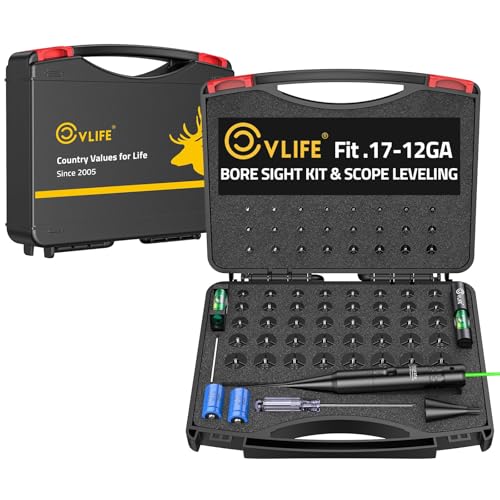
- ARS Mark9.2
ARS Mark is a ranking system developed by bestairriflescopes.com. ARS Mark has no relationship or impact from any manufacturers or sales agent websites. Learn more
- BrandCVLIFE

- ARS Mark9.0
ARS Mark is a ranking system developed by bestairriflescopes.com. ARS Mark has no relationship or impact from any manufacturers or sales agent websites. Learn more
- BrandUUQ

- ARS Mark9.0
ARS Mark is a ranking system developed by bestairriflescopes.com. ARS Mark has no relationship or impact from any manufacturers or sales agent websites. Learn more
- BrandUUQ

- ARS Mark8.8
ARS Mark is a ranking system developed by bestairriflescopes.com. ARS Mark has no relationship or impact from any manufacturers or sales agent websites. Learn more
- BrandCVLIFE
- ARS Mark8.8
ARS Mark is a ranking system developed by bestairriflescopes.com. ARS Mark has no relationship or impact from any manufacturers or sales agent websites. Learn more
- BrandCVLIFE

- ARS Mark8.8
ARS Mark is a ranking system developed by bestairriflescopes.com. ARS Mark has no relationship or impact from any manufacturers or sales agent websites. Learn more
- BrandStrongTools

- ARS Mark8.8
ARS Mark is a ranking system developed by bestairriflescopes.com. ARS Mark has no relationship or impact from any manufacturers or sales agent websites. Learn more
- BrandEZshoot

- ARS Mark8.6
ARS Mark is a ranking system developed by bestairriflescopes.com. ARS Mark has no relationship or impact from any manufacturers or sales agent websites. Learn more
- BrandEZshoot

BoreSighter for 223/9MM/7.62X39MM/30-30/30-06/.25/270/243/308/7MM/45ACP Colt Caliber Rifle Scope Handgun Brass Red
View on Amazon- ARS Mark8.6
ARS Mark is a ranking system developed by bestairriflescopes.com. ARS Mark has no relationship or impact from any manufacturers or sales agent websites. Learn more
- BrandStrongTools
Last update on 2026-10-02 / Affiliate links / Images, Product Titles, and Product Highlights from Amazon Product Advertising API
FAQs
Why should I sight in at 25 yards before moving out to 100 yards?
Starting at 25 yards provides a safety cushion that keeps your initial rounds on paper even if your new optic was mounted slightly crooked. At 100 yards, a tiny mechanical error of just one degree will cause your bullet to miss a four-foot target backer completely. Centering your impact at 25 yards guarantees that your first round at 100 yards will land safely on target paper.
Which way do I turn my scope dials if my shots hit low and to the left?
Turn your top elevation dial in the direction marked "UP" to raise your bullet impacts toward the bullseye. Turn your side windage dial in the direction marked "R" or "RIGHT" to steer your bullet impacts toward the right. Scope dial arrows always indicate the direction your bullet holes will travel across the target face.
How many shots should I fire before making a dial adjustment?
Always fire at least three shots before touching your adjustment knobs. A single stray shot can come from a sudden wind gust, a rough trigger pull, or an unsteady rest position. Firing three steady shots reveals a clear triangle cluster that indicates your rifle's true mechanical point of impact.
Do I need to re-zero my rifle scope if I switch to different ammunition?
Yes, you must verify your zero whenever you change ammunition brands, bullet profiles, or powder charges. Different cartridges produce distinct velocities and barrel vibrations, which can shift your bullet impacts several inches away from your original center. Always confirm your final zero using the exact cartridge you plan to carry in the field.


12 Best 22 Pcp Air Rifle For Hunting of 2026 With Quiet Power

7 Best 22 Pcp Air Rifle Under 300 of 2026 For Backyard Pest Control

10 Best 22 Break Barrel Air Rifles of 2026 For Backyard Pest Control

10 Best 30 Caliber Pcp Air Rifle of 2026 For Medium Game

Top Best 177 Air Rifle Under 100: Budget-Friendly Picks for 2026

How to Safely Reload Shotgun Shells at Home

11 Best Co2 Air Rifle For Pest Control of 2026 To Ensure Humane Dispatch

12 Best Inexpensive Air Rifles of 2026 For Dependable Backyard Accuracy






