
How to Sight In an Air Rifle Without Wasting Pellets

Missing the target with a freshly mounted sight is completely normal and easy to fix. The quickest solution is to set your target just ten yards away, fire a steady three-shot group, and turn the sight dials toward the pellet holes until your aim matches where the pellets strike. Starting close keeps every shot on the paper, so adjustments become simple and predictable instead of pure guesswork.
A few practical details change how smoothly this goes. Spring-piston air rifles kick in two directions and need a loose, balanced hold rather than a rigid bench rest, while pre-charged pneumatic models sit happily on soft sandbags. Switching pellet brands or weights will also shift where your shots land, so stick with one pellet type while adjusting your dials. Setting up your rest and target the right way will have your rifle hitting center in just a few minutes.
Setting Up Your Bench and Supporting the Rifle
The biggest reason people waste pellets is starting too far away. When you mount a new scope or dot sight, the reticle might point several inches away from where the barrel is actually aiming. If you place your target out at 30 or 40 yards right away, your shots can easily miss the paper completely. You end up burning through lead, turning dials blind, and guessing where the pellets went. Starting at a clean 10 yards keeps your pellets on the paper backer so you can see every single hit.
Safety comes first before you fire a single shot. Air rifle pellets travel with plenty of force, and lead will bounce violently off hard surfaces like rocks, bricks, or concrete. Set up a proper backstop that safely absorbs every pellet without throwing fragments back toward your shooting line. Use a dedicated metal pellet trap packed with heavy duct seal putty, a cardboard box filled with dense rubber mulch, or a clean dirt hill free of stones.
- Safe backstop: a heavy pellet trap, dense rubber mulch box, or dirt berm that swallows lead without ricochets.
- Steady shooting table: a firm table or portable shooting bench that does not wobble under your arms.
- Measured 10-yard distance: an exact distance marked out with a measuring tape rather than paced out by foot.
- Firm sight mount: mounting screws secured to the accessory rail with an inch-pound torque tool so the sight cannot slide.
- Single pellet tin: one specific brand and weight of domed pellets to keep every shot uniform throughout the process.
How you support the rifle on your bench depends entirely on the kind of airgun you shoot. Break-barrel and underlever spring-piston rifles, commonly called springers, use a heavy coiled metal spring or gas piston to compress air. When you squeeze the trigger, that heavy internal piston flies forward and slams into the front cylinder wall. This creates a quick backward kick followed immediately by a forward snap. Because airgun pellets travel down the barrel slower than firearm bullets, this two-way recoil happens while the lead pellet is still moving through the rifling.
If you clamp a springer into a heavy shooting vise or lay the wooden stock directly on a hard bench rest, the rifle bounces off the rigid surface during that recoil cycle. That sudden bounce throws the barrel in random directions, scattering pellets all over the target. Instead, use an open artillery hold. Lay the balance point of the rifle across your flat, open palm, or let your open hand rest on a soft, cushioned shooting bag. Do not wrap your fingers tightly around the forend, and do not pull the buttstock hard into your shoulder. Let the rifle slide freely backward and forward across your hand so it recoils the exact same way every single shot.
Pre-charged pneumatic airguns, known as PCP rifles, work completely differently. PCP models store compressed air inside an onboard air cylinder and release it through a small valve. They do not have heavy pistons slamming into metal, which means they produce almost zero recoil. You can rest a PCP airgun directly on front and rear sandbags or clamp a folding bipod to its accessory rail without disturbing where the pellet lands.
Firing Control Groups and Adjusting Your Dials
Chasing single pellet holes is the easiest way to get lost. A single stray hole can happen because a gentle breeze kicked up, your finger twitched on the trigger, or your cheek rested slightly differently on the comb of the stock. If you turn your dials after every single shot, you will end up chasing holes in circles around the paper without ever finding center. You must shoot a consistent grouping, which is simply a cluster of several pellet holes fired at the exact same aiming point.
- Clear the air rifle barrel, confirm your backstop is clear, and set a clean paper target with a distinct bullseye ring at 10 yards.
- Sit comfortably at your bench, square your shoulders to the target, and rest your elbows firmly without hunching your neck.
- Place your aiming mark or red dot right on the center of the bullseye. If you use an open-window sight or an enclosed tube dot sight, keep both eyes open and look directly through the glass at the target.
- Rest the pad of your index finger on the trigger, take a gentle breath, let half of it out, and press the trigger smoothly straight back until the shot releases.
- Keep looking through the optic for one full second after the shot breaks before you move your head or cock the rifle.
- Load a second and third pellet, repeating the exact same point of aim on the bullseye for each shot without touching any adjustment dials.
Once you fire three shots, walk down to the target and look at the cluster. You now have a true control group that shows how the rifle is pointing mechanically. Find the center point between those three holes. That central spot represents your true point of impact.
Now you can make your adjustments using the click dials on your sight. The dial on top of the optic is your elevation dial, which moves your pellet impact up and down. The dial on the side is your windage dial, which moves your pellet impact left and right. Sights adjust in clicks, often measured in minutes of angle, known as MOA. An MOA angle measures how much of the target the reticle covers. At 100 yards, one MOA covers roughly one inch, but at a close 10-yard line, one MOA covers only about a tenth of an inch on paper. That means moving your pellet impact one full inch at 10 yards requires plenty of individual clicks.
Look at the markings on the dials. They typically feature directional arrows labeled with letters like "UP" and "R" for right. These arrows indicate the direction you want the pellet hole to travel across the paper, not where the pellet currently lands. For example, if your three-shot cluster sits two inches below the bullseye and an inch to the left, you need your hits to move up and right. Turn the top elevation dial in the direction of the "UP" arrow, and turn the side windage dial in the direction of the "R" arrow.
Fire a fresh three-shot control group at a new bullseye on the paper to verify the change. If the cluster moved toward the center but has not quite reached the bullseye, count a few more clicks in the same direction. Repeat this process until your three-shot group lands right on top of the aiming dot. If your setup pairs an optical sight with backup open sights, reviewing lining up iron sights with red dot sights can help clarify how mechanical sight lines match up through the optic glass.
Stepping Back to Your Primary Shooting Range
Getting your air rifle zeroed at 10 yards gets you on paper safely, but it is only the first step. Airgun pellets fly much slower than gunpowder bullets. Because pellets move through the air at moderate speeds, they travel along an arching flight curve. The pellet leaves the barrel, climbs slightly through your sight line, reaches the crest of its arc, and drops down under gravity. Most backyard plinking and small pest control happens between 20 and 35 yards, so you need to finish your zero at that real-world distance.
- Move your target back to your main shooting distance, such as 25 yards, and verify that your backstop still completely covers the shooting line.
- Settle into your steady bench position and apply the proper hold for your rifle type.
- Aim dead center at a clean bullseye and fire a three-shot control group without changing your aim.
- Examine the new cluster. At 25 yards, the group may strike slightly higher or lower than the bullseye depending on your optic height above the barrel and the pellet speed.
- Make fine click adjustments to your elevation and windage turrets. Because the target is farther away, each individual click moves the pellet impact much more on paper than it did at 10 yards, so three to six clicks are often plenty.
- Fire a final five-shot group to confirm that your pellets strike the dead center of the bullseye consistently.
Always keep in mind that changing your ammunition will alter where your pellets land. Pellets come in various head shapes, including rounded domes, flat wadcutters, and pointed hunting tips. They also come in different weights, measured in grains. A heavy lead pellet drops faster and spends more time traveling down the barrel during the recoil cycle than a lightweight alloy pellet. That timing difference shifts where the barrel points at the moment of exit, moving your group across the paper.
Once you discover a specific brand, head size, and grain weight that shoots tight clusters in your air rifle, buy several tins from that same production batch. If you switch to a different pellet weight later for pest control or target shooting, always confirm your zero on paper before heading out to shoot.
Using an Airgun Bore Sighter to Speed Up Alignment
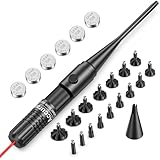
Setting up a newly mounted optic can sometimes lead to wasted ammunition if the sight starts off pointing far away from the bore. A red laser bore sighter is an easy tool that takes the guesswork out of mounting an optic on an air rifle. This device fits directly into the barrel muzzle or chamber, casting a straight red laser beam onto a wall or target backstop across the room. It shows you exactly where the centerline of the barrel points before you ever load a pellet or cock the action.
By shining that red laser beam against a target 10 yards away in a garage or shaded yard, you can look through your sight and turn the windage and elevation click dials until your reticle sits directly over the laser beam. This quick visual alignment ensures that your very first live shot will land cleanly on the paper backer, keeping you from throwing stray lead into the dirt or burning through half a tin of pellets just to find the paper.
Before picking up a laser bore sighter for an airgun, verify that the adapter kit fits small calibers. Many hunting bore sighters are built for large firearms and start at 0.24 caliber or larger. Air rifles typically use small 0.177 or 0.22 caliber barrels, so check that the tool includes soft rubber, silicone, or expanding brass arbors sized specifically for 0.177 and 0.22 bores. Soft adapter tips are critical because hard steel adapters can easily scratch or nick the delicate rifling inside an air rifle barrel, permanently hurting accuracy.
Look for a model with a clean push-button switch that allows you to turn the beam on and off without putting your fingers directly in front of the muzzle. Keep in mind that a laser bore sighter creates a perfectly straight optical beam, whereas real pellets drop under gravity. The laser gets your sights centered on paper quickly in 2026, but you still need to shoot real pellets downrange to dial in your finished, practical zero.

- ARS Mark10.0
ARS Mark is a ranking system developed by bestairriflescopes.com. ARS Mark has no relationship or impact from any manufacturers or sales agent websites. Learn more
- BrandLiterary Licensing, LLC

- ARS Mark10.0
ARS Mark is a ranking system developed by bestairriflescopes.com. ARS Mark has no relationship or impact from any manufacturers or sales agent websites. Learn more
- BrandIndependently Published

- ARS Mark9.0
ARS Mark is a ranking system developed by bestairriflescopes.com. ARS Mark has no relationship or impact from any manufacturers or sales agent websites. Learn more
- BrandHuman Kinetics
- ARS Mark8.4
ARS Mark is a ranking system developed by bestairriflescopes.com. ARS Mark has no relationship or impact from any manufacturers or sales agent websites. Learn more
- BrandEZshoot

- ARS Mark6.8
ARS Mark is a ranking system developed by bestairriflescopes.com. ARS Mark has no relationship or impact from any manufacturers or sales agent websites. Learn more
- BrandN/A

- ARS Mark5.2
ARS Mark is a ranking system developed by bestairriflescopes.com. ARS Mark has no relationship or impact from any manufacturers or sales agent websites. Learn more
- BrandMajosta
Last update on 2026-10-02 / Affiliate links / Images, Product Titles, and Product Highlights from Amazon Product Advertising API
FAQs
Why do my air rifle pellets scatter in wide patterns instead of grouping?
Wide shot patterns usually occur when a spring-piston rifle is rested on a hard surface or clamped into a rigid bench vise. Springers need to recoil naturally on an open palm or soft cushion, or the barrel will bounce erratically as the piston slams forward. Loose mounting screws on your scope rings or using bent, low-quality pellets can also cause wild flyers.
Can I sight in an air rifle indoors safely?
You can sight in an air rifle indoors if you have a clear, uninterrupted space of at least 10 yards and an enclosed pellet trap that safely stops lead. The trap should be backed by a dense rubber stall mat or thick hardwood backer to capture any errant shots, and everyone present must wear safety glasses. Never shoot indoors toward concrete, bare plywood, or stone surfaces that can cause ricochets.
Will changing to a different pellet weight ruin my zero?
Switching pellet weights will almost always change your point of impact on the target. Heavier pellets fly slower, drop sooner, and spend more time inside the barrel during the recoil stroke, which shifts where the barrel points when the pellet exits. Whenever you change brands, pellet shapes, or grain weights, fire a three-shot control group to adjust your sight dials for the new ammunition.


12 Best 22 Pcp Air Rifle For Hunting of 2026 With Quiet Power

7 Best 22 Pcp Air Rifle Under 300 of 2026 For Backyard Pest Control

10 Best 22 Break Barrel Air Rifles of 2026 For Backyard Pest Control

10 Best 30 Caliber Pcp Air Rifle of 2026 For Medium Game

Top Best 177 Air Rifle Under 100: Budget-Friendly Picks for 2026

How to Safely Reload Shotgun Shells at Home

11 Best Co2 Air Rifle For Pest Control of 2026 To Ensure Humane Dispatch

12 Best Inexpensive Air Rifles of 2026 For Dependable Backyard Accuracy






