
9 Laser Sight Vs Red Dot Sight of 2026 For Fast Target Acquisition

Relying on a projected laser as a primary sighting system is a costly miscalculation that routinely wastes ammunition and precious reaction time. In dim rooms, that tiny beam looks like a foolproof shortcut to instant hits, but stepping outdoors under bright midday sun tells a completely different story. The red dot vanishes instantly against outdoor terrain and textured clothing, leaving shooters hunting for a missing point of impact right when split-second speed matters most. Recoil can also knock cheap rail hardware off zero, turning what felt like an effortless aiming aid into dead weight.
True speed comes from bringing the firearm to eye level and seeing an immediate, crisp aiming reticle against any background. Opting for an open reflex sight with green illumination preserves peripheral vision with both eyes open, cutting through bright daylight without washing out. For those who still want close-quarters beam projection without sacrificing daytime precision, choosing a rugged combo unit with independent windage adjustments and intuitive switchgear bridges the gap seamlessly. Here is how a laser sight and a red dot sight stack up across visibility, target acquisition speed, and long-term durability.
- ARS Mark9.6
ARS Mark is a ranking system developed by bestairriflescopes.com. ARS Mark has no relationship or impact from any manufacturers or sales agent websites. Learn more
- BrandCVLIFE

- ARS Mark9.0
ARS Mark is a ranking system developed by bestairriflescopes.com. ARS Mark has no relationship or impact from any manufacturers or sales agent websites. Learn more
- BrandCVLIFE

- ARS Mark9.0
ARS Mark is a ranking system developed by bestairriflescopes.com. ARS Mark has no relationship or impact from any manufacturers or sales agent websites. Learn more
- BrandCVLIFE
- ARS Mark8.8
ARS Mark is a ranking system developed by bestairriflescopes.com. ARS Mark has no relationship or impact from any manufacturers or sales agent websites. Learn more
- BrandCVLIFE

- ARS Mark8.6
ARS Mark is a ranking system developed by bestairriflescopes.com. ARS Mark has no relationship or impact from any manufacturers or sales agent websites. Learn more
- BrandFeyachi
- ARS Mark8.6
ARS Mark is a ranking system developed by bestairriflescopes.com. ARS Mark has no relationship or impact from any manufacturers or sales agent websites. Learn more
- BrandBeileshi
- ARS Mark8.6
ARS Mark is a ranking system developed by bestairriflescopes.com. ARS Mark has no relationship or impact from any manufacturers or sales agent websites. Learn more
- BrandPinty

- ARS Mark8.6
ARS Mark is a ranking system developed by bestairriflescopes.com. ARS Mark has no relationship or impact from any manufacturers or sales agent websites. Learn more
- BrandFeyachi

- ARS Mark7.8
ARS Mark is a ranking system developed by bestairriflescopes.com. ARS Mark has no relationship or impact from any manufacturers or sales agent websites. Learn more
- BrandLECPECON
Last update on 2026-10-02 / Affiliate links / Images, Product Titles, and Product Highlights from Amazon Product Advertising API
Can you actually see a laser sight in bright daylight?
Projected laser beams are often difficult to track in direct midday sunlight, though beam color makes a noticeable difference. Green laser diodes, such as Class I units or models listed under 5mW output, offer significantly higher visual contrast to the human eye outdoors than red lasers rated at 2mW or less than 1mW. Even with a green beam, bright sunlight and textured backgrounds like tree bark or dark clothing can swallow a small projected dot at extended distances. An open reflex red dot sight eliminates that problem because the reticle is reflected on the internal multi-coated glass rather than projected onto the target surface, allowing adjustable brightness settings to keep the aiming point sharp against washed-out backgrounds.
Is an open red dot optic faster to aim than a projected laser?
Yes, an open reflex red dot sight is generally faster for daylight shooting because the reticle appears directly in your line of sight. Looking through an optic with a 28mm or 33mm lens lets you shoot with both eyes open while preserving your full field of view and peripheral awareness. With a projected laser, your eye must actively scan the target downrange to locate where the beam hit, which takes valuable fractions of a second on uneven or moving targets. Projected beams work well for non-traditional shooting stances where bringing the firearm to eye level is difficult, which is why a dedicated rail mount pistol laser sight remains popular on sidearms. For rapid shoulder-mounted shooting, however, keeping the aiming point contained within an optical window provides more consistent speed.
Does an integrated red dot and laser combo sight give you the best of both worlds?
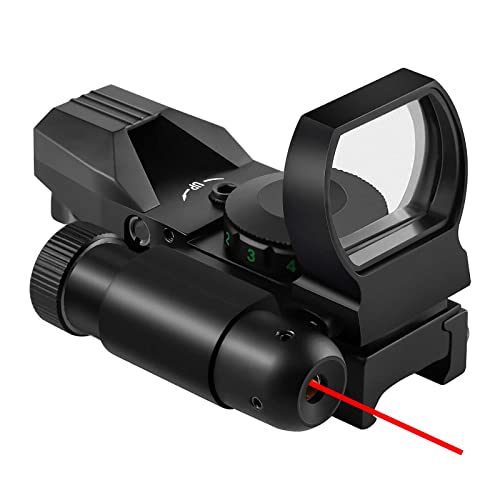
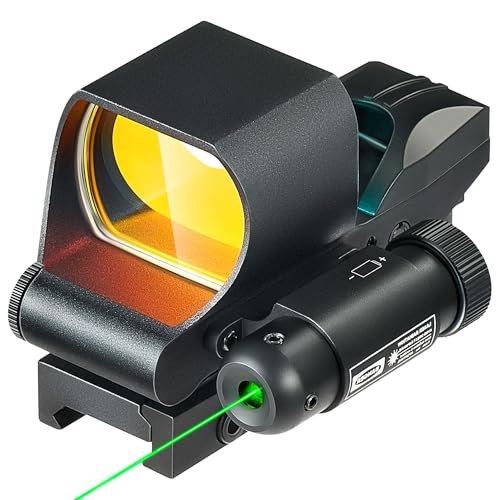
Yes, an integrated combo unit combines an optical reflex window and a projected beam on a single 20mm Picatinny rail mount. This design places an open reflex sight with a 28mm, 33mm, or 28x40mm lens directly alongside or above an integrated red or green laser. You get the daylight clarity and wide field of view of a reflex reticle for standard shooting, while retaining the laser diode for point shooting, low-light targeting, or fast hip indexing. Many combo units also include a remote pressure pad switch, enabling momentary or constant laser activation with your support hand without shifting your firing grip.
Can you zero the red dot optic and the laser independently?
Yes, combo sights require separate adjustments for the reflex optic and the built-in laser. Because the laser diode sits offset from the center of the reflex lens, both systems have distinct optical paths and point-of-impact points. Reliable combo units feature independent windage and elevation adjustment screws for the optical reticle and the laser module. The proper procedure is to dial in the reflex reticle on your 20mm or 21mm rail first at your intended zero distance, and then adjust the laser windage and elevation until the beam converges with your target point.
What reticle patterns work best on an open reflex sight?
Selecting the right reticle depends on whether your priority is pinpoint accuracy or immediate visual pickup. Many reflex sights offer four distinct reticle patterns, including a single 3 MOA dot, a crosshair, a bullseye, and a star pattern, backed by five brightness levels. A smaller 3 MOA dot covers less of the target for tighter shot placement, while a broader circle, bullseye, or star reticle guides your dominant eye into the center of the 33mm lens almost instantly. Dual illumination in red and green provides extra flexibility, letting you switch colors to counter specific background tones.
Can you cowitness iron sights through an open red dot and laser combo?
Cowitnessing depends on the base height of your sight and the profile of your rail. Because combo units combine a reflex housing and a laser diode into one assembly, they typically sit higher above a 20mm rail than a bare micro red dot optic. If your firearm features fixed or folding sights, check the deck height of the reflex glass to see if your irons can align through the lower third of the window. In setups where the factory sights sit too low to be seen through the glass, pairing your rail with taller iron sights for cowitness with red dot sights can restore an emergency backup sight picture.


12 Best 22 Pcp Air Rifle For Hunting of 2026 With Quiet Power

7 Best 22 Pcp Air Rifle Under 300 of 2026 For Backyard Pest Control

10 Best 22 Break Barrel Air Rifles of 2026 For Backyard Pest Control

10 Best 30 Caliber Pcp Air Rifle of 2026 For Medium Game

Top Best 177 Air Rifle Under 100: Budget-Friendly Picks for 2026

How to Safely Reload Shotgun Shells at Home

11 Best Co2 Air Rifle For Pest Control of 2026 To Ensure Humane Dispatch

12 Best Inexpensive Air Rifles of 2026 For Dependable Backyard Accuracy






