
What Grain Broadhead Should You Use on a Ravin Crossbow?

Stick with a 100-grain broadhead. The factory sights the scope and balances the arrows around that exact weight. Sticking to a 100-grain hunting point means your arrows fly true and strike right where your practice tips landed all summer. It keeps your setup predictable right out of the box.
A few details can change that choice, like hunting bigger game where you want more punch on impact. If you move up to a 125-grain tip, you have to adjust the speed ring on your scope, which is the dial that matches your crosshair marks to arrow speed. Extreme arrow speed also matters because weak blades can pull open mid-air before hitting the target. Here is how weight affects your flight path and how to pick the right tip for your bow.
The Short Version
- Use 100-grain broadheads: Ravin designs its factory arrows, match-grade components, and calibrated scopes around a 100-grain point weight to give you flat arrow flight right out of the box.
- 125-grain tips drop faster: Moving up to 125 grains increases total arrow weight, which slows down arrow speed and causes your scope yardage marks to hit low past 30 yards.
- Match broadheads to crossbow speed: Because Ravin crossbows push arrows at 400 to 500 feet per second, you need broadheads with heavy-duty blade retention systems so they do not open mid-flight.
- Pick mechanical blades for field-point accuracy: Compact mechanical heads fly truest at extreme crossbow speeds, keeping your practice shots and hunting shots landing in the exact same spot.
Why Ravin Tunes Its Crossbows to 100-Grain Points
Every arrow setup relies on a delicate balance between total weight, stiffness, and balance point. In archery, weight is measured in grains. A grain is a tiny unit of weight used for arrow points and shafts, with roughly 437 grains in a single ounce. Ravin builds and sights its crossbow packages specifically around 100-grain tips. When you open a factory box, the included arrows come fitted with 100-grain field points, which are smooth practice tips used for target shooting.
The primary reason for sticking to this weight is your optic. Ravin crossbows feature a speed-calibrated scope equipped with a speed ring, which is a dial on the scope that matches crosshairs to arrow speed. When you twist that dial to match the rated velocity of your bow, the crosshair hashes automatically line up for 20, 30, 40, and out to 100 yards. That calibration relies on the total finished weight of a factory arrow carrying a 100-grain point. If you screw on a hunting tip with the exact same 100-grain weight, your arrow keeps the trajectory your scope expects.
Arrow balance also depends on point weight. Crossbow arrows are much shorter and stiffer than traditional vertical bow arrows. They need enough weight up front to steer properly through the air, but too much nose weight makes the arrow drop like a brick. A 100-grain tip creates the ideal balance point for Ravin carbon shafts. It keeps the nose steady in wind without robbing you of the blistering speed you bought the bow for in the first place.
Using the standard weight also protects you from unnecessary re-sighting chores. Switching between target practice and hunting season should be straightforward. When your field points and your broadheads weigh the exact same 100 grains, you spend less time turning adjustment dials and burning through targets, and more time building shooting confidence.
Choosing 100-Grain vs. 125-Grain: What Changes Downrange
Hunters often wonder if moving up to a 125-grain broadhead makes sense. A heavier head adds 25 grains of steel to the very front of the arrow. While that extra mass gives you slightly more impact energy against heavy bone, it changes almost everything about how the arrow flies through the air.
The first change is arrow velocity. Adding 25 grains to your point slows your arrow down by roughly 8 to 12 feet per second, depending on your bow model. That might sound like a small drop, but crossbow trajectory arcs quickly. At 20 yards, you might only see a half-inch difference between a 100-grain tip and a 125-grain tip. At 40 or 50 yards, that extra drop widens noticeably. The arrow strikes several inches lower than your aiming point because the extra weight pulls the front end downward sooner in flight.
The bigger issue is what happens inside your scope. Because the arrow travels slower, the crosshair markings on your scope no longer match real yardages. If you aim at a 50-yard target using your 50-yard reticle mark, a 125-grain arrow will land low. To fix this, you must reset the speed ring on your scope to a lower speed setting, and then confirm every single distance mark from scratch. Hunters looking into high-energy setups, like those comparing the TenPoint TX-Ultra 265 crossbow to other compact options, know that changing arrow point weight always requires resetting scope yardage rings.
For almost all big-game hunting across North America, including whitetail deer, black bear, and elk, a 100-grain hunting head produces more than enough kinetic energy. Ravin bows generate tremendous force. A 100-grain mechanical broadhead will pass completely through a mature deer with ease, giving you a clean pass-through and a heavy blood trail without forcing you to fight arrow drop at longer distances.
Blade Design Rules for Crossbows Shooting Over 400 Feet Per Second
Speed changes how air moves over an arrow. When a crossbow shoots an arrow over 400 feet per second, small aerodynamic issues turn into massive flight problems. Choosing the right grain weight is only half the battle; you also need a blade style built to survive that level of speed and acceleration.
Fixed-blade broadheads have solid, permanently exposed blades. At lower speeds from traditional compound bows, those blades fly reasonably straight. But when launched out of a high-speed crossbow, those exposed metal edges act like airplane wings or boat rudders. Air hits the blades and steers the front of the arrow off line, a problem called wind planing. Wind planing causes arrows to drift sideways, group poorly, and miss the bullseye by several inches, even when your bow is perfectly sighted in with smooth practice tips.
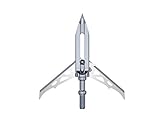
Mechanical broadheads, which are hunting tips with folded blades that stay tucked inside the ferrule and open on impact, solve the wind-planing issue. In flight, a closed mechanical head looks and cuts through the air just like a smooth target point. This lets you get the same point of impact with your hunting setup as you do during practice.
However, extreme crossbow speed introduces another hazard: premature blade opening. When you pull the trigger, the bowstring slams forward with violent force. The arrow accelerates from a dead stop to over 400 feet per second in a fraction of an inch. If a mechanical head uses weak rubber bands or flimsy plastic collars meant for slow vertical bows, that sudden burst of force can jerk the blades open right as the arrow leaves the rail. Wind resistance in flight can also catch loose blade edges and tear them open in mid-air.
A blade opening in mid-flight is dangerous. It ruins arrow accuracy, robs the shot of speed, and can even strike your bow limbs or stirrup as it exits. For any high-speed crossbow, only use broadheads with heavy-duty retention systems, such as internal spring clips or high-tension locking collars rated for 450 to 500 feet per second. When browsing the best TenPoint crossbow for hunting or tuning a fast Ravin, picking broadheads rated for your bow's exact speed bracket is essential for safe, accurate shooting.
How to Confirm Your Arrow Flight Before Hunting Season
Never take an unverified broadhead into the deer woods. Even if your broadheads match the 100-grain weight of your field points, you must confirm that your hunting arrows hit exactly where you aim. Follow these steps to prepare your setup before opening day.
- Inspect and flex-test your arrows: Before screwing in any broadhead, run your fingers down the carbon arrow shaft to feel for splintering, dents, or cracks. Perform flex-testing carbon arrows by gently bending the shaft in an arc between your hands while turning it, listening closely for any cracking or popping sounds. If you hear noise or see carbon fibers lifting, discard the arrow immediately. Also examine the plastic nock at the back for small fractures that could lead to a dry fire, which is firing the bow without an arrow properly seated.
- Confirm your 20-yard zero with field points: Set up a standard target at exactly 20 yards. Fire three shots using your 100-grain field points to ensure your main crosshair is dead center. If the group hits left or right, turn the side-to-side knob on your scope. If the group hits high or low, adjust the up-and-down adjustment dial until you split the bullseye.
- Calibrate your scope speed ring at longer range: Step back to 40 or 50 yards and shoot your 100-grain field points using the corresponding yardage mark in your reticle. If your arrows hit lower than the aiming mark, turn the speed dial to a slightly lower velocity number, which widens the reticle spacing. If they hit high, dial the speed ring to a higher velocity number. Adjust the ring until your 40- or 50-yard mark matches your arrow impact perfectly.
- Shoot a practice broadhead into a broadhead target: Swap out your field point for a 100-grain broadhead. Use a dedicated broadhead-approved foam target, never a soft bag or standard layered target, which broadhead blades will destroy instantly. Many mechanical broadhead makers include a dummy practice head with blunt blades that matches the aerodynamics of the real thing. Fire this tip at 20, 30, and 40 yards.
- Inspect the broadhead and retention system: After pulling the arrow from the foam target, examine the tip closely. Check that the retention clip or internal spring system still holds the blades firmly in place without rattling. If you shot a live broadhead with sharp blades, replace the blades or swap in fresh retention collars before packing that arrow into your hunting quiver.
What to Look for in a Crossbow Broadhead
When selecting broadheads to pair with your high-speed crossbow, prioritize construction durability and flight stability above all else. Look for models explicitly engineered for crossbow use rather than standard vertical archery. Crossbow-specific heads feature heavier ferrules, thicker blades, and reinforced retention systems that handle high kinetic energy without bending or failing on launch.
Pay close attention to how the broadhead secures its cutting blades during flight. Broadheads that use internal steel spring clips or heavy-duty mechanical locking collars hold blades tightly against the body, eliminating premature deployment even at speeds reaching 500 feet per second. Avoid older designs that rely on simple, thin rubber o-rings, as extreme crossbow acceleration can snap them instantly.
Finally, always check that the manufacturer clearly rates the broadhead for high-velocity crossbows. A solid aluminum, steel, or titanium ferrule combined with a wide cutting diameter of roughly two inches gives you clean, straight arrow flight on release and devastating cutting channels upon arrival.

- ARS Mark8.8
ARS Mark is a ranking system developed by bestairriflescopes.com. ARS Mark has no relationship or impact from any manufacturers or sales agent websites. Learn more
- BrandRAVIN

- ARS Mark8.5
ARS Mark is a ranking system developed by bestairriflescopes.com. ARS Mark has no relationship or impact from any manufacturers or sales agent websites. Learn more
- BrandRAVIN
- ARS Mark8.0
ARS Mark is a ranking system developed by bestairriflescopes.com. ARS Mark has no relationship or impact from any manufacturers or sales agent websites. Learn more
- BrandRAVIN
Last update on 2026-10-18 / Affiliate links / Images, Product Titles, and Product Highlights from Amazon Product Advertising API
FAQs
Can you shoot fixed-blade broadheads out of a Ravin crossbow?
You can shoot them, but they rarely fly as accurately as mechanical heads at speeds above 400 feet per second. The exposed blades catch rushing air, creating wind planing that pushes arrows away from your practice point zero. If you prefer fixed blades, choose low-profile, short-ferrule heads and confirm their flight path thoroughly on the practice range.
Will a 125-grain broadhead damage my crossbow?
No, shooting a 125-grain broadhead will not harm your crossbow limbs, cables, or string. Heavier arrow points actually absorb slightly more energy from the bow limbs, which slightly softens shot vibration. However, the heavier tip slows down arrow speed and causes your scope yardage marks to shoot lower than labeled past 30 yards.
Why do my broadheads hit lower than my field points?
Broadheads typically hit lower due to added aerodynamic drag or a mismatch in total point weight. Even if both tips weigh 100 grains, exposed broadhead blades create friction against the air that smooth field points do not experience. Choosing streamlined mechanical heads rated for high crossbow speeds minimizes this drag and brings your points of impact together.
Do I need a special target to practice with hunting broadheads?
Yes, you must use a dense foam target rated specifically for broadheads. Shooting broadheads into regular hanging bag targets or light practice blocks will ruin the target and can bend your broadhead blades or rip the target open. Dense, self-healing foam stops broadheads safely and lets you pull arrows out without damaging the cutting edges.


12 Best 22 Pcp Air Rifle For Hunting of 2026 With Quiet Power

7 Best 22 Pcp Air Rifle Under 300 of 2026 For Backyard Pest Control

10 Best 22 Break Barrel Air Rifles of 2026 For Backyard Pest Control

10 Best 30 Caliber Pcp Air Rifle of 2026 For Medium Game

Top Best 177 Air Rifle Under 100: Budget-Friendly Picks for 2026

How to Safely Reload Shotgun Shells at Home

11 Best Co2 Air Rifle For Pest Control of 2026 To Ensure Humane Dispatch

12 Best Inexpensive Air Rifles of 2026 For Dependable Backyard Accuracy






