
What Is a Good Distance to Sight In a Rifle?

Choose 100 yards for most rifles. That distance gives a scoped rifle the most predictable path across standard hunting ranges. But if you mount an unmagnified red dot sight on a light carbine, 50 yards works much better. At 50 yards, your shots stay within two inches of your aim from close range out to 200 yards.
The right distance always depends on your gear and your goals. A small .22 rifle used for casual target practice drops quickly and favors a closer setup, while a high-powered hunting rifle handles longer stretches with ease. Your optic matters too, since looking through a magnified scope solves a different problem than aiming through a simple illuminated dot. Here is how bullet paths work and how to choose the right target distance without wasting ammunition.
Why 100 Yards and 50 Yards Are the Standard Sighting Distances
Scoped rifles shooting centerfire hunting or target cartridges almost always use a 100-yard zero. At 100 yards, minor differences in sight height above the barrel have settled out, and calculating bullet drop at longer distances becomes straightforward. Most ammunition makers print ballistic drop tables on their packaging using 100 yards as the baseline. Sighting in a hunting rifle at 100 yards gives you a flat, dependable baseline where normal medium-game rounds drop only a couple of inches between the muzzle and 200 yards.
For modern carbines equipped with an unmagnified red dot sight, 50 yards is the most practical distance. Setting your aiming dot at 50 yards creates a versatile trajectory often called a 50/200 yard zero. Because of how the bullet arcs, a round zeroed at 50 yards will strike within roughly two inches of your aiming point from 25 yards all the way out to 200 yards. This flat trajectory lets you place your red dot dead-center on a defensive target or steel plate across practical carbine distances without guessing holdovers.
How Bullet Flight Paths Cross Your Line of Sight Twice
Bullets do not fly in a straight laser beam. Gravity pulls the bullet toward the ground the instant it leaves the muzzle of your rifle. To make the bullet meet your point of aim downrange, your sight tilts downward at a very slight angle, which points the rifle barrel upward. The curved flying path of the bullet on its way to the target is its trajectory.
Your optic sits one to two inches higher than the center of your rifle bore. Because of this height over bore, the bullet starts its flight lower than your line of sight. As the bullet travels downrange, it climbs upward through your visual aim line. This first crossing point is known as your near zero. The bullet continues climbing until it reaches the highest point in its arc, called the zenith, and then gravity pulls it back down across your line of sight. That second intersection is your far zero.
This arching flight path is why zeroing at very close targets can cause frustrating misses downrange. If you adjust your sight dials so your rifle hits dead center at 25 yards, your barrel must angle sharply upward. By the time that bullet reaches 100 yards, it is still climbing, often landing six to nine inches above your aim point. Understanding that the bullet crosses your aim line twice keeps you from wasting time chasing mysterious high hits at the range.
Best Sighting Distances for Different Rifles and Calibers
Choosing the best distance depends on your firearm, your optic, and what you plan to shoot. Different cartridges produce vastly different bullet speeds, which alters how steep the flight path curves.
Bolt-action hunting rifles: For standard hunting calibers like .308 Winchester, .30-06 Springfield, or 6.5 Creedmoor, zero your rifle at 100 yards. Scopes with magnification make seeing individual bullet holes easy at this distance. A 100-yard zero provides an exact baseline for hunting big game, where a shot out to 250 yards requires minimal adjustment in the field.
AR-15 and defensive carbines: If you run a fast-handling rifle chambered in 5.56 NATO or .223 Remington with an unmagnified dot, choose 50 yards. A 50-yard zero keeps your point of impact within the vital zone of a standard silhouette target from point-blank out past 200 yards. If you mount a magnified precision scope on your AR-15 for small target shooting, switch to a 100-yard zero to simplify your elevation math.
Rimfire rifles: Small, low-speed cartridges like .22 Long Rifle drop quickly after leaving the barrel. Zeroing a .22 rifle at 50 yards balances small-game hunting with casual target practice. If you shoot at an indoor range or mount red dot sights for a Ruger Mark pistol or rimfire carbine for short-range steel plinking, a 25-yard zero works best to keep shots flat across close distances.
Pistol caliber carbines: Rifles chambered in 9mm or .45 ACP fire heavy bullets at pistol velocities. Zero these carbines at 25 or 50 yards. Beyond 75 yards, pistol ammunition loses speed rapidly and drops several feet, making a 100-yard zero impractical for regular shooting.
The Step-by-Step Range Method to Sight In With Minimal Ammunition
Before heading to the shooting bench, always drop the magazine, pull the bolt back, and visually clear the firearm chamber. Zeroing your sight does not require burning through boxes of expensive cartridges if you follow a steady, repeatable sequence.
- Align your barrel and optic mechanically at 25 yards before live firing. Reason: Lining up your barrel with the target at close range using a bore tool guarantees your very first live round strikes the paper instead of wasting ammunition in the dirt.
- Fire an initial three-shot group at the 25-yard target from a solid bench rest. Reason: Firing three shots reveals where the rifle naturally groups and prevents you from making dial adjustments based on a single pulled shot or flinch.
- Turn your windage and elevation click dials to center the group at 25 yards. Reason: Making large adjustments at 25 yards is easy to track and keeps your shots on target before you move back to longer distances.
- Move your target out to your final zero distance of 50 or 100 yards. Reason: Close targets mask tiny alignment errors, so stretching out to your intended operating range reveals the true flight path of your ammunition.
- Fire a second three-shot confirmation group from a stable, supported rest. Reason: Confirming your hits at distance tests your real bullet drop and ensures your optic or backup iron sights for cowitness with red dot sights stay properly aligned.
- Make your final fine-tune adjustments and screw on your turret caps. Reason: Small dial adjustments center your point of impact perfectly, and tightening your dust caps protects your dials from shifting when bumping around in a gun bag.
Common Range Mistakes That Ruin Your Rifle Zero
Even with the right distance selected, simple setup errors at the shooting bench can scatter your shots and ruin your zero. Check these physical factors if your groups wander across the paper:
- Loose optic mounting hardware: Failing to tighten scope rings or red dot cross-bolts with an inch-pound torque tool allows recoil to shake the sight loose. Always secure screws to manufacturer ratings and apply a small drop of thread-locking fluid.
- Resting the barrel directly on a hard surface: Laying the steel rifle barrel on a wooden railing or hard bench interferes with natural barrel vibrations during firing. Always support the rifle under the wooden stock or composite handguard using a soft shooting bag.
- Adjusting dials after a single shot: Wind, breathing, and trigger control cause individual rounds to wander slightly. If you turn your dials after every shot, you will chase holes all day; always shoot a cluster of three to five rounds before touching a dial.
- Misunderstanding click values at different distances: Most sight adjustment dials are calibrated in minutes of angle (MOA). One click usually moves the bullet impact one-quarter inch at 100 yards, which means that same click moves the impact only one-sixteenth of an inch at 25 yards.
- Shooting a hot barrel too quickly: Firing multiple rapid strings heats up the barrel metal, causing thermal expansion that shifts your point of impact away from your true cold-barrel zero. Let the barrel cool down between groups.
Using a Laser Bore Sighter to Save Ammunition at Home
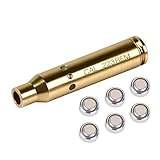
Before heading to the shooting range, you can complete your initial sight alignment at home. A universal laser bore sight kit fits directly into your rifle barrel or chamber, projecting a straight laser beam onto an indoor wall. Once the beam is projected, you adjust your optic dials until your crosshair or aiming dot sits directly over the laser dot.
When selecting a bore sighting kit, confirm that it includes multiple adapters that fit your specific caliber snugly. A loose adapter will wobble inside the muzzle, throwing off your alignment. Look for tools with straightforward push-button switches that let you conserve battery life while making adjustments. Remember that laser bore tools only help you get your first shot on paper; you must always confirm your zero with live ammunition at the range.

- ARS Mark9.2
ARS Mark is a ranking system developed by bestairriflescopes.com. ARS Mark has no relationship or impact from any manufacturers or sales agent websites. Learn more
- BrandOWLSHOOT

- ARS Mark9.0
ARS Mark is a ranking system developed by bestairriflescopes.com. ARS Mark has no relationship or impact from any manufacturers or sales agent websites. Learn more
- BrandUUQ

- ARS Mark8.8
ARS Mark is a ranking system developed by bestairriflescopes.com. ARS Mark has no relationship or impact from any manufacturers or sales agent websites. Learn more
- BrandEZshoot

- ARS Mark8.8
ARS Mark is a ranking system developed by bestairriflescopes.com. ARS Mark has no relationship or impact from any manufacturers or sales agent websites. Learn more
- BrandEZshoot

- ARS Mark8.8
ARS Mark is a ranking system developed by bestairriflescopes.com. ARS Mark has no relationship or impact from any manufacturers or sales agent websites. Learn more
- BrandStrongTools

- ARS Mark8.8
ARS Mark is a ranking system developed by bestairriflescopes.com. ARS Mark has no relationship or impact from any manufacturers or sales agent websites. Learn more
- BrandMCREHOTZ
- ARS Mark8.8
ARS Mark is a ranking system developed by bestairriflescopes.com. ARS Mark has no relationship or impact from any manufacturers or sales agent websites. Learn more
- BrandMidTen

- ARS Mark8.6
ARS Mark is a ranking system developed by bestairriflescopes.com. ARS Mark has no relationship or impact from any manufacturers or sales agent websites. Learn more
- BrandEZshoot

- ARS Mark8.4
ARS Mark is a ranking system developed by bestairriflescopes.com. ARS Mark has no relationship or impact from any manufacturers or sales agent websites. Learn more
- BrandMidTen

- ARS Mark8.2
ARS Mark is a ranking system developed by bestairriflescopes.com. ARS Mark has no relationship or impact from any manufacturers or sales agent websites. Learn more
- BrandTheopot
Last update on 2026-10-01 / Affiliate links / Images, Product Titles, and Product Highlights from Amazon Product Advertising API
FAQs
Why does sighting in at 25 yards make my rifle hit high at 100 yards?
Because your optic sits an inch or more above the barrel, the barrel points upward so the bullet path intersects your line of sight. At 25 yards, the bullet is still climbing upward through that line. By the time it reaches 100 yards, it has traveled to the top of its arc, often hitting several inches above where you aimed.
What is the difference between a 50-yard zero and a 100-yard zero on an AR-15?
A 50-yard zero provides a flatter trajectory across general carbine ranges, keeping your shots within two inches of your aiming dot from 25 to 200 yards. A 100-yard zero eliminates hold-unders at close distances and creates a simpler baseline for dialing long-range elevation on magnified scopes.
How many shots should I fire before adjusting my sight dials?
You should always fire at least three shots, and ideally five, before turning your windage or elevation adjustment dials. Shooting a group shows you the true mechanical grouping of the rifle and ammunition. Making adjustments after a single shot often leads to chasing human errors like trigger jerk or shifting cheek position.
Can a laser bore sight replace shooting live rounds at the range?
No, a laser bore sight only aligns the mechanical axis of the barrel with your optic to get your initial shots on paper. Laser light travels in a perfectly straight line, while real bullets arc and drop under gravity and atmospheric drag. You must always shoot live rounds at your intended zero distance to confirm where the bullets strike.


12 Best 22 Pcp Air Rifle For Hunting of 2026 With Quiet Power

7 Best 22 Pcp Air Rifle Under 300 of 2026 For Backyard Pest Control

10 Best 22 Break Barrel Air Rifles of 2026 For Backyard Pest Control

10 Best 30 Caliber Pcp Air Rifle of 2026 For Medium Game

Top Best 177 Air Rifle Under 100: Budget-Friendly Picks for 2026

How to Safely Reload Shotgun Shells at Home

11 Best Co2 Air Rifle For Pest Control of 2026 To Ensure Humane Dispatch

12 Best Inexpensive Air Rifles of 2026 For Dependable Backyard Accuracy






