
What Is an Iron Sight and How Do You Aim with It?

Many new shooters assume modern firearms require digital optics or glass screens to hit a target. In reality, an iron sight is just a simple, non-electronic aiming piece made of metal or plastic. It uses an upright front post and a rear opening to align your eye with the target, giving you a reliable aiming point that never runs out of battery power.
The exact look changes depending on your firearm setup. Handguns usually feature open square notches, while rifles often use small round peep rings. Some models stay permanently fixed in place, while folding styles flip down flat until you need them as a backup beneath an electronic red dot optic. Here is how these two simple pieces line up to help you stay on target.
The Short Version
- An iron sight is a physical, non-electronic aiming tool made of metal or polymer that uses no batteries and has no glass lenses to fog or shatter.
- Aiming requires lining up two parts: you look through a rear notch or small peep hole, center the upright front aiming pin in that opening, and place the pin on your target.
- Handguns typically use open notch-and-post sights for fast target pickup, while rifles often use round peep sights for tighter precision at longer distances.
- Many modern shooters keep folding backup iron sights on their firearm so they can still aim through their optic window if an electronic dot sight battery dies.
What an Iron Sight Is and the Two Parts That Guide Your Eye
An iron sight is a mechanical aiming piece attached directly to a firearm. Even though people still call them iron sights, modern versions are rarely made of raw iron. Most are machined from aluminum alloy, steel, or molded from impact-resistant polymers. They rely purely on your vision and straight-line geometry, which means they never need charging, never run out of battery power, and continue working in heavy rain, freezing cold, or blowing dust.
Every standard iron sight setup consists of two primary parts mounted along the top of the barrel or receiver. The front sight sits near the muzzle, which is the front opening where the bullet leaves the barrel. On most firearms, this front piece is a front post (an upright front aiming pin). Some front pins include a painted white dot, a brass bead, or a glowing fiber optic rod to help your eye spot the pin quickly in dim lighting.
The rear sight sits closer to your eye on the rear of the slide or receiver. This rear piece acts as a viewing frame for the front post. On handguns, the rear sight is usually an open notch, which looks like a small square or U-shaped cutout. On rifles, the rear sight is typically an aperture (a small peep hole) that you look directly through.
Iron sights also feature adjustment controls so your shots land exactly where you point. These include windage (the left-and-right adjustment) and elevation (the up-and-down adjustment). Adjusting these settings so your point of aim matches your bullet impact on target is called zeroing. Before adjusting or inspecting your sights, always drop the magazine, pull the slide or bolt back, and check the chamber to confirm the firearm is completely unloaded and safe.
How to Align Front and Rear Sights on a Target
Aiming with iron sights requires managing three visual points at different distances: the rear sight near your eye, the front post out on the barrel, and the target downrange. Following a steady sequence makes the alignment second nature.
- Check firearm safety and set your stance. Verify the chamber is clear before practicing your sight alignment at home. Stand with your feet shoulder-width apart, bring the firearm up to your natural eye level, and keep your head upright rather than ducking your neck down to the gun.
- Align the front post in the rear opening. Center the upright front aiming pin inside the rear cutout. On handguns with an open notch, use the rule of equal height and equal light. Keep the flat top of the front post level with the top edges of the rear notch. Leave an equal gap of daylight visible on both the left and right sides of the front post inside the notch.
- Look naturally through a rifle peep hole. If your rifle uses a rear aperture (a small peep hole), look through the ring without trying to focus on the ring itself. Your eye naturally centers objects inside a circle, so the tip of the front post settles in the middle on its own.
- Shift your eye focus to the front post. The human eye cannot focus sharply at three different distances at once. Keep your sharp focus on the front post. The rear sight and the distant target will look slightly soft or blurry, but the front aiming post must stay crisp and clear.
- Place the post on the target and press the trigger. Set the top edge of the sharp front post on your target, such as the center of a bullseye. Hold your alignment steady and press the trigger smoothly straight back without disturbing the sights.
Common Styles: Pistol Notches, Rifle Peep Sights, and Folding Sights
Iron sights come in distinct styles based on firearm type and how far your eye sits from the rear sight opening.
Pistol sights use an open notch-and-post layout because handguns are held at arm length, roughly 15 to 25 inches from your face. At that distance, a tiny peep hole would be too difficult to acquire quickly. An open notch gives you a wide field of view to track moving targets. Handgun sights often add bright fiber optic inserts (small colored plastic rods that gather ambient light to glow bright red or green) or white dots to speed up alignment in poor light.
Rifles rely on an aperture or peep sight design. Because your eye rests only a few inches from the rear sight on a rifle stock, looking through a small hole feels natural and clear. Many rifle sights feature a flip switch with two peep sizes: a wide ring for close, rapid shooting in dim light, and a small pinhole for precision shooting at distant targets.
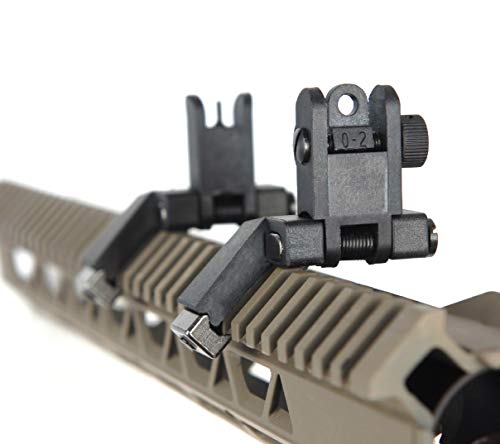
Modern rifles also use BUIS (folding backup sights). Unlike permanent fixed blades, folding sights lie flat against standard Picatinny or 20mm slotted accessory rails until needed. They pop upright with a button push or manual pull if your primary optic stops working. A common beginner mistake is mounting the rear sight backward. Installing it backward flips the protective side wings the wrong way, crowds the receiver, and shortens your sight radius (the distance between front and rear sights), which makes aiming errors harder to notice.
Iron Sights vs. Red Dot Sights: Speed Against Reliability
Both iron sights and electronic red dots serve distinct roles. Choosing between them comes down to mechanical reliability versus aiming speed.
Red dot sights use an electronic diode reflected on a coated glass lens. They project an illuminated aiming dot onto the target plane. When using a red dot, you keep both eyes open, look directly at the target, and place the dot on the mark. You do not have to align two separate metal pieces or shift your eye focus back to a front pin. This makes red dots faster for target acquisition, especially for shooters with astigmatism who struggle with sharp front sight focus.
Iron sights offer mechanical reliability. Electronic optics depend on batteries, delicate internal wiring, and glass lenses that can fog up or crack when dropped onto hard ground. If an electronic sight loses power, the window becomes blank glass. Iron sights have no batteries to drain, no electronics to short out, and no lenses that scratch or smudge. Sturdy metal sights can sit in storage for decades and function the moment you pick up the firearm.
How Backup Iron Sights Work Through an Optic Window
Many shooters combine both systems by using co-witness (lining up your backup iron sights through the optic glass).
When you attach a red dot to your rail, you can install folding backup sights in front of and behind the optic. If your red dot battery dies during practice or in an emergency, you do not need tools to unbolt the optic. You flip your backup sights upright and look straight through the clear glass window of the unpowered red dot.
Shooters arrange this in two common configurations. With absolute co-witness, your iron sights align directly through the center of the optic window, sharing the exact height of the red dot. With lower 1/3 co-witness, the iron sights sit in the bottom third of the window. This leaves the upper two-thirds uncluttered for your red dot while allowing you to drop your sightline slightly to use the iron sights if the battery fails. You can learn more about finding matching mount heights by reading the best iron sights for cowitness with red dot sights in 2026 to ensure your setup lines up properly.
What to Look for in Backup Sights for Your Setup
When choosing backup iron sights to pair with your firearm, focus on mounting stability, materials, and adjustment controls.
Confirm rail fit first. Most modern firearms use standard Picatinny or 20mm slotted accessory rails. Make sure the sight base includes a sturdy cross-bolt that seats deep into the rail slots. When mounting the sights, use an inch-pound torque tool to match the manufacturer tightness specifications, and apply a drop of thread-locking fluid so firearm recoil does not vibrate the screws loose.
Next, consider materials and deployment. Aluminum alloy sights provide durable drop protection, while quality polymer sights reduce weight on the front of your barrel. Look for spring-loaded folding designs that flip up smoothly with a button press and lock securely upright so recoil does not collapse them while firing. Tool-free adjustment click dials for windage and elevation are also helpful, allowing you to zero your sights at the range without hunting for small hex wrenches.

- ARS Mark9.0
ARS Mark is a ranking system developed by bestairriflescopes.com. ARS Mark has no relationship or impact from any manufacturers or sales agent websites. Learn more
- BrandBear Armz Tactical

- ARS Mark9.0
ARS Mark is a ranking system developed by bestairriflescopes.com. ARS Mark has no relationship or impact from any manufacturers or sales agent websites. Learn more
- BrandStinger
- ARS Mark8.8
ARS Mark is a ranking system developed by bestairriflescopes.com. ARS Mark has no relationship or impact from any manufacturers or sales agent websites. Learn more
- BrandIORMAN

- ARS Mark8.6
ARS Mark is a ranking system developed by bestairriflescopes.com. ARS Mark has no relationship or impact from any manufacturers or sales agent websites. Learn more
- BrandMAGORUI
- ARS Mark8.4
ARS Mark is a ranking system developed by bestairriflescopes.com. ARS Mark has no relationship or impact from any manufacturers or sales agent websites. Learn more
- BrandCHAOS READY OUTDOOR GEAR

- ARS Mark8.2
ARS Mark is a ranking system developed by bestairriflescopes.com. ARS Mark has no relationship or impact from any manufacturers or sales agent websites. Learn more
- BrandZBULAR

- ARS Mark8.2
ARS Mark is a ranking system developed by bestairriflescopes.com. ARS Mark has no relationship or impact from any manufacturers or sales agent websites. Learn more
- BrandZBULAR

- ARS Mark8.0
ARS Mark is a ranking system developed by bestairriflescopes.com. ARS Mark has no relationship or impact from any manufacturers or sales agent websites. Learn more
- BrandHATSEN
Last update on 2026-10-01 / Affiliate links / Images, Product Titles, and Product Highlights from Amazon Product Advertising API
FAQs
Do iron sights need batteries or electrical power?
No, iron sights are mechanical aiming pieces made of metal or durable polymer. They function entirely on straight-line visual alignment, meaning they have no wiring, require no batteries, and will never stop working because of an electrical failure.
How do you adjust iron sights if your shots hit off-center?
You adjust the sights using windage dials for left-or-right drift and elevation dials for high-or-low hits. When adjusting a rear sight, move the rear piece in the direction you want your shots to shift. For instance, if your shots land too far left, move the rear sight to the right.
Why do shooters keep iron sights if red dots are faster?
Shooters keep iron sights as a failsafe backup in case an electronic optic stops working. Batteries can drain, electronic circuits can fail, and glass lenses can crack or collect thick mud. Having folding iron sights attached ensures you can still aim effectively if your primary dot goes dark.
What is sight radius and why does it matter?
Sight radius is the distance between your front aiming post and your rear sight opening. A longer sight radius makes slight alignment mistakes much easier for your eye to spot and correct, which helps you shoot more accurately over longer distances.


12 Best 22 Pcp Air Rifle For Hunting of 2026 With Quiet Power

7 Best 22 Pcp Air Rifle Under 300 of 2026 For Backyard Pest Control

10 Best 22 Break Barrel Air Rifles of 2026 For Backyard Pest Control

10 Best 30 Caliber Pcp Air Rifle of 2026 For Medium Game

Top Best 177 Air Rifle Under 100: Budget-Friendly Picks for 2026

How to Safely Reload Shotgun Shells at Home

11 Best Co2 Air Rifle For Pest Control of 2026 To Ensure Humane Dispatch

12 Best Inexpensive Air Rifles of 2026 For Dependable Backyard Accuracy






