
What Distance Should You Sight In Your Rifle?

Most shooters assume a rifle must always be sighted in at 100 yards, regardless of what they shoot. That standard works reliably for traditional hunting, but it is not a universal rule. For hunting rifles with magnified scopes, 100 yards is the ideal distance. For compact carbines fitted with red dot sights, setting your target at 50 yards creates a much flatter, more forgiving bullet path.
A few practical details decide the right yardage for your setup. The optic on your rail matters first, since a high-power glass scope serves a different purpose than an unmagnified red dot. Your specific cartridge and realistic shooting distance also change where the bullet travels. Even the height of your sight above the center of the barrel influences how high the bullet rises before falling. Matching your distance to your gear now prevents wasted ammunition and eliminates doubt at the range.
Why 100 Yards Is the Standard for Hunting Rifles and Scopes
Hunting rifles paired with magnified scopes perform best when zeroed at 100 yards. Zeroing simply means adjusting your sight dials so shots land exactly where the crosshairs point at a set distance. When looking through a magnified scope, targets at 100 yards appear sharp and easy to center. Most centerfire hunting calibers, such as .308 Winchester, .30-06 Springfield, or 6.5 Creedmoor, travel with a very flat trajectory (the curved bullet path shaped by gravity).
At 100 yards, these hunting bullets reach near the top of their flight arc. Sighting in at this distance gives you a predictable flight path across normal hunting ranges. If you aim dead-center on game 50 yards away, your bullet strikes only a fraction of an inch below your crosshairs. At 150 yards, the bullet drops just an inch or two. Even at 200 yards, bullet drop remains within three to four inches, keeping your shot inside the vital zone without holding high.
Zeroing at 100 yards also protects your range session from wind confusion. At 25 yards, you cannot see how your rifle behaves at field distances. At 200 yards, a light breeze can push your shots wide, making it hard to tell whether your optic is off or the wind moved the bullet. Sighting in at 100 yards shows true rifle accuracy while keeping wind interference low.
Why 50 Yards Fits Defensive Carbines and Red Dot Sights
Defensive carbines like the AR-15 work differently from traditional bolt-action rifles. Most carbines use an unmagnified red dot sight, which gives you an illuminated aiming dot for fast target alignment with both eyes open. Dot size is measured in MOA (minute of angle). A fine 2 MOA dot covers roughly 2 inches of your target at 100 yards or 1 inch at 50 yards, keeping your target visible while remaining quick to find. Whether you choose an open-window sight (an open reflex design with an exposed lens) or an enclosed tube sight (a sealed optic body with protected glass), 50 yards is widely considered the most practical zero distance.
The reason 50 yards works so well involves how bullets arc through the air. Because an optic on a flat-top carbine sits about 2.5 to 2.8 inches above the center of the barrel, the barrel points slightly upward to meet your sight line. When you zero at 50 yards, the bullet leaves the muzzle lower than your optic, climbs upward, and crosses your aiming dot at 50 yards. The bullet peaks roughly 1.5 to 2 inches above your sight line around 120 yards, then drops back down through your sight line near 200 yards.
Shooters call this setup the 50/200 yard zero. From arm's reach out to roughly 230 yards, your bullet never rises or drops more than two inches from your aiming dot. You can hold dead-center on a target and score a solid hit without calculating drop. If you also run backup iron sights, choosing the best iron sights for cowitness with red dot sights allows your backup sights to match this exact point of aim through the glass without cluttering your view.
The 25-Yard Distance: A Great Starting Step, but an Unreliable Finish
Many shooters have access only to short indoor ranges and wonder if sighting in at 25 yards is enough. Starting at 25 yards is an excellent first step, but stopping there leads to frustrating misses outdoors.
The main benefit of 25 yards is getting on paper without wasting expensive ammunition. At 25 yards, the target appears large in your view. It is easy to spot where your shots land even if your sight was completely misaligned when mounted. You can quickly bring your shot cluster into the center of the target, proving that your mount is secure and your barrel points in the right general direction.
The trouble starts if you treat 25 yards as your finished zero. Small errors multiply as distance grows. If your shot cluster is off by just a quarter-inch at 25 yards, that error stretches to 1 full inch at 100 yards and 2 inches at 200 yards.
Sight height makes a 25-yard zero even more misleading on a carbine. If you adjust your optic so bullets strike dead-center at 25 yards, the barrel must angle upward sharply. The bullet passes through your aiming point at 25 yards, but keeps climbing high downrange. At 100 yards, it can impact 6 to 9 inches above your target, sending your rounds flying clean over a target backer. Use 25 yards to center your first group, then move out to 50 or 100 yards for your final zero.
How Sight Height Above the Barrel Shapes Your Bullet Path
To understand why sighting distances matter, you must look at how your sight and barrel line up. Bullets do not fly like straight laser beams. Gravity pulls every bullet downward the moment it leaves the barrel, creating a curved bullet path (trajectory). Because the sight sits higher than the barrel, the rifle barrel must angle upward slightly so the bullet climbs to meet your line of sight.
The vertical distance between the center of your sight lens and the center of your barrel is called height over bore. This measurement changes the angle needed to align your optic:
- Traditional hunting rifles: Bolt-action rifles have a downward-sloping stock, placing your cheek low. Scopes sit close to the barrel, usually around 1.5 inches of height over bore. The barrel needs only a shallow upward angle, keeping the bullet path close to your line of aim from the muzzle outward.
- Modern carbines: An AR-15 uses a straight inline stock to absorb recoil. Your eye sits higher, so red dot sights must sit 2.5 to 2.8 inches above the barrel center for comfortable viewing. This taller height over bore requires a steeper barrel angle, creating a taller flight arc.
Height over bore also causes close-range offset. If you place your aiming dot on a target just 5 or 10 feet away, your bullet will strike roughly 2.5 inches lower than your dot. The bullet simply has not had enough distance to rise up to the sight line yet.
How to Sight In Your Rifle in Five Simple Steps
Setting up your rifle does not require boxes of wasted ammunition. Follow these five straightforward steps to get centered quickly and safely.
-
Check firearm safety and inspect optic mounting screws. Clear the firearm chamber, remove the magazine, and verify the action is completely empty. Use an inch-pound torque tool to tighten your mount screws according to the manufacturer's guidelines, applying a drop of thread-locking fluid so firearm recoil does not shake the optic loose.
Reason: A loose sight base wanders under recoil, producing erratic shot clusters that make accurate sighting impossible. -
Pre-align your barrel using a bore sight tool. Insert a barrel laser tool (a bore sight) into your muzzle with the proper caliber adapter, turn on the beam, and project the dot onto a target 25 yards away. Turn the windage and elevation click dials (left-to-right and up-and-down adjustment dials) on your optic until your reticle sits directly over the laser dot. If you have a bolt-action rifle, remove the bolt and look through the empty barrel to center the target visually.
Reason: Pre-aligning the barrel guarantees your first live shot strikes the target paper, preventing wasted ammunition. -
Shoot an initial three-shot cluster at 25 yards. Rest your rifle on steady sandbags or a bench rest, aim at the center bullseye of a clean target 25 yards away, and fire three steady shots with a smooth trigger press.
Reason: Firing three shots instead of one rules out shooter flinch and shows the true mechanical center of your rifle. -
Adjust your click dials to shift the shot cluster to center. Measure the distance between your group center and the bullseye, then turn your windage and elevation dials to move the group to center. Remember that most dials are calibrated for 100 yards, so moving an impact one inch at 25 yards takes four times as many clicks as it does at 100 yards.
Reason: Centering your group at close range establishes a dependable baseline before you move to longer distances. -
Move to your final sighting distance and verify your group. Place your target at your chosen final distance (50 yards for a defensive carbine with a red dot, or 100 yards for a scoped hunting rifle). Fire a final three-shot cluster from a solid rest and make minor dial clicks until your shots hit the bullseye.
Reason: Sighting at full distance accounts for the bullet's natural curved flight path and reveals minor alignment errors that remain hidden at 25 yards.
Using Laser Tools to Speed Up Your Sighting Routine
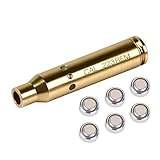
Laser bore sight kits make sighting in faster by bridging the gap between mounting an optic and firing live rounds. A laser bore sight is a small alignment tool that slides into your muzzle or fits inside the chamber. It shines a straight red or green laser beam down the center axis of your bore, projecting a visible reference point onto your target board.
When choosing a bore sight kit, check for a few practical features:
- Caliber adapter fit: Universal kits include expanding rubber or polymer adapters that seat securely inside the muzzle rifling. Check that the kit covers your specific barrel calibers so the adapter fits snug without binding or wobbling. A firm fit keeps the laser centered straight down the bore.
- Switch design: Models with a simple push-button or rocker switch let you turn the beam on and off without twisting sensitive battery caps that could disturb your alignment.
- Beam color: Red lasers work well for indoor ranges or overcast days, while bright green lasers offer better contrast on outdoor targets in sunny conditions.
Always clear your firearm chamber before inserting any tool, and remove the bore sight from the muzzle before loading live ammunition.

- ARS Mark9.2
ARS Mark is a ranking system developed by bestairriflescopes.com. ARS Mark has no relationship or impact from any manufacturers or sales agent websites. Learn more
- BrandOWLSHOOT

- ARS Mark8.8
ARS Mark is a ranking system developed by bestairriflescopes.com. ARS Mark has no relationship or impact from any manufacturers or sales agent websites. Learn more
- BrandEZshoot

- ARS Mark8.8
ARS Mark is a ranking system developed by bestairriflescopes.com. ARS Mark has no relationship or impact from any manufacturers or sales agent websites. Learn more
- BrandStrongTools

- ARS Mark8.8
ARS Mark is a ranking system developed by bestairriflescopes.com. ARS Mark has no relationship or impact from any manufacturers or sales agent websites. Learn more
- BrandEZshoot

- ARS Mark8.8
ARS Mark is a ranking system developed by bestairriflescopes.com. ARS Mark has no relationship or impact from any manufacturers or sales agent websites. Learn more
- BrandMCREHOTZ
- ARS Mark8.8
ARS Mark is a ranking system developed by bestairriflescopes.com. ARS Mark has no relationship or impact from any manufacturers or sales agent websites. Learn more
- BrandMidTen

- ARS Mark8.6
ARS Mark is a ranking system developed by bestairriflescopes.com. ARS Mark has no relationship or impact from any manufacturers or sales agent websites. Learn more
- BrandEZshoot

- ARS Mark8.2
ARS Mark is a ranking system developed by bestairriflescopes.com. ARS Mark has no relationship or impact from any manufacturers or sales agent websites. Learn more
- BrandTheopot
Last update on 2026-09-30 / Affiliate links / Images, Product Titles, and Product Highlights from Amazon Product Advertising API
FAQs
Can I sight in my rifle at 25 yards and just leave it there?
Sighting in at 25 yards works well as a starting step, but leaving it there is not recommended for field shooting. Small sighting errors at 25 yards expand significantly as distance increases, causing wide misses at 100 or 200 yards. On rifles with tall optic mounts, a 25-yard zero can also cause bullets to fly 6 to 9 inches over your target at 100 yards.
What is the main difference between a 50-yard and a 100-yard zero on an AR-15?
A 50-yard zero keeps your bullet within two inches of your aiming point from 15 yards out to roughly 230 yards, making it ideal for quick shooting without holdover adjustments. A 100-yard zero means the bullet never rises above your aiming line, but it drops steadily past 100 yards, requiring holdover at longer distances. Most carbine owners prefer 50 yards for its flatter overall shooting window.
How many shots does it take to sight in a rifle?
If you use a laser bore sight to align your barrel first, you can typically zero a rifle in nine to twelve live shots. This involves three shots at 25 yards to center your baseline, three shots at your final distance to check the shift, and three to six final shots to confirm dial adjustments. Rushing the process with single shots often leads to chasing flinches and wasting ammunition.
Do I need to sight in again if I switch ammunition brands or bullet weights?
Yes, changing ammunition brands, bullet weights, or powder charges changes the speed and curved path of the bullet. A heavier bullet often impacts lower or slightly to the side compared to a lighter, faster round fired from the same barrel. Always fire a three-shot confirmation group whenever you change your hunting or defense cartridge to confirm where it strikes.


12 Best 22 Pcp Air Rifle For Hunting of 2026 With Quiet Power

7 Best 22 Pcp Air Rifle Under 300 of 2026 For Backyard Pest Control

10 Best 22 Break Barrel Air Rifles of 2026 For Backyard Pest Control

10 Best 30 Caliber Pcp Air Rifle of 2026 For Medium Game

Top Best 177 Air Rifle Under 100: Budget-Friendly Picks for 2026

How to Safely Reload Shotgun Shells at Home

11 Best Co2 Air Rifle For Pest Control of 2026 To Ensure Humane Dispatch

12 Best Inexpensive Air Rifles of 2026 For Dependable Backyard Accuracy






