
Which Shotgun Sight Is Right for Your Target?

Struggling to see a standard factory bead is completely normal, and fixing it does not require a trip to a gunsmith. The ideal setup depends entirely on your target: bright fiber-optic beads work best for moving birds and clays, while compact red dots are superior for stationary targets like turkeys and home defense.
What works best changes with three practical factors. Target speed is the first, because swinging after flying game feels completely different from aiming tight groups with deer slugs. Next is your barrel style, since a ventilated rib (the raised metal strip along the top of the barrel) accepts easy clip-on sights, while smooth plain barrels need different mounting solutions. Finally, low-light woods or nighttime home defense demand much more visibility than a bright midday sporting range. Here is how to match the right sight style to your barrel and your shooting goals.
Pointing Versus Aiming: Why Your Target Decides Your Sight Style
Shotgun shooting divides into two distinct techniques: pointing and aiming. Most shooting frustration happens when someone uses the wrong technique for their target, or attaches a sight that forces them into the wrong visual habit. Understanding this difference is the single most important step in finding the right sight setup.
When you hunt ducks, flush pheasants, or break clay targets, you point the shotgun. You do not aim down the barrel like a rifle shooter. Instead, you keep both eyes wide open and lock your focus on the moving target. Your hands, cheek, and shoulder move the shotgun as a single unit. The front bead serves only as a soft reference point in your peripheral vision. If you stop looking at the bird to stare directly at your sight, your barrel stops moving. The moment your swing stops, your shot cloud passes behind the bird.
Aiming is the complete opposite. When you sit against an oak hunting spring turkeys, track deer with slugs, or stage a shotgun for home defense, your target is stationary or moving slowly. You are not spreading a wide pattern across an open sky. You need tight, exact pellet placement or a single accurate slug. For a turkey at forty yards, the vital head and neck area is no larger than a soda can.
For stationary targets, you must aim deliberately. You need a clear reference point showing exactly where your pattern will center. If you rely on a tiny factory brass bead in low light, any slight head tilt throws your pattern off target. A bead provides no rear reference point, meaning any change in cheek placement alters where you hit. Choosing the right sight comes down to whether your target demands fluid pointing or steady aiming.
Fiber Optics Versus Red Dots: Matching Sight Mechanics to Your Target
Factory shotguns almost always ship with a small brass or silver bead pressed or threaded into the muzzle. On a sunny afternoon at a clay range, that simple bead works well enough. But in real field conditions, it quickly fails. In early morning timber, deep marsh grass, or heavy overcast, a dull metal bead blends right into the background.
When you lose sight of your bead in your peripheral vision, your eyes instinctively leave the target to search for the muzzle. That split-second distraction breaks your focus, lifts your cheek off the stock comb, and causes a clean miss.
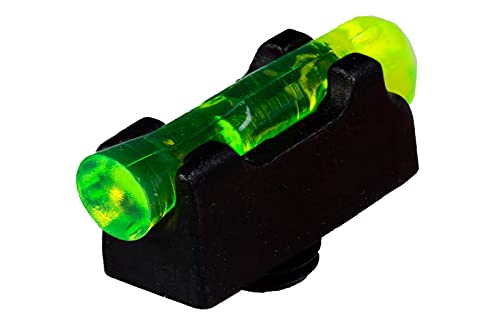
Fiber-optic front beads solve this problem without interrupting your visual swing. A fiber-optic sight uses a slender rod of optical plastic that gathers ambient light along its length and channels it out the rear tip facing your eye. To the shooter, it appears as a glowing dot sitting on the end of the barrel.
This bright dot stands out cleanly against dark brush, cloudy skies, and dim shadows. Because it glows naturally from ambient light, your eye picks it up instantly without pulling focus away from the flying target. Green light pipes are naturally the easiest for human eyes to detect in deep woods or at dawn and dusk. Red and orange light pipes provide sharp contrast against bright blue skies, green summer foliage, or yellow crop fields. Many front bead upgrades offer interchangeable light pipes, allowing you to switch colors depending on the weather.
Best of all, a fiber-optic bead keeps your shotgun light and balanced. It sits flat against the barrel, so your cheek stays firmly planted against the comb of the stock. There is no added bulk to slow your swing, and no glass lenses to fog up in the cold.
When your target requires deliberate aiming rather than instinctive pointing, electronic red dots and ghost rings take over. A red dot sight uses a small glass window that reflects an illuminated aiming dot back toward your eye. When you look through the window with both eyes open, the red dot appears to hover directly over the target.
Red dot sights come in two main styles: open-window sights and enclosed tube sights. Open-window sights feature an exposed glass lens protected by a thin metal hood, giving you an expansive view of the surrounding area. Enclosed tube sights house the glass and electronic emitter inside a sealed aluminum cylinder. This enclosed design shields internal components from mud, snow, rain, and thick brush, making it ideal for rough turkey woods or wet environments.
Dot size is measured in minutes of angle, which describes how much of the target the dot covers at a set distance. A fine 2 MOA dot covers roughly two inches of target at one hundred yards, or half an inch at twenty-five yards, providing the precision needed for deer slugs. In contrast, a larger 4 to 6 MOA dot is much faster to acquire in a hurry, which suits close-range home defense.
Before hunting or staging your gun, you must complete the zeroing process. Zeroing means adjusting the left-to-right and up-and-down dials so your shot pattern or slug lands exactly where the illuminated dot points at a chosen distance. Once zeroed, a red dot eliminates alignment errors caused by inconsistent cheek placement. Wherever the dot rests on the target, that is where your shot hits.
Ghost ring sights provide a tough, battery-free alternative for mechanical reliability. A ghost ring is a large round rear sight ring you look through, paired with a front post at the muzzle. When you look through the rear aperture, your eye naturally centers the front post inside the ring. Ghost rings handle rough drops and heavy recoil without losing alignment, and they never fail from dead batteries.
For home defense, combining both systems offers the greatest reliability. In defensive setups, lining up your backup iron sights through the optic glass ensures you can still aim accurately if your battery dies or the optic fails in an emergency.
How Your Barrel and Recoil Dictate Your Mount
Shotgun barrels and receivers vary widely across models. Before choosing any sight, examine how your barrel is built. A sight designed for a competition sporting shotgun will not attach to a tactical smoothbore barrel.
Many hunting shotguns feature a ventilated rib, which is a raised metal strip on top of the barrel with open vents underneath. A ventilated rib provides the most versatile mounting surface. You can replace the factory threaded bead, slide a spring-steel clamp over the rib edges, or attach a magnetic base directly to the flat steel. If you choose a magnetic or snap-on sight, measure your rib width across the top flat. Rib widths range from narrow quarter-inch field ribs to wide three-eighths-inch competition ribs. The sight base must match your rib width so it cannot shift under recoil.
Plain barrels are smooth round tubes without a raised rib. Upgrades for plain barrels are more limited. You can install snap-over sights that clamp directly around the outer curve of a 12-gauge or 20-gauge barrel, or replace the front bead if your barrel uses a threaded hole.
Your receiver determines whether you can mount a red dot or ghost ring. Some shotguns come drilled and tapped with threaded holes along the receiver top. These holes allow you to screw down standard Picatinny or 20mm slotted accessory rails. If your receiver is smooth and undrilled, you must take the shotgun to a gunsmith for drilling, use a saddle mount that straddles the receiver using trigger pins, or use a mount that locks onto your ventilated rib.
Recoil durability is another vital consideration. Heavy 12-gauge magnum turkey loads, buckshot, and slugs produce violent backward shock. That force can instantly strip loose mounting screws or fling cheap plastic sights off your barrel.
Follow this simple checklist to ensure your sight stays secure:
- Unload and clear the firearm: Open the action, visually inspect the chamber, and check the magazine tube with your finger to confirm no shells remain before handling the muzzle.
- Identify your barrel style: Check if your shotgun has a ventilated rib or a plain round barrel, and measure the rib width before buying clamp-on accessories.
- Match bead thread sizes: If replacing a screw-in bead, check your shotgun brand's thread pitch, because different makers use different screw threads.
- Apply thread-locking fluid: Place a drop of medium-strength blue thread-locking compound on all mounting screws so heavy recoil vibration does not loosen them.
- Tighten with a torque tool: Tighten rail and sight screws using an inch-pound torque tool according to manufacturer recommendations instead of hand-tightening, which prevents stripped receiver threads.
What Kind of Upgraded Sight You Should Look For
The best upgrade for your shotgun depends on your target, your barrel style, and how much modification you want to make. You do not need expensive gunsmithing to gain a dramatic improvement in target visibility.
If your primary goal is breaking clays, hunting waterfowl, or shooting upland birds, look for a low-profile fiber-optic front bead. Clip-on and screw-in fiber-optic beads offer an immediate sight upgrade for common ribbed barrels without permanent alterations. Choose a model matching your rib width or existing bead threads, and look for interchangeable light pipes so you can adapt to changing sunlight. Avoid tall rifle sights or bulky optical housings for wingshooting, as extra height lifts your cheek off the stock and ruins your natural pointing balance.
If you focus on spring turkeys, big game slug hunting, or home security, look for a dedicated aiming optic or a rugged ring sight. An open-window or enclosed tube dot sight mounted to a secure receiver rail gives you rapid target acquisition in dim light. When shopping for an electronic optic, check for long battery life, motion-sensing auto-on features that wake the sight when moved, and clear brightness settings. If you prefer a setup that never needs batteries, a sturdy ghost ring setup gives you reliable precision that withstands heavy recoil. Before buying, always confirm how the sight attaches to your specific shotgun model and verify that the mounting hardware fits your receiver.

- ARS Mark9.2
ARS Mark is a ranking system developed by bestairriflescopes.com. ARS Mark has no relationship or impact from any manufacturers or sales agent websites. Learn more
- BrandHIVIZ

- ARS Mark9.0
ARS Mark is a ranking system developed by bestairriflescopes.com. ARS Mark has no relationship or impact from any manufacturers or sales agent websites. Learn more
- BrandHIVIZ
- ARS Mark9.0
ARS Mark is a ranking system developed by bestairriflescopes.com. ARS Mark has no relationship or impact from any manufacturers or sales agent websites. Learn more
- BrandHIVIZ

- ARS Mark9.0
ARS Mark is a ranking system developed by bestairriflescopes.com. ARS Mark has no relationship or impact from any manufacturers or sales agent websites. Learn more
- BrandDead Ringer

- ARS Mark9.0
ARS Mark is a ranking system developed by bestairriflescopes.com. ARS Mark has no relationship or impact from any manufacturers or sales agent websites. Learn more
- BrandDead Ringer
- ARS Mark8.6
ARS Mark is a ranking system developed by bestairriflescopes.com. ARS Mark has no relationship or impact from any manufacturers or sales agent websites. Learn more
- BrandHIVIZ

- ARS Mark8.4
ARS Mark is a ranking system developed by bestairriflescopes.com. ARS Mark has no relationship or impact from any manufacturers or sales agent websites. Learn more
- BrandTRUGLO

- ARS Mark8.4
ARS Mark is a ranking system developed by bestairriflescopes.com. ARS Mark has no relationship or impact from any manufacturers or sales agent websites. Learn more
- BrandGotical

- ARS Mark8.0
ARS Mark is a ranking system developed by bestairriflescopes.com. ARS Mark has no relationship or impact from any manufacturers or sales agent websites. Learn more
- BrandTRUGLO
Last update on 2026-09-30 / Affiliate links / Images, Product Titles, and Product Highlights from Amazon Product Advertising API
FAQs
Can I install a new shotgun sight without drilling into my barrel?
Yes, you can install many aftermarket sights without drilling or permanent modifications. If your shotgun has a ventilated rib, you can use magnetic bases, snap-on spring-steel sights, or simple screw-in fiber-optic beads that thread directly into your factory bead hole. Plain round barrels can use clip-over sights that snap securely around the outside of the barrel tube.
Which fiber-optic sight color works best in low light?
Green fiber-optic rods are generally the easiest to see in low-light conditions like dawn, dusk, or heavy tree canopies. The human eye detects green wavelengths more efficiently than red or orange when light levels drop. Red and orange light pipes remain excellent choices for bright, sunny days because they create strong contrast against green leaves and open blue skies.
Why is a red dot sight difficult to use for wingshooting?
A red dot sight forces your eye to focus inside an optic housing, which interferes with your natural peripheral vision and depth perception. Wingshooting requires you to keep both eyes locked onto a moving bird while swinging the barrel smoothly through the target path. Staring at an illuminated dot causes most shooters to aim rather than point, which stops their swing and causes shots to miss behind the target.


12 Best 22 Pcp Air Rifle For Hunting of 2026 With Quiet Power

7 Best 22 Pcp Air Rifle Under 300 of 2026 For Backyard Pest Control

10 Best 22 Break Barrel Air Rifles of 2026 For Backyard Pest Control

10 Best 30 Caliber Pcp Air Rifle of 2026 For Medium Game
Top Best 177 Air Rifle Under 100: Budget-Friendly Picks for 2026

How to Safely Reload Shotgun Shells at Home

11 Best Co2 Air Rifle For Pest Control of 2026 To Ensure Humane Dispatch

12 Best Inexpensive Air Rifles of 2026 For Dependable Backyard Accuracy






