
How Heavy Should a Crossbow Bolt Be for Hunting?

There is no need to stress over tiny weight differences when setting up your hunting gear. For whitetail deer, a total bolt weight of 400 to 450 grains hits the sweet spot between flat flight and deep, clean penetration. That total includes everything from the grooved plastic back piece to the razor-sharp broadhead screwed into the front.
A few practical factors can shift that target number. Most importantly, never shoot an arrow that falls below the manufacturer minimum weight listed in your manual, as going too light can crack the limbs and destroy the bow. Stepping up to heavy game like elk or black bear also requires extra heft, often pushing your target closer to 500 grains for deeper punch through heavy bone. Shorter woods shots also welcome more weight, while open fields reward flatter flight. Here is how to dial in the exact balance for your bow and your hunt.
Aim for 400 to 450 Total Grains for Reliable Big Game Results
When you prepare for deer season, you want an arrow setup that flies straight and hits hard enough to bring down game cleanly. For most hunters pursuing whitetail deer, the sweet spot for total bolt weight sits comfortably between 400 and 450 grains. This total includes everything on the arrow: the carbon shaft, the plastic vanes, the back end piece, and the razor-sharp hunting tip screwed onto the front.
Archery gear uses a very old unit of measurement called the grain. A grain is a tiny unit of weight, where 7,000 grains equal one single pound. Because arrows are so light, measuring them in ounces or grams does not give you enough detail to fine-tune your shot. A few dozen grains can completely change how fast your arrow leaves the rail and how deeply it sinks into an animal.
Staying in the 400 to 450-grain window gives you the best mix of arrow speed and hitting power. An arrow in this middle bracket leaves modern crossbows fast enough to keep your flight path reasonably flat out to 40 yards. At the same time, it carries enough punch to drive a broadhead completely through the rib cage of a mature buck, even if you hit a rib on the way in. A complete pass-through leaves two open holes, which produces a much shorter tracking job and a cleaner, quicker harvest.
If you drop below 400 grains, you might see blisteringly fast flight on a target range, but you will lose punching power when the arrow meets real hide and bone. If you jump way past 475 grains for standard deer hunting, your arrow will hit like a sledgehammer, but it will drop so quickly that judging distance past 30 yards becomes tricky. Sticking close to 420 or 430 grains keeps your crossbow quiet, keeps your flight path predictable, and gives you deep penetration every single time.
Check Your Crossbow Minimum Weight Rating Before You Shoot
Before you buy any pack of bolts or screw on a new set of points, pull out your crossbow manual and look for the minimum arrow weight rating. Every manufacturer sets a strict floor limit for arrow weight, usually somewhere between 370 and 400 grains. Ignoring this number is the quickest way to destroy your bow and put your own safety at risk.
Crossbows pack an immense amount of stored energy in their limbs. When you pull the trigger, that energy has to go somewhere. In a proper shot, the heavy arrow absorbs almost all of that force and carries it downfield. If your arrow is lighter than the manufacturer requires, the arrow cannot take in all that power. The leftover energy bounces violently back into the bow limbs, the central riser, and the string assembly.
Shooting an arrow that is too light causes the exact same damage as a dry fire, which means firing the bow without an arrow loaded at all. A near-dry fire can shatter the composite limbs, bend the wheels, snap the bowstring, and fling sharp composite splinters right toward your face. If you cannot find your manual, look for a warning sticker on the inside of the bow limbs, check the maker's website, or contact their customer support before you load a bolt.
Always inspect your arrows for hidden damage while checking their weight. Get into the habit of flex-testing carbon arrows before each hunt or practice session. You do this by holding the shaft at both ends and bending it gently into a slight curve between your hands while listening closely. If you hear any faint clicking, creaking, or cracking sounds, or if you feel any soft spots, throw that arrow in the trash immediately. A cracked carbon shaft can snap in half right on the flight rail when fired, driving carbon shards into the rail and potentially into your support hand.
Balance Arrow Speed Against Hard-Hitting Bone Penetration
Archery marketing often highlights speed above everything else. Seeing numbers like 400 or 450 feet per second printed on a bow box sounds impressive, but pure speed does not guarantee a clean kill in the woods. You have to balance that raw speed against forward momentum and bone-breaking punch.
Think about the difference between throwing a ping-pong ball and throwing a baseball. You can throw a ping-pong ball exceptionally fast with your hand, but because it has almost no mass, wind slows it down immediately. If that ping-pong ball hits a piece of cardboard, it bounces right off. A baseball moves a bit slower, but its solid weight carries it straight through the cardboard without slowing down. The same rule applies when an arrow meets deer hide, thick muscle, and rib bones.
Light arrows travel at high speed and drop very little over short distances, which makes them forgiving if you misjudge distance by three or four yards. But a light arrow bleeds speed rapidly as it flies downrange. Even worse, if your deer takes a half-step and your shot catches the thick front shoulder blade instead of soft ribs, a featherweight arrow will often stop dead in the bone, leaving a wounded animal with little to no blood trail.
A heavier arrow leaves the bow rail slightly slower, but it holds its energy deep downfield. When it connects with bone, that extra mass powers the broadhead through the obstruction. Heavy arrows also make your crossbow significantly quieter when you pull the trigger. Because the heavy arrow drinks up more of the bow's kinetic energy, less energy turns into vibrating limb noise. In woods where whitetail deer react to the sudden pop of a bowstring before the arrow arrives, a quieter shot prevents the animal from dropping or ducking out of the way.
If you run a high-energy platform, like those featured in our best TenPoint crossbow for hunting guide, a medium-heavy arrow around 425 grains lets the bow operate smoothly without shaking loose your accessories or creating unnecessary noise in quiet woods.
Add Up Every Arrow Part to Find Your True Hunting Weight
A common mistake among newer hunters is confusing the weight of the bare carbon shaft with the weight of the complete, ready-to-shoot arrow. Your hunting weight is the sum of five distinct parts. When someone asks what bolt weight you shoot, you must count every piece sitting on the rail.
To understand where your grains come from, break down a completed hunting arrow from front to back:
- The broadhead or practice point: This is the razor-sharp hunting tip screwed onto the front. Hunting tips usually weigh either 100 grains or 125 grains. This single piece makes up nearly a quarter of your total arrow weight.
- The threaded insert: This is a small metal tube glued completely inside the front opening of the carbon shaft. The broadhead screws into this insert. Standard aluminum inserts weigh about 20 to 30 grains, while heavy brass inserts can weigh 50 to 110 grains to add forward punch.
- The carbon shaft: This is the main hollow tube. Arrow makers rate shafts by grains per inch. A 20-inch shaft rated at 9 grains per inch will weigh roughly 180 grains before adding any hardware.
- The fletchings or vanes: These are the three soft plastic wings glued near the back of the shaft. They spin the bolt in flight to keep it stable. Together, three vanes usually add 20 to 30 grains.
- The nock: This is the grooved plastic or aluminum piece on the back end that touches the string. Depending on whether your bow requires a half-moon nock, a flat nock, or an illuminated lighted nock, this piece adds 10 to 35 grains.
If your bare shaft with vanes weighs 290 grains, and you screw in a standard 100-grain point, your total hunting weight sits at 390 grains. If your bow requires a 400-grain minimum, that setup puts your limbs at risk. Swapping your 100-grain tip for a 125-grain version immediately raises your total package to 415 grains, moving you safely into the target hunting range.
Do not guess your numbers based on rough math. Buy an inexpensive digital grain scale, which costs very little online or at local sporting goods counters. Set the scale to grains, place your completed arrow on the tray, and confirm the exact number before you head to the woods.
Match Your Arrow Setup to the Specific Game You Hunt
Different game animals present completely different physical barriers. An arrow setup that punches straight through a thin-skinned pronghorn may struggle against the thick shoulder shield of a feral boar or the massive chest cavity of an elk. You should adjust your total bolt weight to fit the quarry you plan to pursue.
For open-country hunting on animals like pronghorn or smaller southern deer, you can keep your arrow closer to the 400-grain line. These animals have lighter bones, and you often face longer shots across windy plains where a flatter arrow trajectory helps you stay on target. The lighter weight keeps your speed high, minimizing arrow drop if you must take a shot near 45 or 50 yards.
For typical whitetail deer and mid-sized feral hogs across wooded areas, 420 to 450 grains is the standard. Most whitetail shots happen well inside 35 yards, especially if you hunt from tight ground blinds or tree stands. In those close-range setups, flat long-range trajectory matters far less than raw punch and low bow noise. Reviewing setups like the one discussed in our TenPoint TX Ultra 265 review shows how compact woods hunting benefits when you favor quiet releases and sturdy arrow momentum over raw, blistering speed.
If you hunt larger big game like elk, moose, or heavy black bear, push your total bolt weight to 450 grains or even 500 grains. An elk has ribs as thick as pickets and heavy muscle coats that swallow arrow energy. When an arrow hits an elk, you need deep, continuous driving force to reach both lungs. Stepping up to a 125-grain broadhead combined with a heavy brass insert gives your bolt the forward balance and mass needed to punch through thick hide and survive bone contact.
Pick Factory-Matched Carbon Hunting Bolts to Skip the Guesswork
Building custom arrows piece by piece requires specialized tools, arrow saws, insert glues, and tuning scales. If you want a dependable hunting setup without building shafts from scratch in your garage, look for pre-assembled carbon hunting bolt packages that come matched directly to your hunting style.
When shopping for ready-to-shoot hunting arrows, look for carbon packs that clearly list the total finished weight with standard points included. Verify the exact shaft length your bow calls for, such as standard 20-inch lengths, so the tip clears your bow rail safely upon release. Check that the package includes the exact nock style your bow design demands, whether that is a half-moon grooved back or an engineered flat face. Grabbing factory-fletched packs with reliable, stiff carbon construction guarantees that each arrow leaves your rail consistently, putting your broadhead on target when your season is on the line.

- ARS Mark9.3
ARS Mark is a ranking system developed by bestairriflescopes.com. ARS Mark has no relationship or impact from any manufacturers or sales agent websites. Learn more
- BrandIRQ

- ARS Mark8.7
ARS Mark is a ranking system developed by bestairriflescopes.com. ARS Mark has no relationship or impact from any manufacturers or sales agent websites. Learn more
- BrandBARNETT
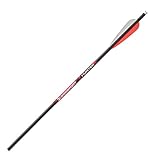
- ARS Mark7.2
ARS Mark is a ranking system developed by bestairriflescopes.com. ARS Mark has no relationship or impact from any manufacturers or sales agent websites. Learn more
- BrandBLOODSPORT
Last update on 2026-10-18 / Affiliate links / Images, Product Titles, and Product Highlights from Amazon Product Advertising API
FAQs
Does total arrow weight include the broadhead?
Yes, your total arrow weight always includes the broadhead screwed onto the front. Total weight accounts for the bare carbon shaft, front insert, broadhead, plastic fletching vanes, and the back nock. When checking your bow manual for minimum weight requirements, compare that number against the fully assembled arrow with the hunting tip attached.
What happens if I shoot an arrow lighter than what the bow manual says?
Shooting an arrow that weighs less than the manufacturer's minimum rating can severely damage your crossbow. The arrow cannot absorb all the bow's released energy, forcing that shock back into the limbs, cams, and strings. This stress can crack composite limbs, snap bowstrings, void your warranty, and create dangerous flying debris.
Should I use a 100-grain or a 125-grain broadhead for hunting?
Both options work well, but your choice depends on your overall arrow weight goals. A 100-grain broadhead is the most common hunting size and works great if your shaft and insert already put you over 400 total grains. Choosing a 125-grain tip adds extra weight right at the front of the bolt, which helps stabilize arrow flight and improves penetration on large animals like elk or heavy hogs.
How do I weigh my crossbow bolts at home?
You can weigh your completed hunting bolts using an inexpensive digital pocket scale that measures in grains. Turn the scale on, verify that the display reads in grains rather than grams or ounces, and place your fully assembled arrow across the tray. Doing this ensures every arrow in your hunting quiver hits the exact same weight class for consistent flight.


12 Best 22 Pcp Air Rifle For Hunting of 2026 With Quiet Power

7 Best 22 Pcp Air Rifle Under 300 of 2026 For Backyard Pest Control

10 Best 22 Break Barrel Air Rifles of 2026 For Backyard Pest Control

10 Best 30 Caliber Pcp Air Rifle of 2026 For Medium Game

Top Best 177 Air Rifle Under 100: Budget-Friendly Picks for 2026

How to Safely Reload Shotgun Shells at Home

11 Best Co2 Air Rifle For Pest Control of 2026 To Ensure Humane Dispatch

12 Best Inexpensive Air Rifles of 2026 For Dependable Backyard Accuracy






